
That lingering, earthy odor wafting up from downstairs isn't just "old house smell." It's an alarm bell, signaling that mold and mildew have found a place to thrive.
The classic musty smell in a basement is actually caused by Microbial Volatile Organic Compounds (MVOCs)—gases that mold releases as it eats, grows, and multiplies. Ignoring it is like hearing a smoke alarm and just fanning the air.
What That Musty Basement Smell Really Means
When you catch that damp, dirty-sock scent, your nose is telling you there’s a moisture problem somewhere. It’s the first and most obvious sign that water has created a breeding ground for fungi, hidden out of sight.
Spraying air freshener or running a diffuser is like putting a bandage on a broken arm. It might cover up the symptom for a little while, but it does absolutely nothing to fix the underlying issue that could be compromising your home’s structure and your family's health.
For mold to take hold, it only needs three things, and basements are notorious for providing all of them:
- A water source: This could be anything from a pinhole leak in a copper pipe to condensation on your HVAC ducts.
- A food source: Mold isn't a picky eater. It happily devours the paper on drywall, wooden floor joists, cardboard boxes, and even layers of dust.
- Stagnant air: Basements often have poor ventilation, which traps humid air and gives mold spores the quiet, undisturbed environment they need to flourish.
Uncovering the Root Causes
That smell almost always traces back to a handful of common culprits. I've seen it all—a slow-leaking water heater tucked away in a corner, a cracked drain line hidden behind a finished wall, or groundwater seeping through hairline cracks in the foundation after a heavy storm.
Even something as simple as condensation forming on cold water pipes or cool concrete walls in the summer can provide enough moisture to get a mold colony started. To really get to the bottom of it, it helps to understand What Causes Musty Smell In House from different angles.
To help you narrow it down, here’s a quick reference guide based on what you might be noticing.
Common Sources of Basement Odors at a Glance
| Symptom | Likely Cause | First Action Step |
|---|---|---|
| Smell is strongest near a bathroom or laundry area | Plumbing Leak | Check connections to toilets, sinks, and washing machines. Look for water stains on the ceiling below. |
| Odor gets worse after it rains | Groundwater Intrusion | Inspect the foundation walls and floor for cracks, damp spots, or white, chalky residue (efflorescence). |
| You notice "sweating" on pipes, ducts, or walls | Condensation | Check the basement's humidity level with a hygrometer. Aim for below 50%. |
| The smell is generally "everywhere" | Poor Ventilation | Assess air movement. Is the air stagnant? Is there a way to introduce fresh, dry air? |
This table is a starting point. The key is to remember that the smell itself isn't the problem—it's just a symptom.
Key Takeaway: The musty odor is your cue to start investigating. The real enemy is the source of the moisture that’s feeding the mold. Finding and fixing that source is the only way to solve the problem for good.
If you’re dealing with this, you’re not alone. It's an incredibly common issue, especially for those of us in humid climates. In fact, studies show that nearly 47% of U.S. homes report problems with either visible mold or that telltale musty odor.
Basements are ground zero. Here in the Greater Philadelphia area, South Jersey, and Delaware, our summer humidity often spikes well above the 55% threshold where mold growth takes off. This guide will walk you through exactly how to play detective, fix the source, and make sure that smell is gone for good.
Finding the Hidden Source of Basement Moisture
That musty, earthy smell in your basement isn't just unpleasant—it's a blaring alarm that you have a moisture problem somewhere. To get rid of that odor for good, you have to put on your detective hat and trace the moisture back to its origin.
Sometimes the source is obvious, like a puddle after a storm. More often, though, it’s a sneaky, slow-developing issue that has been festering for months or even years. In my experience, the culprit almost always falls into one of three buckets: leaks from your home's plumbing, groundwater getting in from outside, or condensation forming on cool surfaces.
It's a simple chain of events, really. The moisture shows up, mold finds a place to grow, and the smell is the final result.
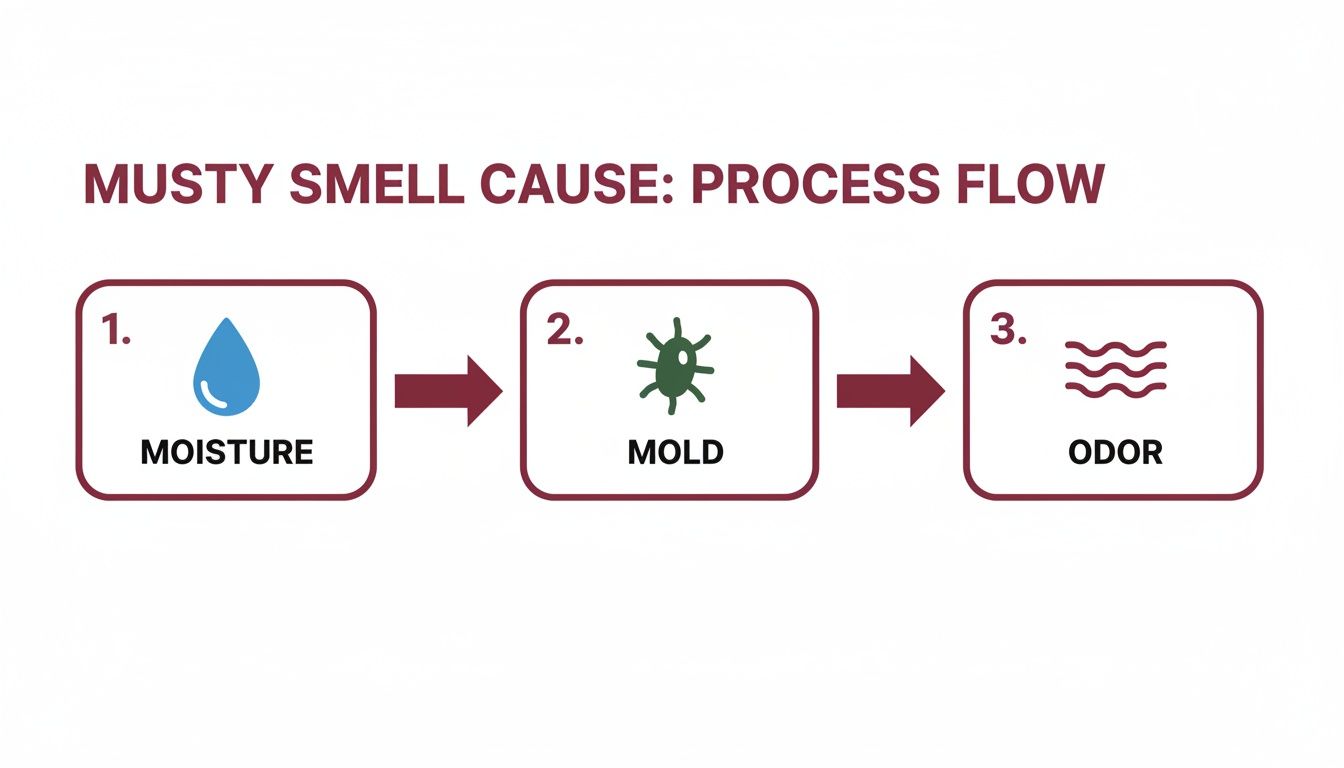
This diagram shows why just using an air freshener never works. You have to stop the water at its source to break the cycle.
Start Your Investigation with Interior Plumbing
Your home's own plumbing is a surprisingly common source of basement moisture. Even a tiny, slow drip can release an incredible amount of water over time, quietly saturating drywall, floor joists, and insulation without ever forming a noticeable puddle.
I always tell homeowners to start their search at the water heater. Get a good flashlight and check every connection at the top and bottom. Look for any hint of corrosion or tiny drips. Run a dry finger along the pressure relief valve and the drain valve at the bottom—any dampness means you have a problem. These leaks are often so slow they evaporate before hitting the floor, but they're still pumping humidity into the air.
From there, move on to all the exposed pipes you can see. Pay close attention to these common offenders:
- Drain Lines: Look under any basement sinks and trace the larger drain pipes coming from upstairs bathrooms and kitchens. Check for water stains or damp spots on the wood and drywall around them.
- Supply Lines: These pipes are under pressure, so leaks can be more serious. Look for drips around shut-off valves and fittings, especially where pipes connect.
- Washing Machine Hoses: Pull out the washer and inspect the hoses. Old rubber hoses are notorious for cracking and developing pinhole leaks that you’d never see otherwise.
Pro Tip: Here’s a simple trick I use on service calls. If you suspect a slow leak at a pipe fitting, wrap a single, dry paper towel tightly around it. Come back in a few hours. If that paper towel is even slightly damp, you've found your leak.
Hunt for Signs of Groundwater Intrusion
If your plumbing gets a clean bill of health, your next suspect is groundwater pushing its way in from outside. This is a huge issue here in the Philadelphia and South Jersey area, especially after heavy rains when the soil gets waterlogged and puts immense pressure on your foundation.
The first thing to look for is efflorescence. It’s a fine, white, chalky powder that appears on concrete or brick. What you're seeing are salt deposits left behind after water seeps through the masonry and evaporates. It's a dead giveaway that moisture is coming through your foundation.
Next, get up close and personal with your walls and floor. Carefully inspect them for cracks. Even hairline cracks are an open door for water. Pay special attention to the cove joint—that little seam where the basement wall meets the floor. This is probably the most common entry point for groundwater.
And don't forget to look outside at your window wells. If they're clogged with leaves and gunk, they essentially turn into small ponds during a storm, and that water has nowhere to go but through your window frame or the surrounding foundation.
Unmasking Condensation as a Moisture Source
Sometimes, the water isn't leaking in at all—it’s literally coming from the air inside your basement. Condensation happens when warm, humid air makes contact with a cold surface. Basements are the perfect breeding ground for this.
During our humid summers, you’ll often see surfaces "sweating." Check these areas first:
- Cold water pipes
- Metal HVAC ductwork
- Bare concrete walls and floors that stay cool year-round
There's a classic test to figure out if you're dealing with condensation or seepage. Grab a one-foot square of aluminum foil and some duct tape. Tape the foil tightly to a dry section of the foundation wall, making sure to seal all four edges. Wait 24 to 48 hours, then peel it off.
- If the outside of the foil (facing the room) is wet, the moisture is coming from the air. You have a condensation problem.
- If the inside of the foil (the side against the wall) is wet, water is seeping through the foundation from outside.
Finding the source is the single most critical step. Once you know whether you're fighting a plumbing leak, groundwater, or condensation, you can finally take the right steps to fix it. For those tougher issues, knowing how a professional plumber can help with water damage restoration can make all the difference.
Stopping Moisture and Repairing the Damage
Alright, so your detective work has paid off and you’ve figured out why your basement is damp. Excellent. Now comes the hard part: fixing it for good.
Moving from diagnosis to action is the most critical step in getting rid of that musty smell permanently. How you tackle the repair, though, depends entirely on what you found.
Some fixes are surprisingly simple—things a determined homeowner can knock out in a weekend. But others are loaded with risk and are absolutely best left to the pros. The real skill is knowing the difference, so you don't turn a small headache into a full-blown, expensive disaster.
DIY vs. Professional Plumbing Repairs
If you've traced the moisture back to your plumbing, the right fix depends on the leak. A slow drip from a loose fitting on a drainpipe under a laundry sink, for instance, is often a straightforward job. Grab the right wrench, maybe a little thread sealant, and you could have it solved in under an hour.
But don't be fooled; many plumbing issues are deceptive. What looks like a simple drip can be a red flag for a much bigger problem lurking behind a wall or under the floor.
Here are a couple of real-world scenarios to think about:
A Solid DIY Fix: You find a little moisture around the cold-water supply line connected to your washing machine. More often than not, this is just a loose connection that needs a quick turn with a wrench or a worn-out rubber washer that needs replacing. It's a low-risk, high-reward repair.
When to Call Us: You spot heavy corrosion and a slow, weeping leak on an old galvanized steel pipe. This is a trap. Trying to tighten a fitting or patch it yourself could easily cause the brittle pipe to burst, flooding your basement with gallons of water in minutes. A pro needs to come in, safely cut out the damaged section, and replace it.
That pungent, musty basement smell is a classic sign of hidden moisture fueling mold growth. And the data shows why basements are ground zero for this problem, especially in the Northeast. With an estimated 45 million U.S. buildings affected by mold, basements are the most vulnerable spots thanks to leaky pipes, poor drainage, or humidity levels creeping over 60% relative humidity (RH). You can learn more about how our humid climate contributes from these insights on FDP Mold Remediation.
Tackling Groundwater Intrusion Head-On
When the water is seeping in from the outside, your battleground shifts from your pipes to your home’s exterior defenses. Stopping groundwater intrusion isn't about one magic bullet; it requires a multi-pronged approach that controls how water behaves around your foundation.
First things first, manage rainwater at its source. Take a hard look at your gutters and downspouts. Are they clogged with leaves and debris? If so, rain will just cascade over the sides, dumping water directly against your foundation.
Next, follow your downspouts. They need to discharge water at least four to six feet away from the house. If they're just dropping water at the corner of your foundation, you're practically rolling out the welcome mat for moisture. Inexpensive downspout extenders are one of the best investments you can make.
Finally, check the grading—the slope of the soil around your foundation. The ground should gently slope away from your house for at least ten feet. If it slopes towards your foundation (a "negative grade"), every storm channels water directly against your basement walls. Correcting this might mean bringing in some topsoil to build up the ground and create that positive slope.
Sealing Cracks and Controlling Condensation
Found some minor, hairline cracks in your foundation walls or floor? If they aren't getting wider, you can often tackle these yourself. Hydraulic cement or polyurethane foam injection kits from the hardware store are great for filling small cracks and stopping minor seepage.
But let me be clear: if you see a crack that is wide, growing, or has one side sticking out farther than the other, stop what you are doing. That's a sign of potential structural failure, and you need to call a structural engineer immediately.
If condensation is the main culprit, your goal is to manage temperature and humidity. Insulating cold water pipes with foam pipe sleeves is a fantastic first step. It's cheap, easy, and stops that warm, moist basement air from "sweating" on the cold pipes.
Your best weapon against condensation, however, is a high-quality dehumidifier. Set it to maintain a relative humidity between 30% and 50%, and you'll create an environment where mold simply can't thrive. Just remember, a dehumidifier only manages airborne moisture—it's not going to stop an active leak. You have to fix the source of the water first for it to do its job effectively.
How to Safely Clean Up Mold Contamination
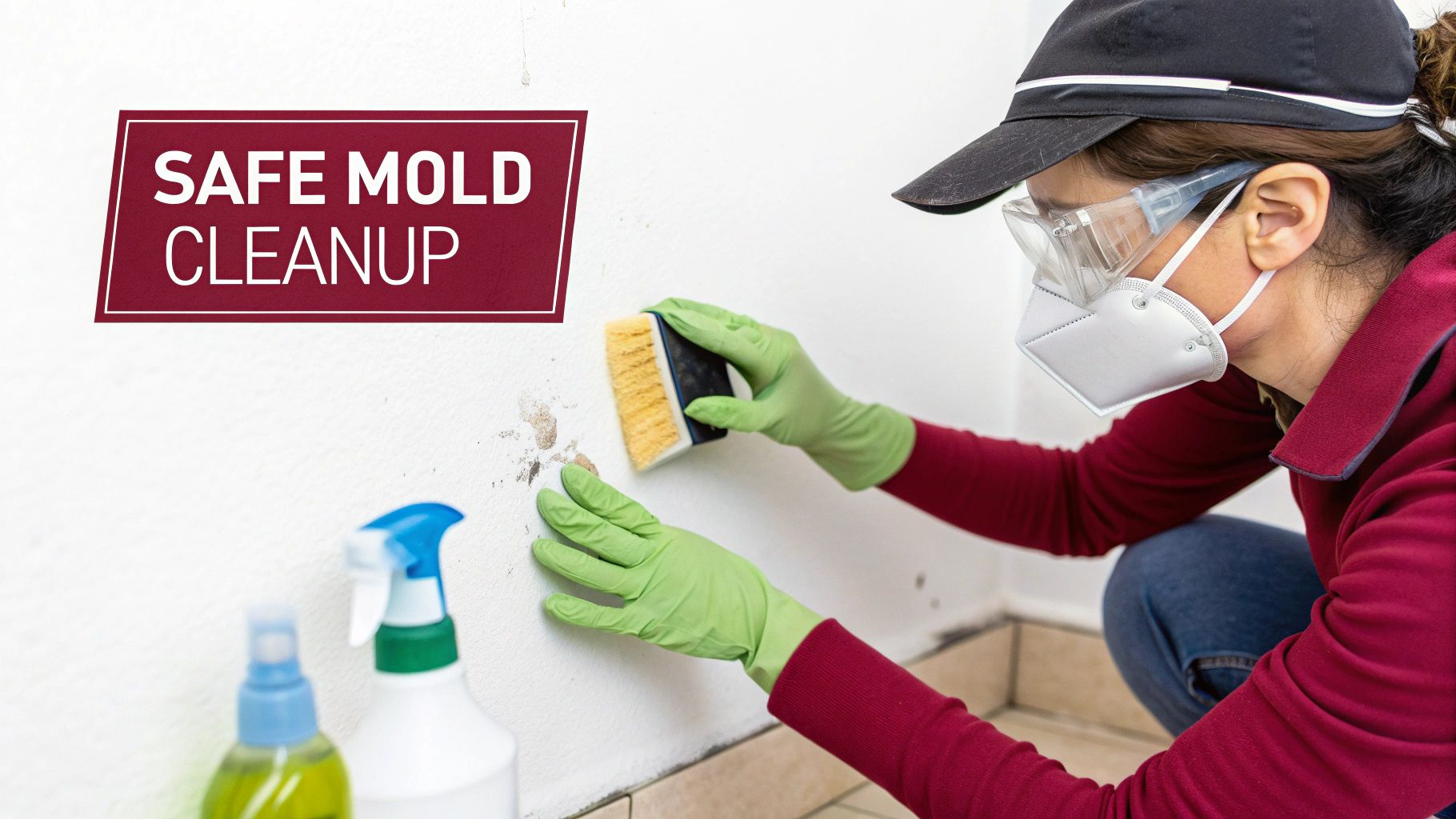
So you've found the moisture source and stopped it in its tracks. Great. Now comes the part that requires real care: dealing with the mold itself. This is where safety has to be your top priority. Simply scrubbing at a mold colony can send a cloud of invisible spores into the air, turning a contained issue into a house-wide problem.
The good news? A small cleanup is often a manageable DIY project. The U.S. Environmental Protection Agency (EPA) gives a good rule of thumb: if the patch is smaller than 10 square feet (think a 3×3 foot area), you can likely handle it yourself. Once it gets bigger than that, you're looking at a job for the pros.
Gearing Up for a DIY Cleanup
Before you start scrubbing, you need to gear up properly. This isn't just about cleaning; it's about protecting yourself. Your health is on the line, so don’t cut corners here.
Here's your essential checklist for safety gear:
- N95 Respirator Mask: A simple paper dust mask won't cut it. You need a properly fitted N95 to filter out microscopic spores.
- Safety Goggles: Make sure they're the non-vented kind to keep spores and cleaning solutions out of your eyes.
- Long Rubber Gloves: Get a pair that extends up your forearms to prevent any skin contact.
- Disposable Coveralls: You can use old clothes, but disposable coveralls are better because you can just toss them—and the spores—when you're done.
- Scrub Brushes and Rags: Gather a few stiff brushes and plenty of rags you won't mind throwing away afterward.
For the cleaning solution itself, you don’t always need to go nuclear. On hard, non-porous surfaces like concrete or metal, a bucket of soap and water is often all it takes. If you need more firepower, a solution of one cup of bleach per gallon of water works well. Just remember: never mix bleach with ammonia or any other cleaner. Doing so creates a dangerous toxic gas.
Drawing the Line: When to Call for Professional Help
Knowing your limits is just as crucial as knowing how to clean. A lingering musty odor, especially from soft materials, often means the problem runs deep. It's a common headache when you need to get rid of carpet mold, because cleaning the surface rarely solves the issue. For porous materials like drywall, carpet, or insulation, removal is almost always the only real solution.
Deciding between a DIY approach and calling in a professional can be tricky. This table breaks down common scenarios to help you make the right call.
DIY Cleanup vs. Professional Remediation
| Scenario | Recommended Action | Why It Matters |
|---|---|---|
| Small, surface-level mold on hard surfaces (less than 10 sq. ft.) | DIY Cleanup | A small, contained spot on concrete or tile is typically manageable with proper safety gear and cleaning solutions. |
| Mold patch is larger than 3×3 feet | Call a Professional | Large infestations require professional containment to prevent spores from spreading throughout your home during cleanup. |
| Mold is inside your HVAC system or ductwork | Call a Professional | This is a high-risk situation. Running the system will distribute spores to every room, requiring a whole-house solution. |
| The area has been wet for >48 hours or there's structural damage | Call a Professional | Chronic moisture often leads to hidden mold behind walls and structural rot that requires expert assessment and repair. |
| Household members have health issues (asthma, allergies, etc.) | Call a Professional | Don't risk it. The health of your family is paramount, and pros can ensure the air is safe for sensitive individuals. |
Ultimately, if you're ever in doubt, calling a professional is the safest bet. They don't just clean what you can see; they address the entire problem to ensure it's gone for good.
It's time to put down the scrub brush and pick up the phone if you run into any of these situations:
- The Mold Patch is Large: Anything over that 10-square-foot guideline requires professional-grade containment to stop cross-contamination.
- Mold is in Your HVAC System: If you even suspect mold has infiltrated your heating or cooling system, shut it down immediately. This is a serious problem that can quickly contaminate your entire house.
- You Have Health Concerns: If anyone in your home suffers from asthma, allergies, or has a compromised immune system, DIY cleanup is not worth the risk.
- The Damage is Extensive: Rotting wood, crumbling drywall, or other signs of structural decay mean you're beyond a simple cleaning job. You need an expert to assess the damage safely.
Professionals bring in heavy-duty equipment like HEPA air scrubbers and set up containment zones with negative air pressure. They do the job right and often perform post-remediation testing to prove it. If you're ready to bring in an expert, check out our guide on questions to ask before hiring a mold removal company to ensure you find a reputable one.
Keeping Your Basement Dry and Odor-Free for Good
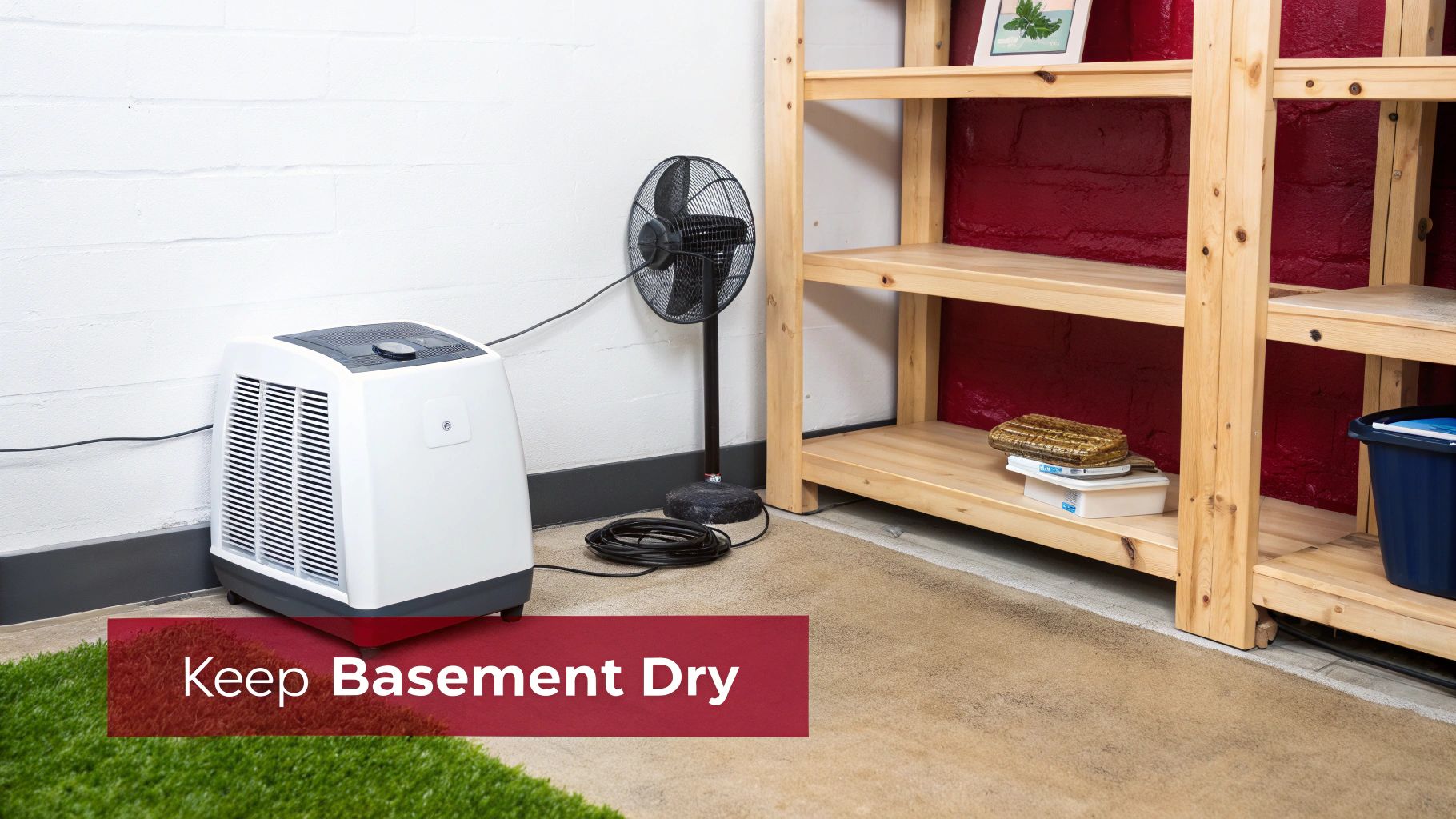
Getting rid of active mold and stopping the immediate moisture source is a huge victory. But don't pop the champagne just yet. Winning the battle doesn't mean the war is over. Keeping that musty smell in your basement from ever returning requires a shift from reactive repairs to proactive, long-term maintenance.
This final phase is all about creating an environment where moisture and mold simply can't get a foothold again. Think of it as mold-proofing your basement for the future.
Master Your Basement's Humidity
Your single most powerful tool in this fight is a quality dehumidifier. Mold loves to party when the relative humidity climbs above 55-60%, which happens all the time in basements, especially during our humid Philadelphia-area summers. Your goal is to keep that humidity level consistently between 30% and 50%.
But just grabbing any dehumidifier off the shelf is a common mistake. Sizing is critical. A unit that’s too small will run nonstop without ever hitting the target, wasting electricity and offering false security.
- Measure your space: Start by calculating the total square footage of your basement.
- Assess the conditions: Is it just a little damp, or do you regularly see condensation on pipes and walls? Be honest about your starting point.
- Check the specs: Dehumidifiers are rated by how many pints of water they can pull from the air in 24 hours. A bigger, wetter basement needs a higher-capacity unit.
Pro Tip: I always recommend clients get a dehumidifier with a built-in pump or a port for a continuous drain hose. This saves you from the chore of hauling a heavy, full bucket of water upstairs every day and ensures the unit is always working to protect your home.
Promote Healthy Air Circulation
Stagnant, trapped air is an open invitation for mold and mildew. Improving air circulation disrupts the damp, quiet conditions that allow spores to settle in and thrive. The good news is this doesn't require a pricey HVAC overhaul.
A few small, strategically placed fans can make a world of difference. Stick one in a far corner to push air toward the center of the room. Place another to keep air moving in dead zones, like behind the furnace or under the stairs. On dry, low-humidity days, crack open the basement windows for an hour to swap that damp, stale air for fresh air from outside.
Another simple but effective habit is to de-clutter, especially along the foundation walls. Stacking cardboard boxes or pushing furniture right up against the concrete creates a perfect micro-climate for mustiness to develop unseen. Always leave a gap of at least a few inches to let the air circulate.
Establish a Simple Inspection Routine
The key to preventing a big, expensive problem is catching it when it's a small, easy fix. A quick visual inspection just once a season can save you thousands in the long run.
This doesn't have to be a major chore. Your routine should take no more than 15 minutes:
- Walk the Perimeter: Grab a bright flashlight and scan the base of your foundation walls. Look for new cracks, dark spots, or that white, chalky powder called efflorescence.
- Check Your Pipes: Eyeball all the accessible plumbing, paying close attention to joints and valves. Are there any fresh drips or new corrosion?
- Inspect Windows and Vents: Look at the seals around your basement windows and the dryer vent exit. They should be tight, with no signs of water staining on the wall below.
- Test Your Sump Pump: If you have one, pour a bucket of water into the sump pit. You want to see the float switch rise and hear the pump kick on immediately.
This simple routine, combined with professional maintenance like annual drain cleanings, creates a powerful defense. It's always easier and cheaper to prevent the common causes of mold growth than to clean up the mess afterward. You can learn more about common causes of mold growth and how to prevent them in our detailed guide. Stay vigilant, and you'll ensure your basement remains a healthy, dry, and useful part of your home for years to come.
Your Top Questions About Basement Smells, Answered
Once you've tracked down and fixed a moisture problem, it's normal to still have some nagging questions about that lingering musty smell. Let's tackle some of the most common things homeowners ask me after they've dealt with a damp basement.
The Musty Smell Vanished. Am I in the Clear?
This is a really common and tricky situation. Just because the smell goes away, especially when the weather dries up, doesn't mean the root problem is solved. The mold spores that create that odor are incredibly resilient. They're likely still there, just lying dormant and waiting for the humidity to tick back up.
Think of it like this: you can pull the top off a weed, but if the root is still in the ground, it's coming back. You have to be certain you've permanently solved the water issue, not just put a temporary bandage on the symptom.
A Word of Caution: A lack of odor can give you a false sense of security. If you've had a leak or any significant dampness, the only way to be 100% sure the air is healthy is with a professional mold test. It's the only way to know if the spore count is back to a normal, safe level.
Can I Just Run a Dehumidifier to Fix the Smell?
A good dehumidifier is your best friend for long-term basement health, but it's not a silver bullet. It’s a maintenance tool, not a repair tool. It’s fantastic at pulling ambient moisture out of the air, but it's completely powerless to stop water from getting in.
If you have a crack in your foundation wall or a leaky pipe, that dehumidifier will just run itself into the ground trying to keep up. It’s a losing battle. You absolutely have to stop the water at the source first. After that, a dehumidifier is the perfect way to maintain that dry, healthy environment.
How Do I Know if It's a Musty Smell or Something Worse, Like Sewage?
Telling these two apart is critical because they point to vastly different and urgent problems.
- Musty Smell: This is that classic damp, earthy, "old cabin" scent. It's the signature of mold and mildew. It tends to build up over time and is usually linked to general dampness or a past water intrusion.
- Sewage Smell: You'll know this one when you smell it. It’s a much sharper, deeply unpleasant, and foul odor. This isn't something to ignore; it signals a major problem with a drain line, a cracked sewer pipe, or even a dried-out P-trap in a floor drain, which can let sewer gas seep in.
If you even think it might be a sewage issue, that's a health hazard. Your next call should be to an emergency plumber, immediately.
What About Those "Mold-Killing" Paints? Do They Work?
This is a huge misconception. Mold-resistant paints are meant to prevent mold from growing on the painted surface itself. They are absolutely not a fix for an existing mold problem. In fact, painting over active mold is one of the worst things you can do.
The paint simply traps the moisture and covers the mold up. The mold will happily continue to grow and feed on the drywall or wood underneath, eventually blistering and pushing right through your brand-new paint job. Always, always properly clean and remove every trace of existing mold before you even think about applying a specialty paint or sealant.
If you’re stuck with a musty odor you can't shake or you've found signs of water damage, don't let it fester. The team at Precision Plus Plumbing provides 24/7 emergency service throughout the Greater Philadelphia, South Jersey, and DE area. Get professional help now to find the source of the problem and get it fixed right the first time.