When a toilet overflows or raw sewage floods your basement, one thing becomes crystal clear: you need professional sewage cleanup services near me, and you need them now. This isn't just a messy inconvenience—it's a full-blown health hazard that requires an immediate response from certified experts who know how to handle it safely.
The Immediate Dangers of a Sewage Backup
Picture this: you walk into your basement after a heavy rainstorm and are hit with a foul smell. Murky, disgusting water is spreading across the floor. The panic is real, but what you can’t see is far more dangerous than the mess in front of you.
A sewage backup is what the pros call a "blackwater" event. That’s not just for dramatic effect; it means the water is severely contaminated with pathogens that can make you and your family incredibly sick. It's best to think of it as a toxic soup of invisible threats.
Raw sewage can contain over 120 different viruses, bacteria, and parasites, including E. coli, Salmonella, and Hepatitis A. Even just breathing the air in a contaminated room can lead to serious gastrointestinal infections, skin rashes, and respiratory problems.
Your Urgent Safety Checklist
When you're facing a sewage backup, what you do in the first few minutes is critical for keeping everyone safe and containing the problem. Don't even think about trying to clean it up yourself. Instead, follow these steps immediately while you wait for a professional team to arrive.
- Stop All Water Use Immediately: Don't flush any toilets, run faucets, or start a load of laundry. Doing so will only add more water to an already overwhelmed system.
- Turn Off Electricity to the Area: If you can get to your breaker box without walking through water, shut off the power to the affected rooms. Water and electricity are a deadly mix.
- Keep Children and Pets Away: The contaminated zone is a biohazard. Block it off completely to keep your loved ones from being exposed to dangerous pathogens.
- Ventilate the Space (If Possible): If it's safe, open some windows in the flooded area to help air out the foul odors and airborne contaminants. But whatever you do, do not turn on your central HVAC system—that will spread the contamination throughout your entire home.
Why Professional Intervention Is Not Optional
Trying to clean up sewage yourself is a huge gamble with both your health and your home's integrity. Standard household cleaners, including bleach, just aren't powerful enough to properly disinfect porous surfaces like drywall, wood, and carpeting that have soaked up blackwater. These materials act like sponges, trapping bacteria and moisture deep inside where you can't see them.
Without the right training and equipment, you're almost guaranteed to leave behind hidden contamination. This creates a perfect breeding ground for mold and allows dangerous pathogens to linger. Professional sewage cleanup services bring in industrial-strength water extractors, hospital-grade antimicrobial agents, and powerful drying equipment. They have a process to ensure every last bit of hazardous material is gone, your home is thoroughly sanitized, and the structure is bone-dry. Calling an expert isn't just a good idea; it's the only way to protect your family and properly restore your home.
When you’re staring at a sewage backup, the first question is always, "What happens now?" Calling in a professional crew is the right move, but it helps to know exactly what they’re going to do. It’s not just about mopping up the mess; it's a systematic process to make your home safe and sound again.
Think of it this way: a professional cleanup team is like a hazmat crew for your house. Their first priority is containment. They’ll assess the damage, figure out how far the contamination has spread, and then set up barriers to keep it from getting into unaffected areas. This step alone is one of the biggest reasons to call a pro instead of trying to tackle it yourself.
The Cleanup and Restoration Process
Once the scene is contained, the real work begins. A proper sewage cleanup follows a very specific order of operations to make sure no hazard, visible or invisible, is left behind.
While you wait for the experts to arrive, there are a few things you absolutely must do to keep the situation from getting worse.
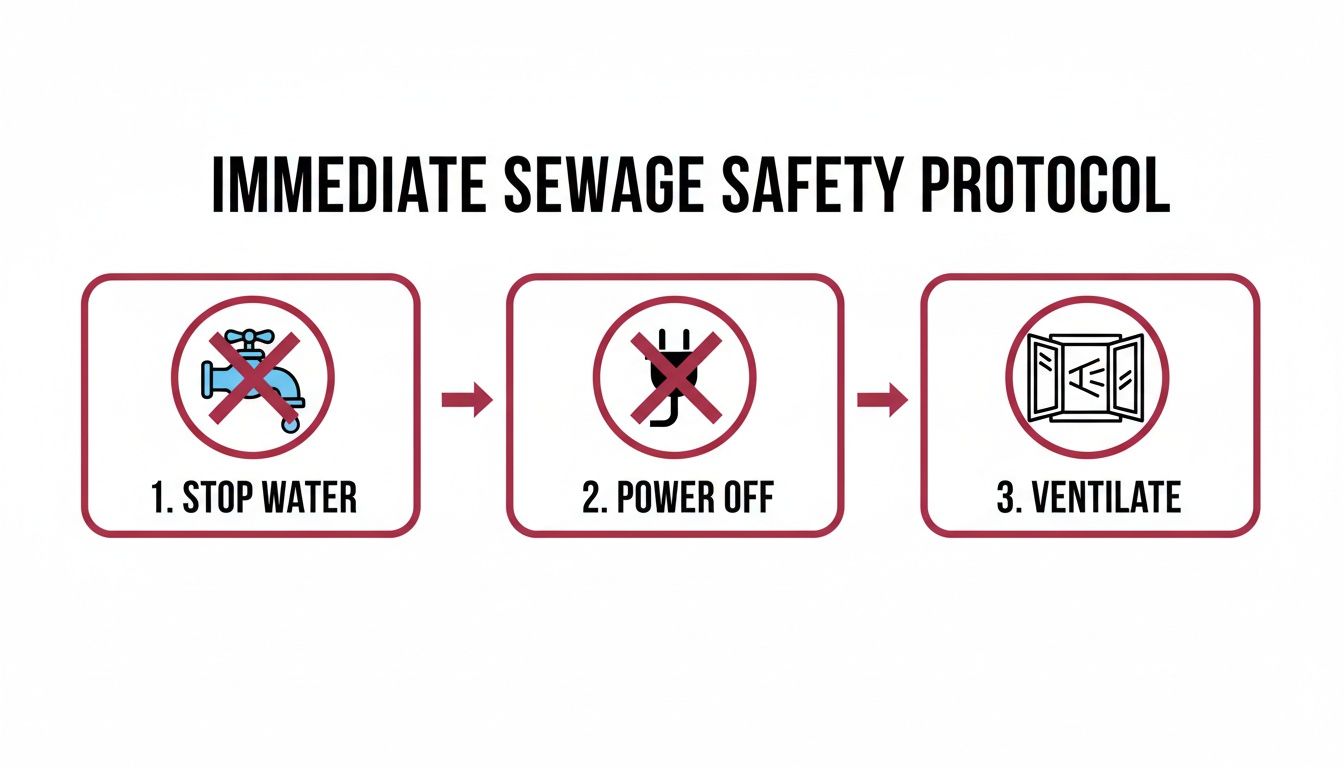
These three actions—stopping the water, shutting off the power to the affected area, and getting some air moving—are your immediate priorities. They protect your family and your property from further damage.
When the pros take over, their process looks something like this:
- Water and Sewage Extraction: First, they have to get the bulk of the liquid and solid waste out. They use powerful, truck-mounted pumps and vacuums that can remove thousands of gallons of contaminated water in a hurry. A shop vac just can't compete.
- Removal of Contaminated Materials: This is the part that often surprises homeowners. Anything porous that soaked up sewage—think drywall, carpet, insulation, even furniture—has to go. These materials can’t be properly sanitized and will become a breeding ground for mold and bacteria if left in place.
- Advanced Structural Drying: With the contaminated materials gone, the crew focuses on drying out the structure itself. They bring in an arsenal of high-volume air movers and commercial-grade dehumidifiers to pull every last bit of moisture from the wood framing, concrete slab, and subfloor.
- Cleaning, Disinfection, and Deodorizing: Finally, every remaining surface in the affected area gets a deep cleaning with hospital-grade antimicrobial solutions. To finish the job, they often use thermal foggers or ozone generators to completely eliminate any lingering odors, ensuring the smell is gone for good.
The Technology Behind a Professional Cleanup
The difference between a DIY attempt and a professional job really comes down to the equipment. The tools of the trade are highly specialized and powerful. While the industry is always looking ahead to things like AI and robotics, the technology available today is what makes a safe restoration possible.
This level of professional service is becoming even more crucial. For example, some rural areas are facing a shortage of water utility workers, with 30% to 50% of operators nearing retirement. This puts more pressure on homeowners to rely on expert, independent teams during an emergency.
The goal of a professional service isn’t just to clean what you can see. It’s to restore the hidden parts of your home—the air quality, the structural integrity, and your family’s safety.
This is why trying to handle a sewage backup on your own is so risky. You simply don’t have the right tools or the training to guarantee the job is done safely. For a bit more reading on the subject, you can find some excellent sewage cleanup tips from other industry experts. Knowing what a true professional cleanup involves helps you appreciate why it’s the only safe choice.
Understanding Sewage Cleanup Costs
When you’re dealing with a sewage backup, one of the first questions on your mind is, understandably, "What is this going to cost?" The truth is, there’s no flat-rate answer. Think of it less like buying a product off the shelf and more like taking your car to the mechanic after an accident—the final bill depends entirely on the extent of the damage.
A minor toilet overflow that stays on the tile floor of a bathroom is a completely different job than a main line backup that floods a finished basement. The price for restoring your property reflects the unique circumstances of the disaster, so a detailed assessment is always the first step.

What Drives the Final Cost?
A professional's estimate isn't just an arbitrary number. It’s a careful calculation based on several critical factors that determine the labor, equipment, and materials needed to make your home safe again.
We've put together a table to break down the primary variables that will impact your final invoice.
Factors That Influence Sewage Cleanup Costs
| Cost Factor | Description of Impact | Example Scenario |
|---|---|---|
| Area of Contamination | The total square footage of the affected area is the biggest cost driver. A larger space requires more time, more crew members, and more resources to decontaminate. | Cleaning a 10×10 foot laundry room will be significantly cheaper than remediating an entire 1,200-square-foot basement. |
| Water Category | All sewage is considered Category 3 water ("blackwater"), the most hazardous type. This requires specialized personal protective equipment (PPE) and strict safety protocols, which adds to the cost. | Professionals must treat any surface touched by sewage as a biohazard, unlike a clean water pipe break (Category 1). |
| Affected Materials | Porous materials like drywall, carpet, insulation, and unfinished wood absorb contaminants and are extremely difficult to salvage. Non-porous surfaces like tile or sealed concrete are easier to clean. | Carpet and padding almost always require removal and disposal, whereas a contaminated tile floor can often be sanitized and saved. |
| Removal & Demolition | Anything that can't be safely cleaned must be cut out, bagged, and disposed of as biohazardous waste. This demolition work and the associated disposal fees add to the project scope. | Cutting out the lower two feet of drywall and insulation in a flooded room adds significant labor and disposal costs. |
Understanding these elements helps clarify why a thorough, professional cleanup is an investment in your property's safety and value.
Watch Out for Secondary Issues
The problems don't always stop with the initial water removal. Sewage brings a massive amount of moisture into your home, creating the perfect breeding ground for another serious issue: mold.
Mold can start growing in as little as 24 to 48 hours after the initial exposure. A professional cleanup crew is trained to look for hidden moisture and dry the structure completely to prevent this. If mold has already taken hold, a separate mold remediation process will be necessary.
This is exactly why a fast response is so critical. Getting experts on-site immediately helps contain the damage and stop these costlier secondary problems before they start. While residential and commercial pricing differ, you can get a general sense of how professionals define the scope and costs of a job by reviewing guides on how to price commercial cleaning.
Financial Solutions for an Unexpected Mess
We know a sewage backup is a stressful and unplanned expense. That’s why we believe in total transparency. Before we start any work, Precision Plus Plumbing provides a clear, itemized estimate so there are no surprises on the final bill.
To help manage the immediate financial impact, we also offer flexible financing options. This allows you to get the urgent help you need right away and pay for it over time. For a deeper dive into budgeting for this type of emergency, you can learn more about what to expect from the sewage backup cleanup cost in our detailed guide.
How to Handle Insurance Claims for Sewage Damage
Dealing with an insurance claim on top of a sewage backup can feel like adding insult to injury. Once you know everyone is out of harm's way, one of your first calls should be to your insurance agent. This gets the ball rolling and, more importantly, helps you figure out what your policy actually covers—which is often a nasty surprise.
Here’s the thing most homeowners don’t know: a standard policy that covers a burst pipe inside your home will almost always exclude damage from sewer backups. It’s a fine-print detail that can leave you holding a huge bill. To be covered for this kind of disaster, you need a special endorsement or add-on called sewer backup coverage.
Document Everything Immediately
Before anyone starts cleaning up, your job is to document the scene. Your smartphone is your single most important tool right now. Take tons of photos and videos of absolutely everything—the standing sewage, the water lines on the drywall, and every single item that got wet.
You're trying to build a complete visual record of the damage. Get wide shots of the entire affected area, then get close-ups of specific items or structural damage. Don't even think about throwing anything away until your insurance adjuster gives you the green light. They need to see the proof before they can approve the cost to replace it.
Key Takeaway: Put on your investigator hat. The photos and notes you take are the evidence that will support your claim. The more thorough you are, the better your chances of a smooth process.
After you've documented everything, your next job is "mitigation." That's just an industry term for taking reasonable steps to stop the damage from getting worse, which starts with calling a professional cleanup service. Your policy requires you to do this; ignoring it could put your entire claim at risk.
Your Cleanup Company Is Your Advocate
This is where a professional restoration company proves its real value. They’re not just there to pump out water; they become your partner in the insurance process. An experienced crew, like the team at Precision Plus Plumbing, knows exactly what insurance companies need to see and how to talk to them.
Here's how a pro service makes the claims process easier on you:
- Detailed, Itemized Invoices: They use industry-standard software to create line-by-line estimates that adjusters immediately recognize and accept. No guesswork.
- Moisture Mapping and Reports: They use specialized tools to provide scientific proof of how far the water traveled and what's saturated. This justifies removing contaminated materials and bringing in the right drying equipment.
- Direct Communication: They take over the technical conversations with your adjuster, answering their questions and fighting for the right scope of work to get your home back to normal.
Having this kind of expert coordination takes a massive weight off your shoulders. You don’t have to argue about why a certain part of the wall needs to come out; your restoration expert has the data to prove it. They essentially build the case for your claim, working to make sure you get every penny of coverage you're owed.
It also helps to know what a proper cleanup looks like when you're talking to your insurer. For a deeper dive into the steps involved, take a look at our guide on the complete water damage restoration process. Being informed allows you to ask the right questions and ensure no corners are cut. Trust us, having a pro in your corner changes everything.
Choosing the Right Local Cleanup Service
When you’re dealing with a sewage backup, the company you call can make all the difference. Get it right, and you're on the fast track to recovery. Get it wrong, and you could be looking at a prolonged nightmare of lingering damage and health risks.
It’s easy to feel overwhelmed. A quick search for "sewage cleanup services near me" brings up a long list of options, but they are far from being the same. You're not just hiring someone to clean up a mess; you're bringing in an emergency response team to protect your home and your family's health.
What to Look For Beyond a Good Sales Pitch
In a crisis, you have to look past the slick websites and marketing promises. What really matters is a company's ability to show up and perform when it counts. A fancy ad is useless if nobody answers the phone at 3 AM.
First and foremost, a true 24/7 response is non-negotiable. That means a live person answers your call—even on a holiday weekend—and a fully-stocked truck is on its way immediately. It does not mean an answering service that takes a message for a callback during business hours.
Key Insight: The first 24-48 hours after a sewage spill are absolutely critical. This window is your best chance to prevent permanent damage and stop mold before it starts. A company that can't dispatch someone right away simply isn't an emergency service.
You also want to see guarantees that prove a company stands behind its work. Things like an On-Time Guarantee show they respect your time, especially when you're already stressed. Upfront, transparent pricing is just as important, so you aren’t hit with a massive, unexpected bill at the end.
The Hallmarks of a Quality Provider
So, how do you separate the real pros from the rest? The best companies have tell-tale signs of quality woven into how they operate. These aren't just small details; they're indicators that you’re dealing with a team that gets the job done right the first time.
Look for these signs of a truly professional operation:
- A High "First-Call Fix Rate": Does the company solve the problem on the first visit? A team like Precision Plus Plumbing, which resolves over 90% of issues on the spot, comes prepared. It means they have experienced technicians and vehicles stocked with the right parts and equipment, so you aren't left waiting.
- Rock-Solid Guarantees: Go beyond a simple satisfaction promise. A "Risk-Free Guarantee" or "No-Lemon Guarantee" shows the company is fully accountable for the quality of their work and protects your investment in the long run.
- Fully Equipped Service Vehicles: When a truck pulls up, it should be a "warehouse on wheels." A well-stocked vehicle is a clear sign of professionalism and shows the team is ready for anything, preventing needless delays.
- Services That Go the Extra Mile: The best companies do more than just clean up. They might offer complimentary drain treatments, test your water quality, or even mark your main shutoff valves for free. These touches show they’re invested in helping you prevent future disasters, not just fixing the current one.
If you’re facing a mess and need a team that checks all these boxes, you can see what our dedicated professionals offer by exploring our full range of sewage cleanup services.
Local Experts vs. National Chains
When disaster strikes, it can be tempting to call a big national brand you’ve seen on TV. But more often than not, a locally owned and operated company offers some serious advantages that you just can't get from a corporate giant.
Local experts, like Precision Plus Plumbing, have been serving the Greater Philadelphia area since 1999. We're not just working in a zip code; we're helping our neighbors. That deep community connection translates into a higher level of care and a powerful motivation to protect our reputation with every job we do.
When you call a local provider, you're far more likely to speak with someone who can make decisions, offer flexible solutions like financing, and work directly with your insurance company. It’s the peace of mind that comes from knowing the people restoring your home are part of your community.
Common Questions About Sewage Backup and Cleanup
It’s completely normal to have a ton of questions when you’re facing a sewage backup. For most homeowners, it’s a shocking and unfamiliar disaster. You’re suddenly thrown into a situation you’ve never had to deal with before.
We get it. Our team has guided countless families through this exact scenario. To help you get your bearings, we’ve put together answers to the questions we hear most often, giving you the clear, straightforward information you need right now.
How Long Does the Sewage Cleanup Process Take?
There's no single answer to this, as the timeline really depends on how bad the damage is.
For a small, contained mess—say, a toilet overflow on a tiled bathroom floor—we can often have things fully extracted, sanitized, and dried in just one to three days.
But if you're dealing with a major event, like a main line break that floods your entire finished basement, the job gets a lot more complex. When sewage soaks into porous materials like drywall, carpet, and wood framing, the project can easily stretch to a week or even longer. It’s a multi-stage process that can't be rushed.
- Extraction: This is the first step, where all the standing sewage and dirty water is pumped out. It usually takes a few hours.
- Drying & Dehumidification: This is the longest phase. We set up powerful air movers and commercial-grade dehumidifiers that run 24/7 for several days to pull every last bit of moisture out of the air and structure.
- Repairs & Reconstruction: Once everything is clean and dry, any materials that had to be removed—like drywall or flooring—are replaced to get your home back to normal.
Is It Safe to Stay in My House During Cleanup?
Your family's safety is everything. For that reason, you should never go into the contaminated area while the cleanup is happening. The risk of breathing in airborne bacteria and pathogens is just too high.
Now, if the backup is isolated to one specific area, like an unfinished basement, you might be able to stay in the house. A professional crew will seal off the work zone with heavy plastic barriers to prevent any cross-contamination to the living spaces upstairs.
However, if the contamination is widespread or, more importantly, if it has gotten into your home’s central HVAC system, your project manager will almost certainly advise you to relocate temporarily. The last thing you want is for harmful contaminants to be circulated through every room in your house.
Can I Clean Up a Minor Sewage Leak Myself?
Even if it looks like a small, manageable leak, we strongly urge you not to try and clean it up yourself. Any water that comes out of a sewer line is considered "Category 3 blackwater." That’s the industry term for water that is grossly contaminated with dangerous bacteria, viruses, and pathogens that can make you incredibly sick.
Think of it like this: trying to clean sewage on your own is like attempting a medical procedure without the right training or sterile equipment. You might wipe up the visible mess, but you can’t get rid of the microscopic threats you can’t see.
Professionals use specific personal protective equipment (PPE)—respirators, full-body suits, and specialized gloves—just to handle the material safely. We also have access to hospital-grade disinfectants and follow strict government protocols for safe containment and disposal. Going it alone not only puts your health at immediate risk but almost guarantees you’ll miss hidden moisture, which is a leading cause of major mold problems down the road.
What Happens to My Contaminated Belongings?
This is often the toughest part of the whole ordeal. The unfortunate reality is that any porous item that has soaked up raw sewage has to be thrown away. Things like fabric and paper act like sponges, trapping bacteria deep inside where they can never be fully and safely sanitized.
Items that almost always have to be discarded include:
- Carpets, area rugs, and the padding underneath
- Mattresses and box springs
- Sofas, armchairs, and other upholstered furniture
- Pillows, stuffed animals, and kids' fabric toys
- Books, important papers, and cardboard boxes
On the other hand, non-porous items often stand a good chance. Hard-surfaced belongings made of glass, metal, solid wood, and certain plastics can usually be salvaged. They can be thoroughly cleaned, disinfected by professionals, and restored.
Your restoration team is a huge help here. They will work with you to carefully sort through everything, separating what’s salvageable from what isn’t. Most importantly, they will meticulously document every single item that has to be discarded with photos and detailed notes. This documentation is critical for your insurance claim—it’s the proof the adjuster needs to properly compensate you for your losses.
When disaster strikes, you need a team you can trust to respond immediately and handle the situation with expertise and care. For urgent help with sewage, water, or plumbing emergencies, don't wait. Contact the experts at Precision Plus Plumbing for a 24/7 response you can count on. https://www.precisionserviceexperts.com