
If you've ever noticed those long, low-profile metal units running along the baseboards in an older home, you've likely seen a Crown heater. They were a brilliant, space-saving heating solution, especially popular in homes built across our region in the mid-20th century.
What Exactly Are Crown Heaters In Your Home?
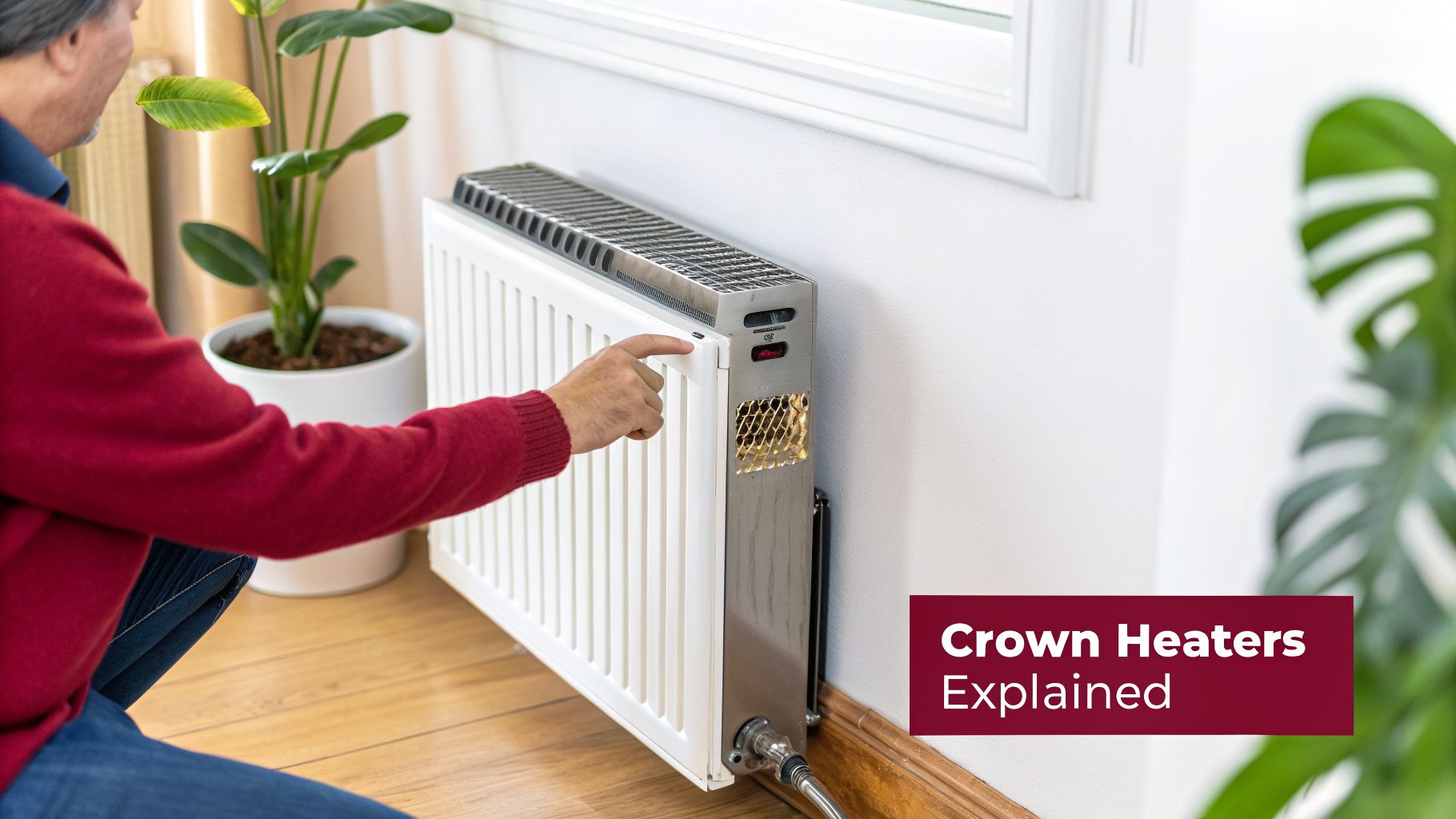
It’s best to think of a Crown heater not as a standalone unit, but as a key component that works with your larger heating system to distribute warmth. Their name comes from where you usually find them: "crowning" the top of a baseboard or radiator. Their whole purpose is to push heat out into a room more efficiently.
These units really hit their stride during the post-war building boom. In fact, they became so common in the Greater Philadelphia area that by 1970, they were part of over 40% of residential heating systems. Their compact design was a perfect match for the classic rowhomes in Philly, South Jersey, and New Castle County, delivering powerful heat without eating up valuable floor space.
Electric vs. Hydronic Systems
The first step in figuring out any issue with your heater is knowing which type you have. Crown heaters fall into two main categories, and the difference is all about how they create and move heat.
- Electric Crown Heaters: These are self-contained units. Inside, an electric heating element—much like the wire in a toaster—glows hot when electricity flows through it. That heat radiates out, often with a boost from a small, quiet fan that circulates the warm air.
- Hydronic (Hot Water) Crown Heaters: More commonly found in homes with a central boiler, these units act like mini-radiators. Hot water from the boiler flows through a pipe surrounded by metal fins. As air passes over the hot fins, it warms up and rises, heating the room naturally through convection.
Not sure which one you're looking at? We created this quick reference table to help you spot the key differences.
Identifying Your Crown Heater System
| Symptom / Component | Likely Electric System | Likely Hydronic (Hot Water) System |
|---|---|---|
| Visible Connections | Only see electrical wires going into the unit. | See metal pipes (usually copper) entering and exiting. |
| Associated Equipment | Wired to a thermostat and your main electrical panel. | Connected to a large central boiler tank somewhere else in the home. |
| Sound When On | Might hear a very faint hum or the quiet whir of a small fan. | May hear soft clicking or gurgling as water moves through. |
| Heat-Up Time | Heats up fairly quickly after being turned on. | Takes longer to warm up as hot water must circulate from the boiler. |
Seeing pipes is the clearest sign you have a hydronic system. If it’s just wiring, you're dealing with an electric model. This distinction is vital because it points to where a problem might be originating.
Because they are part of a larger network, a single malfunctioning hydronic heater could point to a problem with the boiler itself or an issue somewhere in the plumbing loop. This is why a simple "no heat" complaint often requires a professional's eye to diagnose correctly.
While our team at Precision Plus Plumbing is equipped to handle all kinds of residential heating issues, some large-scale boiler problems require deep specialization. In those cases, a dedicated Crown Hot Water Boiler Service can be an excellent resource.
Now that you have a handle on the basics, you're better prepared to spot the warning signs when something goes wrong. Whether you're dealing with an odd noise or a sudden cold spot, this knowledge is the first step. To see the full range of issues we can solve, feel free to review our comprehensive heating repair services.
Common Signs Your Crown Heater Is Failing
When your home's heating system is on its way out, it almost never goes down without a fight. It will usually give you a few warning signs first. For homeowners with Crown heaters, learning to recognize these distress signals can be the difference between a simple repair and a full-blown, no-heat emergency in the middle of winter.
Think of it as a check engine light for your heater. Ignoring a small problem today often means you’ll be dealing with a much bigger, more expensive one tomorrow. If you notice any of these changes in your system, it’s a clear sign that something needs a closer look.
Uneven Heating and Cold Spots
One of the first things people notice is that their home just isn’t comfortable anymore. Maybe the living room is roasting, but the back bedroom feels like an icebox, no matter how high you set the thermostat. This is a tell-tale symptom of a heat distribution problem.
If you have a hydronic Crown boiler, this usually points to an airlock or a blockage in the pipes. The hot water is being produced, but it simply can’t get to where it needs to go. For electric units, it’s more likely a sign of a failing heating element or a bad connection inside that one cold heater.
Strange and Unsettling Noises
Your heating system is supposed to be a quiet workhorse, humming along in the background. When it starts making new and unusual sounds, it's trying to tell you something is wrong.
- Banging or Clanking: Loud, metallic sounds are often a sign of "kettling." This happens when mineral scale builds up inside the boiler, causing water to superheat and flash into steam. It can also be caused by pipes expanding and contracting against the wood framing of your house.
- Gurgling or Bubbling: This sound almost always means there's air trapped in your hydronic system's water lines. These air pockets disrupt the flow, reducing efficiency and making that gurgling noise as water struggles to push past.
- Hissing: While a faint hiss might be normal, a loud or persistent hissing usually points to a water leak. It could be a tiny pinhole in a pipe or a worn-out valve seal letting steam or water escape.
Ignoring these sounds is a gamble. That banging could be putting major stress on your boiler, and a hiss could be the first sign of a leak that’s about to cause serious water damage. For a wider look at heating system issues, learning about 8 clear signs your furnace needs repair can offer some helpful perspective.
Visible Signs of Distress
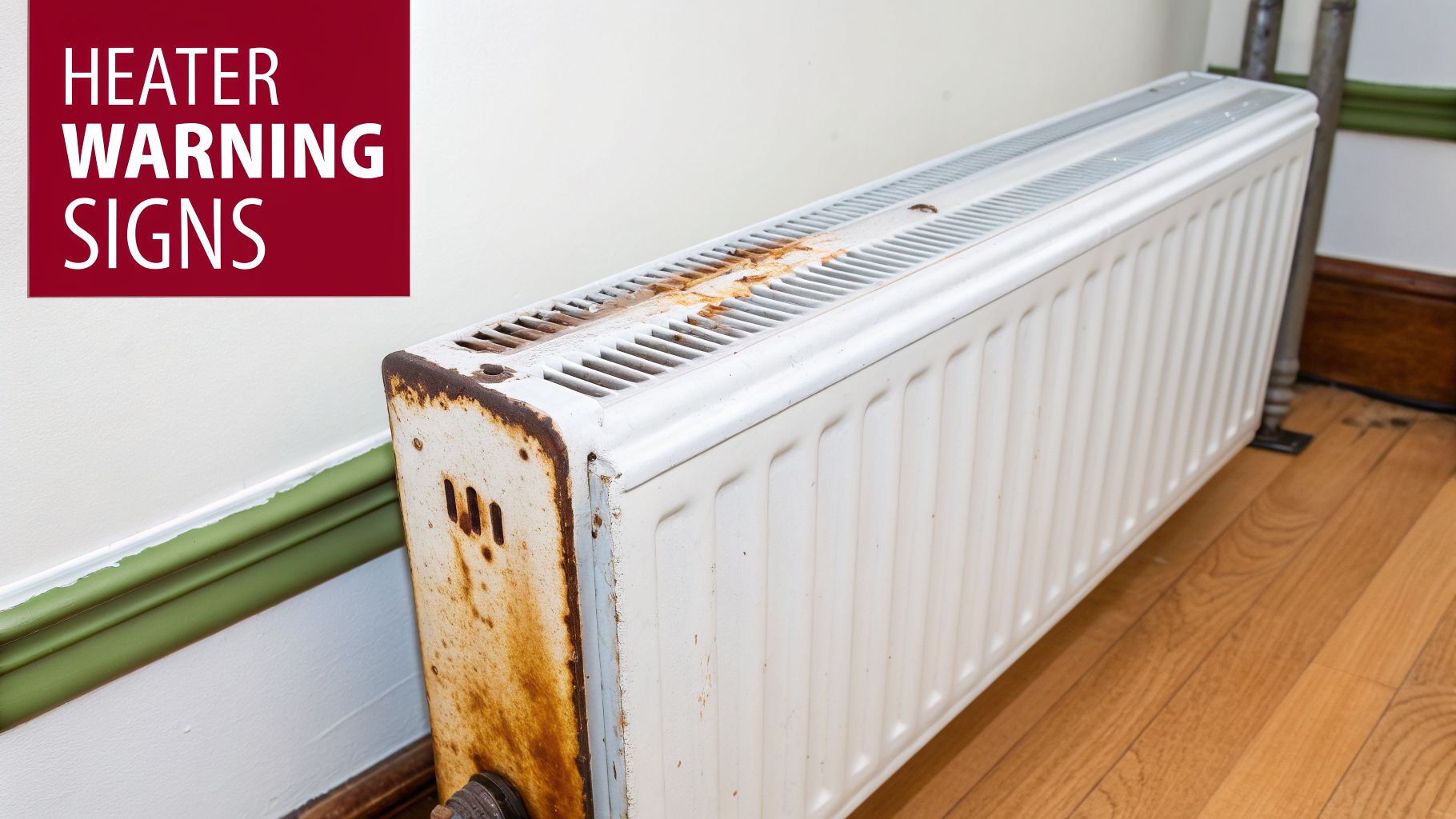
Sometimes, the best diagnostic tool is your own eyes. Take a moment to physically inspect your heaters and any visible pipes. Look for rust stains, drips, or small puddles on the floor.
Any visible leak is an immediate concern. It's a clear sign of corrosion that has already compromised your system. Water and metal don't mix, and once decay starts, it will only get worse.
Understanding Why Crown Heaters Break Down
Knowing the warning signs of a failing heater is one thing, but truly understanding why they fail is what can help you prevent a disaster. Many of the Crown heaters we see in older Philadelphia homes have been putting in work for decades. And just like any hardworking machine, age and the daily grind eventually catch up. The failures we see are rarely a surprise to us—they're often the predictable end to a long, slow process.
More often than not, the root cause comes down to the system's materials and the very water running through its pipes. These aren't sudden, explosive problems. They're silent issues that build up over years until something finally gives.
Corrosion: The Silent System Killer
If there's one public enemy for any hydronic heating system, it’s corrosion. It's the simple, natural process of metal breaking down when it's constantly exposed to water and oxygen. Over many years, the inside of your pipes and the heater itself begins to rust and weaken from the inside out.
At first, you might just get some rust particles clouding up the water, which can start causing little blockages. But given enough time, the metal walls get so thin they can't handle the system's pressure anymore. That's how a tiny, invisible spot of rust turns into a pinhole leak, a burst pipe, or a dripping valve that soaks a ceiling and floods a basement.
A slow leak might not seem like a big deal, but from our perspective, it’s a massive red flag. It’s a clear sign that the system's integrity is shot, and a much bigger failure could be right around the corner. We get countless emergency calls where a "small drip" became a full-blown flood in just a few hours.
The Impact of Mineral Buildup
The other major issue we constantly battle is mineral buildup, or what we call scale. The water flowing into your home isn't pure H2O; it's full of dissolved minerals like calcium and magnesium. When that water gets heated, those minerals solidify and bake onto the inside of your pipes and heating components, forming a hard, chalky crust.
Think of it like cholesterol clogging an artery. This buildup chokes off the flow of hot water, forcing your boiler to work much harder just to keep you warm. This creates a cascade of problems:
- Skyrocketing Bills: Your system has to burn more fuel to push heat through the scale, making your energy bills climb.
- System Stress: When scale builds up in the boiler, it can cause "kettling"—that loud banging or rumbling sound—which puts a huge amount of stress on the metal.
- Cold Spots: Chunks of scale can break off and get lodged in the narrow pipes of your Crown heaters, completely blocking the flow of heat to certain rooms.
As the winters get tougher—Philadelphia saw a record 45 inches of snow in the 2024-2025 season—the strain on these older systems becomes immense. Our own data at Precision Plus Plumbing shows that an alarming 42% of flooded basement calls in the region are directly from Crown heater leaks. This contributes to over $500 million in annual water damage claims across PA, NJ, and DE. You can read more about water heater market trends and their financial impact to see the bigger picture.
For those with electric units, the breakdown is usually a bit different. The failure point is almost always the heating element or the internal wiring. The constant cycle of heating up and cooling down eventually takes its toll, causing electrical connections to work themselves loose or components to simply burn out. One day, you just have a heater that won't turn on.
Immediate Steps for a Heating Emergency
It’s a homeowner's nightmare: the heat cuts out on a freezing night, or you discover a puddle of water spreading from your boiler. That initial jolt of panic is completely normal. But before you do anything else, take a deep breath. A few smart, quick actions can keep a bad situation from turning into a full-blown catastrophe.
Honestly, what you do in the first 15 minutes can save you thousands in water damage repairs. Knowing how to safely get things under control until a professional can get there is the most important skill you can have in these moments.
What to Do When a Leak Appears
If you see an active leak coming from your Crown heater, it's an all-hands-on-deck emergency. Don't second-guess it. Whether it's a slow, steady drip or a gushing flow, you need to move fast.
- Shut Off the Water: Your first move is always to cut off the water. Find your home's main water shut-off valve (usually where the water pipe enters your house) and turn it clockwise until it’s tight. If your boiler has its own dedicated shut-off valve, even better—use that one. This stops feeding the leak.
- Kill the Power: Next, head to your electrical panel. Find the breaker that controls your boiler or heating system and flip it to the "Off" position. Water and electricity are a lethal mix, so this is a non-negotiable safety step.
- Call for 24/7 Help: Do not wait. Leaks don't fix themselves and only get worse. Call Precision Plus Plumbing right away for our 24/7 emergency service. We'll get a technician headed your way to stop the damage and figure out the next steps.
It might seem like a leak appears out of nowhere, but it's usually the final stage of a long process happening inside your unit.
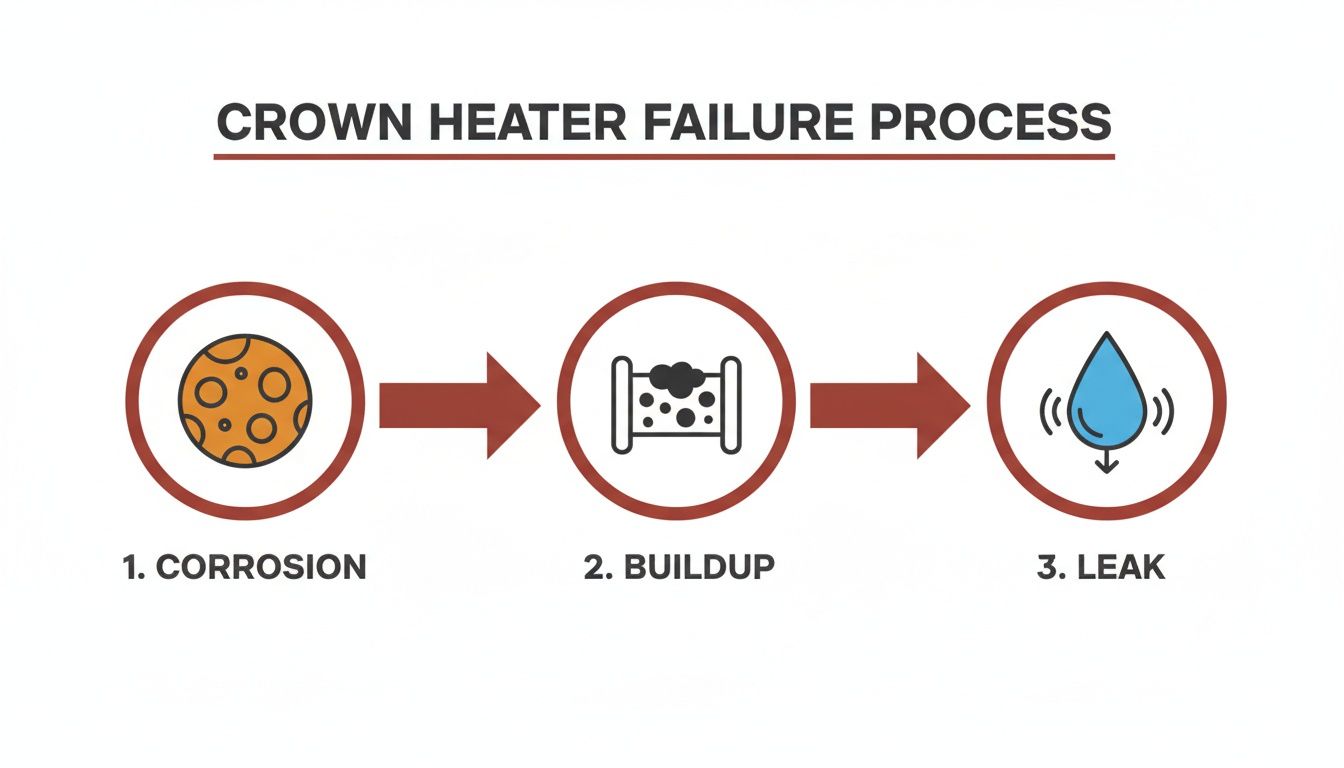
As you can see, the problem starts with hidden corrosion and mineral buildup, which eventually eat through the tank or fittings until water finds a way out.
When to Make an Emergency Call
Not every heating hiccup is a true emergency, but some situations absolutely cannot wait until morning.
You should call for emergency service immediately if you have any active water leak, a complete loss of heat during freezing weather, or smell gas near your boiler. These issues pose a direct risk to your property and your family’s safety.
While you're waiting for our technician to arrive, you can start damage control. Grab some buckets and old towels to catch drips and soak up water. If you can, move electronics, furniture, or rugs away from the wet area. For a more detailed guide, you might find our article on how to fix a leaking water heater helpful.
Deciding Between Repair and Replacement
When your Crown heater starts acting up, you’re left with a tough question: should you repair it or replace it? It's a classic homeowner dilemma, pitting a short-term fix against a long-term solution. There’s no single right answer, as the best path forward really depends on your heater's age, the nature of the problem, and your budget.
Sometimes, a repair is the clear winner. If you're dealing with a leaky valve, a faulty thermostat, or just need to bleed some air out of the system, a quick and affordable fix makes the most sense. This is especially true if your heater is only a few years old and has been working reliably otherwise. In these cases, a targeted repair can get you back to being warm and comfortable without breaking the bank.
But what if this isn't the first time? If you and your heating technician are on a first-name basis from yearly repair calls, the math starts to change. When the cost of a single repair creeps up to half the price of a brand-new unit, you've officially entered replacement territory. Constantly pouring money into an old, inefficient system is a losing game—eventually, it just becomes a money pit.
The Financial Side of Things
To make a smart choice, you have to look beyond the initial repair bill. While a simple fix might only set you back a few hundred dollars, a full replacement is an investment that can actually pay you back over time.
A modern, high-efficiency heating system can slash your energy consumption by up to 30%. Those savings show up month after month on your utility bills, and when you combine that with the peace of mind from a new warranty, a replacement often becomes the smartest financial decision for an aging Crown heater.
There's also the hidden cost of risk. Our own records at Precision Plus show just how disruptive a failing heater can be. In 2025 alone, failing radiators and Crown heaters accounted for 28% of all our emergency plumbing calls—that’s over 2,000 dispatches. Many of these calls were for catastrophic failures that led to basement floods, leaving homeowners with an average of $12,000 in water damage. If your system is already showing signs of trouble, it's worth understanding what to look for. And if your home uses a different type of system, you might find our guide helpful if your electric hot water heater has stopped working.
To help you weigh your options, we've put together this simple checklist. It breaks down the key factors to consider when you're on the fence about repairing or replacing your Crown heater.
Crown Heater Repair or Replace Checklist
| Consider This Factor | Lean Towards Repair | Lean Towards Replacement |
|---|---|---|
| Age of Unit | Less than 10 years old | Over 15 years old |
| Repair Cost | Less than 30% of replacement cost | More than 50% of replacement cost |
| Repair Frequency | First or second repair ever | You're making annual or frequent calls |
| Energy Bills | Your bills have been stable and reasonable | Bills are steadily climbing each year |
| Performance | The unit heats your home effectively | You have cold spots or inconsistent heat |
| Major Component Failure | The issue is with a minor part (valve, thermostat) | A core component like the heat exchanger has failed |
Ultimately, this checklist is a guide. The best decision comes from having clear, honest information from a professional who has seen your system firsthand.
Making the Decision Easier
At Precision Plus, we believe in helping you make an informed choice, not pressuring you into a sale. We lay out all the cards on the table so you can see the costs and benefits of each option for yourself.
Here’s what you can expect from us:
- An Honest Assessment: Our technicians will give you a straight-up evaluation of your heater's condition and lifespan. No sugarcoating.
- Clear, Side-by-Side Options: We'll show you the exact price for a repair versus the investment for a new, high-efficiency system.
- Accessible Financing Solutions: If a replacement is the right move but feels out of reach, we offer flexible "service now, pay later" options to make it manageable.
Our goal is to give you the clarity and confidence to choose the best solution for your home, your family, and your budget.
Why Choose Precision Plus for Your Heating Needs
There’s nothing worse than the heat going out, especially in the dead of winter. Whether you've just discovered a puddle under your Crown boiler or the house has gone completely cold, you need help from someone who knows what they're doing—and you need it fast. At Precision Plus, we get it. That's why we’ve built our entire business around being the team you can count on when things go wrong.
Heating emergencies don't wait for business hours, so neither do we. We offer a guaranteed 24/7 emergency response, which isn't just a marketing slogan. It’s our promise that when you call, a real professional is heading your way. We also have an On-Time Guarantee, so you won't be left waiting around, wondering when help will finally arrive.
Experience and Efficiency You Can Count On
Our technicians don't just show up on time; they show up ready to work. We keep our trucks fully stocked with the parts needed for most common repairs. What does that mean for you? It means we can fix over 90% of heating issues on the very first visit, getting your home warm and comfortable again without delay.
You’ll also appreciate our straightforward pricing. Before we touch a single tool, we'll explain the problem and give you a clear, upfront price for the solution. No hidden fees, no last-minute surprises—just honest work.
Choosing Precision Plus means you're getting a team that knows the old and the new. We have decades of hands-on experience with legacy systems like Crown heaters, but we’re also fully trained on the latest high-efficiency models.
This blend of old-school knowledge and modern expertise is what sets us apart. We can give you the best advice for your specific situation, whether that’s a quick, reliable repair to get your trusted boiler running again or a seamless upgrade to a new system that will cut your energy bills for years to come.
Frequently Asked Questions About Crown Heaters
It's natural to have a lot of questions when your heating system starts acting up, especially if it's an older model. When it comes to your Crown heaters, getting the right information is the first step toward making a smart choice for your home and your wallet. We hear these questions all the time, so let's get you some answers.
Can I Replace Just One Crown Heater In My House?
You bet. In many cases, you can absolutely replace just one problem heater without having to redo the entire system. If the issue is isolated—maybe a leaky valve or a specific unit that just won't heat up—swapping out that single component can be a great, cost-effective fix.
The thing is, if your system is pushing 15 years or older, one failure is often a warning sign. It’s a bit like having old tires on your car; when one finally gives out, the others are usually not far behind. Our technicians can give your whole system a thorough look-over to help you figure out if a single repair makes sense or if planning for a larger upgrade is the wiser move.
Are Modern Heaters More Energy Efficient?
Oh, absolutely. While finding an exact, old-school Crown heater replacement is rare these days, the modern radiators and baseboard heaters that have taken their place are in a different league when it comes to efficiency. Upgrading even one outdated unit can make a real dent in your monthly heating costs.
Modern heating units are just designed smarter. They use materials that transfer heat much more effectively, which means they don't have to work as hard—or use as much energy—to keep your home feeling consistently warm. You'll finally get rid of those frustrating cold spots for good.
How Long Does a Typical Crown Heater Repair Take?
We know that when your heat is out, every minute counts. The good news is that most common repairs on Crown heaters are pretty quick. Things like bleeding air out of the pipes, fixing a small leak, or swapping out a bad valve can usually be handled by one of our pros in just a few hours.
Efficiency is our mantra. Our service trucks are basically workshops on wheels, stocked with all the parts and tools needed for the most common heating headaches. This preparation is why we’re able to solve over 90% of all repairs on the first visit, getting your heat back on without making you wait around for a part to be ordered.
What Is Included in a Complimentary Visit Check?
Anytime we're at your home for a service call, our technician will perform a quick, complimentary health check on your heating system. The goal is to catch small issues before they turn into big, expensive emergencies. This isn't an exhaustive inspection, but a practical once-over that includes:
- Scanning all the visible pipes and connections for any early signs of leaks or corrosion.
- Making sure water pressure and flow look right for hydronic (hot water) systems.
- Checking that your main safety shutoff valves are easy to find, clearly marked, and working properly.
It's a simple, proactive step that gives you a better picture of your system's condition and a little extra peace of mind.
If your Crown heater is acting up or you've woken up to a cold house, don't just cross your fingers and hope it gets better. Precision Plus Plumbing has experts ready to help 24/7 throughout the Greater Philadelphia area. Contact us now for immediate assistance and let's get your home warm and comfortable again.