

Sump pump trouble often announces itself long before a flood. You might hear strange noises from the basement, notice the pump running nonstop, or see rust forming on the unit. Catching these early signs is absolutely critical. A pump that's on its last legs can fail during the worst possible time, leading to a flooded basement, costly water damage, and a nasty mold problem. A little proactive attention can turn a potential disaster into a simple, manageable fix.
Recognizing the Warning Signs of Sump Pump Failure
Most of the time, your sump pump is out of sight and out of mind, quietly protecting your basement from water. It's easy to forget it’s even there—until it stops working in the middle of a heavy storm. Ignoring the subtle hints that your pump is struggling is a gamble, and the stakes are a dry, usable basement.
Learning to spot these early warnings is the best defense against a catastrophic failure. A timely sump pump repair will save you thousands in potential damages and, just as importantly, buy you peace of mind when the skies open up over Philadelphia or New Jersey.
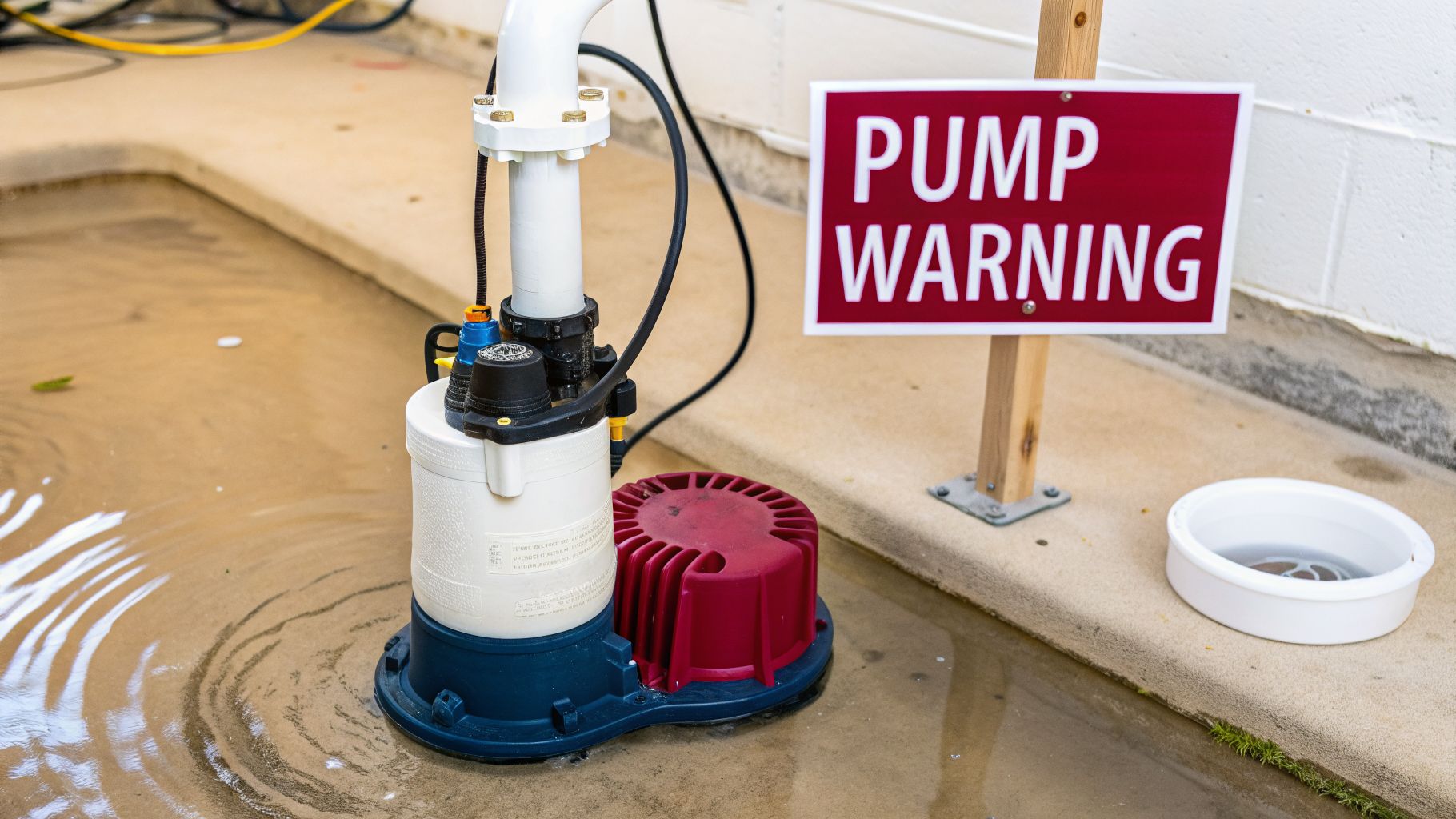
To help you pinpoint the problem, we've put together a quick diagnostic checklist. If you're experiencing any of these symptoms, it’s a clear sign that your sump pump needs a closer look.
Sump Pump Failure Symptom Checklist
| Symptom | What It Sounds/Looks Like | Potential Cause | Urgency Level |
|---|---|---|---|
| Strange Noises | Grinding, rattling, whining, or loud gurgling | Jammed impeller, failing motor, bad check valve | High |
| Constant Running | The pump motor never shuts off, even in dry weather | Stuck or tangled float switch, undersized pump | High |
| No Operation | The pump doesn't turn on as the pit fills with water | Power loss, tripped breaker, failed motor, stuck switch | Critical |
| Short-Cycling | The pump turns on and off every few seconds | Faulty check valve, float switch needs adjustment | Medium-High |
| Visible Rust | Orange or brown flaky corrosion on the pump | Iron bacteria in water, age-related wear | Medium |
| Oily Sheen in Water | A rainbow-like film on the surface of the pit water | Failed oil seal, motor failure is imminent | High |
Noticing any of these signs doesn’t automatically mean you need a full replacement, but it does mean you can’t afford to ignore it. Let’s dig into what these symptoms really mean.
Strange and Unusual Noises
You probably know the quiet, familiar hum your pump makes when it kicks on. When that sound changes, it’s time to listen closely. New, alarming noises coming from the sump pit are a clear signal that something is wrong.
- Grinding or Rattling: This sound almost always points to an issue with the impeller, the small fan that pushes water out. Debris like small rocks or gravel can get sucked in, jamming or even breaking the impeller blades.
- Loud Gurgling: A little gurgling can be normal, but if it’s loud and persistent, your check valve is likely failing. This valve is supposed to stop water from flowing back into the pit after the pump shuts off.
- High-Pitched Whining: This is the sound of a motor bearing giving out. It’s a sign of significant wear and tear that needs to be addressed immediately before the whole motor burns out.
Think of it this way: if your car’s engine started making a loud rattling noise, you wouldn’t just keep driving. The same logic applies here—these sounds are a mechanical cry for help.
Constant or Irregular Operation
How your pump runs—or doesn’t run—is another dead giveaway. It should only activate when the water in the pit reaches a specific level. Any deviation from that predictable cycle is a major red flag. If you want to get a better handle on this, you can learn more about how to tell if your sump pump is working correctly in our detailed guide.
A sump pump that runs constantly, even in dry weather, is often suffering from a stuck float switch. This component, which acts like the float in a toilet tank, can get tangled or lodged in one position, forcing the pump to run nonstop and leading to premature motor burnout.
On the other hand, a pump that won’t turn on at all during a downpour is a true emergency. The cause could be as simple as a power outage or a tripped breaker. But it could also be far more serious, like a completely dead motor or a float switch that’s stuck in the “off” position.
Another problem we see a lot is “short-cycling,” where the pump clicks on and off every few seconds. This puts incredible strain on the motor and will dramatically shorten its lifespan. It’s often caused by a check valve that isn’t holding or a pump that’s simply too powerful for the size of the pit.
Visible Signs of Wear and Tear
Sometimes, the evidence of a problem is right there in plain sight. Taking a quick look into your sump pit from time to time can help you spot issues before they escalate into a total system failure.
Keep an eye out for visible rust or corrosion on the pump’s body. This can weaken the casing and eventually cause it to fail, especially if you have iron-ochre (or “iron bacteria”) in your water, which accelerates the process.
Also, check the water itself. Do you see an oily sheen on the surface? Sump pumps are sealed units containing oil to lubricate the motor. If you see oil in the water, it means a seal has broken and the oil is leaking out. This is a sure sign that a major failure is on the horizon, and a sump pump repair or replacement is needed right away.
Why Timely Repair Is a Critical Home Investment
It’s easy to look at a sump pump repair as just another unexpected household expense. But that’s a risky way to think about it. A much smarter approach is to see it as a direct investment in protecting your home’s structure and your financial stability. That pump in your basement is the only thing standing between you and a water disaster, and when it starts to act up, the clock is ticking.
Ignoring a small problem today can—and often does—turn a simple fix into a full-blown catastrophe during the next heavy downpour. What might have been a minor repair can quickly escalate into a flooded basement, destroyed possessions, and a cleanup bill that will make your head spin.
The Real Cost of a Failed Pump
The price of a proactive repair is a drop in the bucket compared to what you’ll pay after a flood. Once water gets into your basement, the damage spreads far beyond what’s immediately visible.
- Structural Damage: Water has a nasty habit of working its way into your home’s foundation. It can weaken concrete and create cracks, putting the integrity of your entire house at risk.
- Electrical Hazards: When water meets electricity, you have a life-threatening situation. Submerged outlets, appliances, and wiring create a serious risk of fire and electrocution, demanding costly and dangerous repair work.
- Mold Infestation: A damp, dark basement is a paradise for mold. It can start growing in as little as 24-48 hours, and it’s not just ugly—it’s toxic. Getting rid of a serious mold problem is a complicated, expensive process that often costs more than the initial water damage repair itself.
The financial hit from these problems can be truly staggering. That’s why so many homeowners in flood-prone areas like Greater Philadelphia and New Jersey are focusing on getting ahead of the problem. The North American sump pump market, valued at USD 169.66 million in 2024, is expected to swell to USD 261.08 million by 2032. This isn’t a coincidence; it’s a direct response to more frequent extreme weather, where over 70% of U.S. water-related disasters have caused losses exceeding USD 1 billion each.
A Tale of Two Homeowners: Proactive vs. Reactive
Let’s paint a picture. The first homeowner hears a strange rattling from their sump pit. They call a pro from Precision Plus Plumbing, who comes out, cleans a clogged impeller, and services the unit. The cost is predictable, and the pump is back to working perfectly. Total investment? A few hundred dollars.
Now, consider the second homeowner. They hear the same rattle but decide to ignore it. “I’ll get to it later,” they think. A month passes, a major storm rolls in, and that jammed impeller causes the motor to burn out completely. Their basement floods. They’re now on the hook for thousands in water extraction, foundation checks, replacing ruined belongings, and a massive mold remediation job. It’s also worth noting that your proactive approach to maintenance is a factor when you compare home insurance options to protect your home.
A professional sump pump repair is not a cost—it’s insurance. You are paying a small, controlled premium to prevent a massive, uncontrolled financial disaster that threatens your home’s value and your family’s safety.
Dealing with a sump pump problem right away is one of the smartest financial moves you can make as a homeowner. If you’re already seeing signs of water, you can learn more about how to stop basement flooding in our detailed guide. By staying on top of repairs, you’re not just fixing a machine; you’re protecting your most valuable asset.
Safe DIY Sump Pump Troubleshooting Steps
When your sump pump starts acting strange, it’s easy to jump to the worst-case scenario: a basement full of water. While some problems absolutely need a pro for sump pump repair, you’d be surprised how many common issues you can safely diagnose and even fix yourself.
But before you even think about touching the pump, let’s get one thing straight. Water and electricity are a deadly combination. Safety isn’t just a suggestion; it’s the most important step. Never, ever stand in water while inspecting your pump, and always kill the power at the circuit breaker before you start. This is non-negotiable.
Step 1: Start With the Power Source
It might sound almost too simple, but you wouldn’t believe how many emergency calls end with us just plugging a pump back in. Power issues are, by far, one of the most common reasons a pump won’t run.
First, give the plug a good look. Is it firmly seated in the outlet? The vibrations from the pump motor can sometimes work it loose over time. If the plug is tight, head over to your home’s electrical panel and check if the circuit breaker has tripped.
If the breaker is tripped, go ahead and reset it once. If it immediately trips again, do not touch it a second time. This is a clear sign of a bigger electrical problem, like a short in the pump’s wiring or a failing motor, that needs an expert to diagnose safely.
Step 2: Inspect the Sump Pit for Obstructions
Your sump pump lives in a basin called a sump pit, which is designed to collect water. Just like a gutter, this pit can get clogged with dirt, gravel, and all sorts of gunk that can stop the pump from doing its job.
Take a look inside the pit. Is the pump sitting level and upright? Sometimes, strong vibrations can knock it off balance, which can jam the float switch and keep it from turning on.
Next, check for any debris that could be getting in the way. The most important component to check here is the float switch.
The float switch is basically the “on” button for your pump. As water fills the pit, this little float rises with it. Once it hits a certain level, it triggers the motor. If that float gets tangled or stuck, the pump will either run nonstop or won’t turn on at all.
Carefully lift the float switch by hand. Does it move up and down freely? If it feels caught on something, see if any debris is tangled around it or physically blocking its path.
Step 3: Clean the Pump and Pit
If the pit looks like a muddy mess of silt and small stones, it’s time for a clean-out. A clogged intake screen on the pump is like trying to breathe with a hand over your mouth—it starves the motor and will eventually cause it to burn out.
- Kill the Power: Unplug the sump pump from the wall.
- Remove the Pump: Carefully lift the pump out of the pit. It’s a good idea to set it on a tarp to keep your floor clean.
- Clean the Pit: Use a shop vac or a bucket to get all the standing water, sludge, and debris out of the bottom of the pit.
- Inspect and Clean the Pump: Find the pump’s intake screen (usually on the bottom) and clear away any gunk that’s blocking it.
- Reinstall the Pump: Put the clean pump back in the clean pit, make sure it’s sitting level, and plug it back in.
Once everything is back in place, test your work. Pour a few buckets of water into the pit and watch what happens. The float should rise smoothly, the pump should kick on, drain the water quickly, and then shut itself off.
When to Stop and Call a Professional
This checklist will help you tackle the small stuff, but it’s just as important to know when to put the tools down and call for help.
You should stop what you’re doing and call a professional for sump pump repair if you run into any of these red flags:
- Stubborn Electrical Issues: The circuit breaker won’t stay reset.
- Motor Trouble: The pump makes a humming sound but the impeller doesn’t spin, or you see smoke or smell something burning.
- Visible Damage: You find cracks in the pump housing or see leaks coming from the pipe connections.
- Weird Noises: You hear grinding or rattling sounds that don’t go away even after cleaning the pit.
These aren’t minor hiccups; they usually point to serious internal problems like a fried motor or a broken impeller. Trying to fix these yourself isn’t just impractical—it can be downright dangerous and often leads to more expensive damage.
Deciding Between Sump Pump Repair and Replacement
When your sump pump gives out, you’re stuck with a tough question: do you pay for a sump pump repair, or is it time to cut your losses and replace the whole unit? It’s a decision that pits short-term cost against long-term peace of mind. Making the right call now can save you from throwing good money after bad and, more importantly, keep your basement dry when the next storm hits.
The answer isn’t always cut and dry. It’s a lot like deciding whether to fix an old car—a minor, cheap fix on a newer model makes perfect sense. But sinking thousands into an aging clunker with a bad engine? That’s just a poor investment. The same exact logic applies to your sump pump.
Before you even get that far, a quick check on your own can often point to a simple solution.
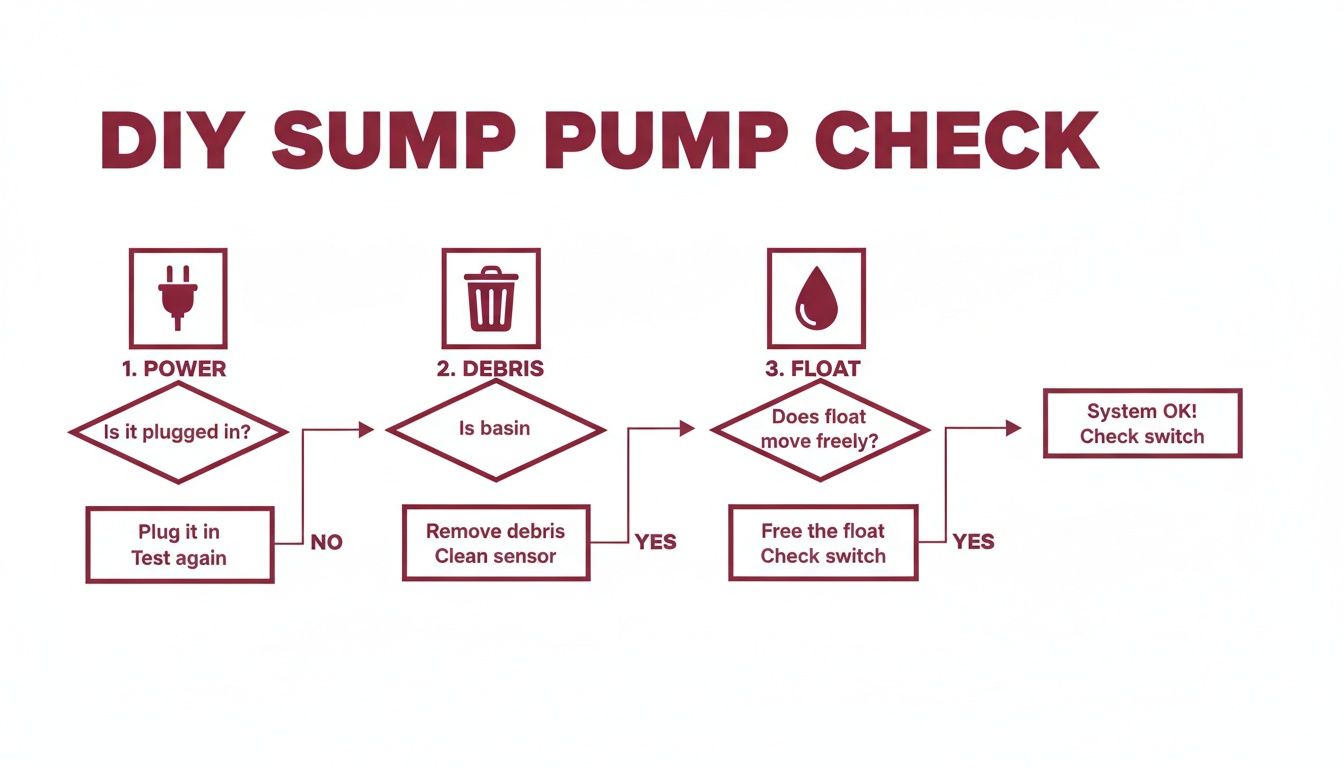
As you can see, sometimes the fix is as easy as plugging it in, clearing some gunk, or untangling the float switch. But if these basic troubleshooting steps don’t get your pump running again, it’s time to look at the bigger picture.
The Age of Your Sump Pump
Honestly, the biggest factor here is your pump’s age. These are hard-working machines, but they don’t last forever. A well-maintained sump pump generally has a lifespan of about 7 to 10 years. If your pump is still in its youth—say, under five years old—and has a minor hiccup, a repair is almost always the smart, cost-effective move.
On the other hand, if your pump is pushing that 10-year mark, replacement starts looking a lot more appealing. Sure, a repair might be cheaper today, but an older pump is on borrowed time. It’s far more likely to fail again, and the next failure could be catastrophic. Paying to fix an eight-year-old pump is often just kicking the can down the road.
Here’s a solid rule of thumb we use in the field: the 50% rule. If a repair is going to cost more than half the price of a brand-new, professionally installed pump, it’s time to replace it.
This isn’t just something we see locally; it’s a nationwide trend. The market for pump repairs is expected to jump from USD 5.83 billion to nearly USD 10 billion by 2032. Why? A huge amount of residential equipment, including sump pumps, is simply reaching the end of its life. This data, highlighted in reports like this one on industrial pumps market growth on GlobalGrowthInsights.com, shows just how common this end-of-life decision has become for homeowners.
Cost and Frequency of Repairs
Now, think about your pump’s track record. Is this its first time causing trouble, or are you and the repair technician on a first-name basis? A single problem, like a stuck float switch, is one thing. But if you’ve already shelled out for repairs once or twice in the past couple of years, you’re getting stuck in a cycle of paying for a failing unit.
Frequent breakdowns are a dead giveaway that the pump’s core components are wearing out. Each repair is just a patch on a sinking ship. Before you know it, the total cost of all those service calls will add up to more than what you’d have paid for a new, reliable pump that comes with a fresh warranty.
Repair vs. Replace Decision Matrix
To help you make a clear-headed choice, we put together this simple matrix. Evaluate your sump pump’s condition using these factors to decide the most cost-effective action.
| Factor | Lean Towards Repair If… | Lean Towards Replacement If… |
|---|---|---|
| Pump Age | The pump is less than 7 years old and has been reliable. | The pump is over 8-10 years old, regardless of the issue. |
| Repair Cost | The repair cost is less than 50% of a new pump's price. | The repair cost is more than 50% of a new pump's installation cost. |
| Type of Failure | The issue is minor, like a stuck float switch or a clogged intake screen. | The failure is major, such as a seized motor, a cracked housing, or an oil leak. |
| Repair History | This is the first or second time the pump has needed a repair. | You have had multiple repairs in the last two years. |
Ultimately, weighing these factors will point you toward the smartest decision for your home and your wallet, ensuring your basement has reliable protection when it needs it most.
What to Expect from a Professional Service Call
When your sump pump gives out, calling for professional help can feel a little nerve-wracking. What's the technician going to find? How long will this take? And what's it going to cost? We get it. At Precision Plus Plumbing, we believe a stress-free sump pump repair experience is built on complete transparency. Knowing exactly what’s coming puts you at ease and helps you feel confident in your decisions.
From the second our technician arrives, our mission is simple: find the problem, explain your options in plain English, and get your home protected from water damage as quickly as we can. It’s a straightforward process, focused entirely on getting you the right solution.
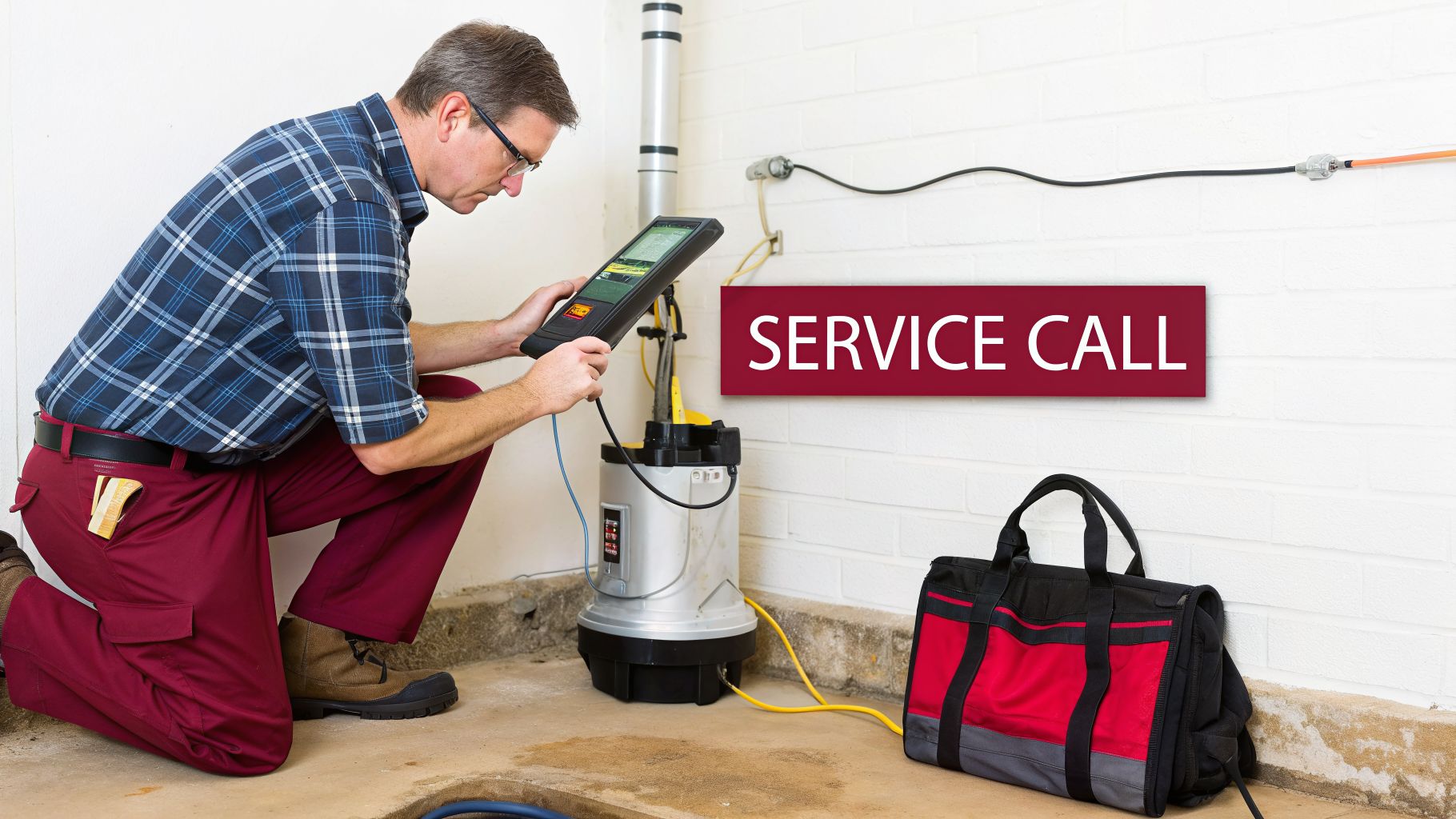
The Diagnostic Investigation
The first thing our certified technician will do isn't to grab a wrench—it's to listen. We'll start by asking you what you’ve noticed. Is the pump making a weird humming sound? Is it running all the time, or not at all? Your side of the story provides the first, and often most important, clues.
After that, we'll get to work on a thorough diagnostic inspection of the entire sump pump system. This isn't just a quick look; it's a methodical hunt for the root cause of the problem, not just the symptom it’s causing. Here’s what we check:
- A Power Supply Check: We’ll start with the basics, making sure the outlet has power and the circuit breaker is solid. You’d be surprised how often it's a simple electrical issue.
- A Float Switch Test: Your technician will manually lift the float switch to see if it moves freely and actually tells the pump to turn on like it’s supposed to.
- An Impeller and Intake Inspection: We look for any gunk, gravel, or other debris that might be clogging the intake screen or jamming the impeller. A blocked impeller can make the motor work way too hard and burn out.
- A Check Valve Examination: A faulty check valve lets water flow right back into the pit after the pump shuts off, forcing it to run again. We’ll make sure it's doing its one-way job correctly.
- A Discharge Line Inspection: We trace the discharge pipe all the way from the pump to where it leaves your house, searching for any clogs, hidden breaks, or blockages that are stopping water from getting out.
This step-by-step approach ensures we nail down the exact point of failure. It prevents a wrong guess that could lead to a repair you didn’t need or, even worse, leave the real problem lurking. The aftermath of water damage is something no one wants to deal with, and you can learn more about what that entails by reading our guide on how long water damage restoration takes.
Upfront Pricing and Clear Solutions
Once we know exactly what’s wrong, our technician will sit down with you and explain everything. No confusing technical jargon here—we’ll show you the faulty part and tell you why it failed.
Most importantly, before a single tool is used, you’ll receive a clear, upfront price for the job. You'll see the total cost for any recommended repairs or a potential replacement, with no hidden charges or last-minute additions. We want you to have all the facts so you can make the best choice for your home and budget.
With Precision Plus Plumbing, you will always know the full cost of the job before we start. This transparent pricing policy is our commitment to you, ensuring there are no surprises on your final bill.
If there are multiple ways to solve the problem, we'll lay them all out. We'll explain the pros and cons of a simple repair versus a full replacement, giving you our honest recommendation on what will be the most reliable, cost-effective solution in the long run. You're always in the driver's seat.
Efficient and Professional Repair
Once you give us the green light, our technician gets right to work on the sump pump repair or replacement. This is where calling us really pays off. Our service trucks are essentially "warehouses on wheels," stocked with an enormous inventory of high-quality pumps, parts, and all the specialty tools needed for the job.
That level of preparation is why we can complete over 90% of our repair jobs in a single visit. No more waiting around for days while a part gets ordered from a supplier. We solve the problem right then and there, getting your basement’s first line of defense back online immediately.
Our technicians treat your home with respect. We lay down drop cloths to protect your floors and make sure to clean up the entire work area when we’re finished. We're not just there to fix a pump; we're there to deliver a professional and completely stress-free experience from start to finish.
Sump Pump Repair: Your Questions Answered
Even after you’ve troubleshooted your sump pump, a few questions might still be nagging you. That’s completely normal. This is a vital piece of your home's defense against water damage, so let's walk through some of the most common questions we hear from homeowners.
How Often Should I Test My Sump Pump?
A good rule of thumb is to test your pump quarterly, or at the very least, twice a year. We always tell clients to mark their calendars for early spring before the thaw and heavy rains arrive, and again in the fall before the ground freezes.
The test itself is incredibly simple. Just pour a five-gallon bucket of water into the sump pit. You’re looking for a few things: The float switch should rise with the water, the pump should kick on without hesitation, it should drain the water quickly, and then it should shut off properly. It's the best five-minute check-up you can do to catch a problem early.
What Is the Average Lifespan of a Sump Pump?
You can generally expect a quality sump pump to last somewhere between 7 and 10 years. But that number isn't set in stone; it really comes down to a few key factors.
- Pump Quality: There's a world of difference between a cheap plastic pump and a solid, cast-iron model. The cast-iron ones dissipate heat better and are simply built to last longer.
- Frequency of Use: Is your pump running every time it rains, or only a few times a year? A pump in a high water table area is working much harder and will naturally wear out faster.
- Water Quality: If your groundwater is full of sediment, iron bacteria, or other minerals, it can be tough on the pump’s internal parts, leading to clogs and corrosion that shorten its life.
If your pump is getting close to that 10-year mark, it’s smart to start thinking about a replacement. It’s far better to replace it on your own terms than to deal with a sudden failure during a downpour.
For a homeowner, a battery backup system is less of a luxury and more of an essential insurance policy. The biggest storms are often the ones that knock out the power, rendering your main pump useless precisely when you need it most.
Should I Have a Battery Backup Sump Pump?
Yes, absolutely. For any homeowner in the Greater Philadelphia and New Jersey area, we consider a battery backup system a must-have. It’s your fail-safe, the second line of defense that protects your basement when the power goes out.
Think of it this way: your main pump runs on electricity. During a severe storm—exactly when you need your pump most—the power is most likely to fail. A battery backup is a separate, smaller pump with its own power source that automatically kicks in when the main pump can't. It buys you hours of protection and priceless peace of mind.
Can I Repair a Sump Pump Motor Myself?
We strongly advise against trying to repair a sump pump motor on your own. That motor is a sealed unit for a reason—it’s complex, and it’s not meant to be serviced by anyone but a trained technician. Trying to open it up is a serious electrical shock hazard.
If you hear humming but the pump isn't moving water, or if you notice a burning smell, the motor has a critical internal failure. Messing with it will void any warranty and, more importantly, put you at risk. This is a job that requires professional sump pump repair. A technician can safely assess the motor and tell you if it's a lost cause or if there's a safe path to repair.
Don't wait for a small pump problem to turn into a major water disaster. The expert team at Precision Plus Plumbing is ready to provide fast, reliable sump pump repair and replacement services 24/7. Get your peace of mind back by scheduling a service call with our certified technicians today. Visit us online at precisionserviceexperts.com to get started.