
Winterizing your outdoor faucets is a straightforward task: shut off the water from inside, open the spigot outside to drain the line, and throw an insulated cover on for good measure. But don't let the simplicity fool you. This quick job is one of the most critical preventative maintenance tasks you can do to protect your home from a winter catastrophe.
Why Winterizing Faucets Is Critical in Our Region
That unassuming hose bib on the side of your house can quickly become public enemy number one during a cold snap. For homeowners across New Castle County, DE, South Jersey, and nearby PA counties like Bucks, Chester, and Montgomery, a single unexpected freeze can turn a forgotten faucet into a full-blown nightmare. We’ve seen it happen countless times in cities like Wilmington, Cherry Hill, and Doylestown.
The science behind it is simple but powerful. When water freezes, its volume expands by about 9%. If that water is trapped in the pipe leading to your spigot, the expansion creates immense pressure—enough to easily split a copper pipe right inside your wall. The real trouble is, you might not even know it's broken until you turn the water back on in the spring, leading to a major indoor flood.
Real-World Consequences in Our Communities
Every winter, we get emergency calls from folks in Wilmington, DE, Cherry Hill, NJ, and Doylestown, PA, dealing with flooded basements and thousands in water damage. More often than not, the source of the chaos traces back to a single outdoor faucet that wasn't properly winterized.
Failing to winterize outdoor faucets is a primary cause of burst pipes, a problem that racks up over $5 billion in insurance claims annually in the U.S. This isn't just an item on a fall cleanup list; it’s a crucial step that can save you a massive headache and expense.
The Scope of the Problem
The risk is very real. Last winter alone, our service area saw a huge spike in burst pipe calls right after an early, unexpected freeze. It’s a stark reminder of just how vulnerable homes in Bucks, Chester, Delaware, and Montgomery Counties can be to our unpredictable weather. To fully grasp how cold can impact your home's plumbing, it's worth understanding the risks of Winterize Plumbing Pipes Damage that we see across the region.
Skipping this task is one of the most common—and easily avoidable—reasons for a winter plumbing emergency. Learning how to winterize outdoor faucets is your first and most effective line of defense against the harsh winters we get around here.
A Practical Guide to Winterizing Standard Faucets
Let's walk through how to protect your home's plumbing this winter. If you have standard, non-frost-free faucets—which are pretty common in homes all over Delaware and Chester Counties—this process is your best defense against a burst pipe.
The whole game plan comes down to one thing: getting every last drop of water out of the pipe that leads to your outdoor spigot. All it takes is one good freeze for any trapped water to expand and split that pipe. The real kicker? It often happens inside a wall, so you might not even know about the damage until you find a major leak in the spring.
Find and Turn Off the Interior Water Valve
First things first, you need to find the shut-off valve for each of your outdoor faucets. This little valve is what cuts off the water supply to that specific spigot. In most homes around Bucks County and Montgomery County, PA, you'll find it in the basement or a crawl space, usually on the pipe that runs directly through the wall to the outside faucet.
You'll likely see one of two types of valves:
- Gate Valves: These have a round, wheel-like handle. You'll want to turn it clockwise (righty-tighty) until it feels snug. Don't crank on it with all your might, though—older valves can be fragile.
- Ball Valves: These have a straight, lever-style handle. When the handle is parallel with the pipe, it's open. To close it, just give it a quarter-turn so the handle is perpendicular to the pipe.
If you have a tough time turning the handle or, worse, it starts dripping as you turn it, stop what you're doing. That’s a clear sign that the valve is failing, and it's time to call in a professional plumber.
Disconnect and Drain Your Garden Hoses
I can't stress this enough: always disconnect your garden hoses. This is, without a doubt, the number one reason faucets burst in the winter, and it can even defeat the protection of a frost-free model. A connected hose traps water inside the faucet and the pipe, leaving it with nowhere to go when it freezes.
Once you've unhooked the hose, make sure to drain it completely. Just lift one end and let gravity do the work. Then, coil it up and store it in your garage or shed. Keeping it out of the freezing weather will prevent the material from getting brittle and cracking.
We see the damage firsthand every year in places like Chester, PA, and Camden, NJ. Local insurance adjusters report that unprotected hose bibs are responsible for a significant percentage of winter water damage claims, with the average cleanup bill often exceeding $3,000.
This is exactly what happens inside a pipe when water is left to freeze.
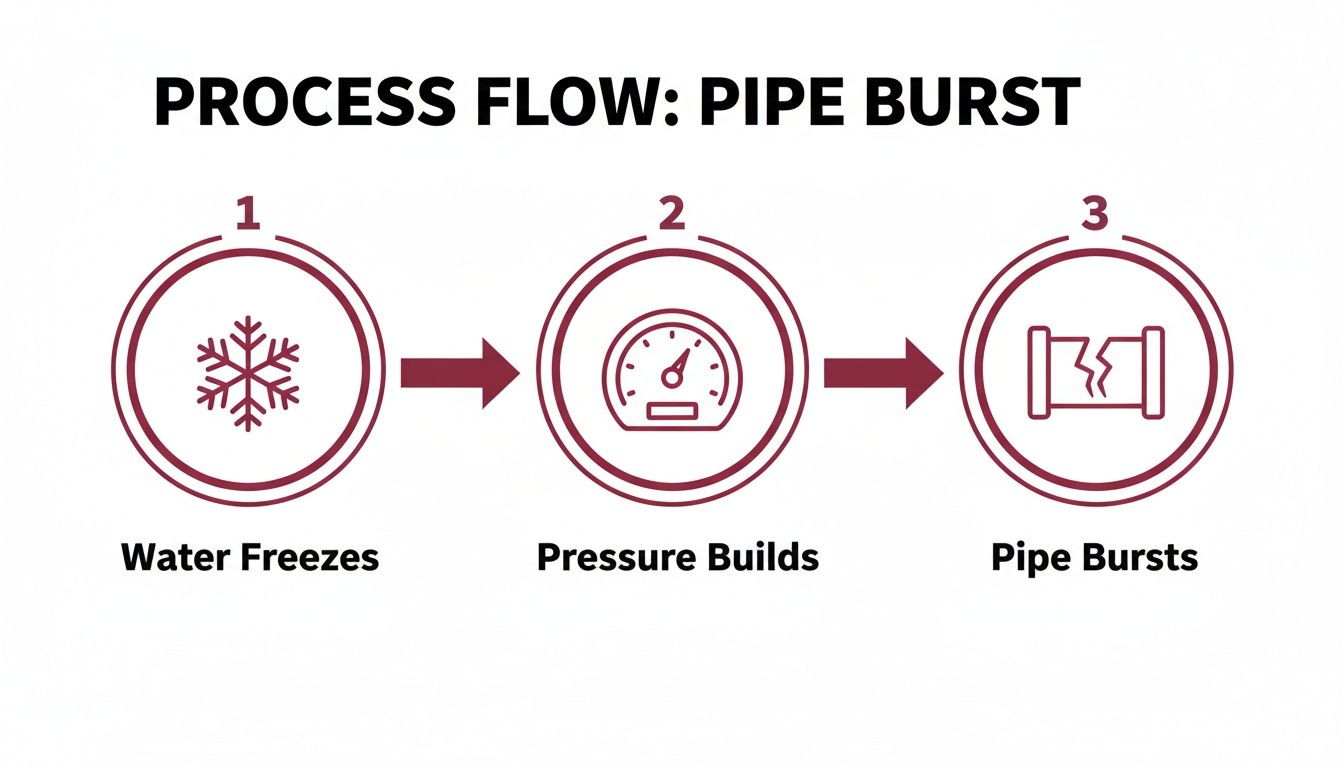
That image really shows how quickly trapped, freezing water builds enough pressure to rupture a solid copper pipe. It's a powerful force.
Open the Spigot to Drain the Line
With the interior valve shut off and the hose disconnected, head back outside and open the outdoor faucet all the way. A bit of water will trickle out—that's the water that was sitting in the pipe between the indoor valve and the spigot.
Now for the pro tip: leave that outdoor faucet in the open position all winter. This acts as a failsafe, allowing any stray drops of water to escape and ensuring no pressure can build up if a small amount of moisture somehow gets in there. Many of the same principles apply to bigger systems; for instance, if you want a deep dive into preparing complex plumbing for the cold, you could look into a guide on how to winterize an RV.
What About Frost-Free Faucets? A Word of Warning
If you have "frost-free" spigots, it's easy to feel like you can just forget about them. We see this false sense of security all the time in newer homes across Montgomery County, PA, and New Castle County, DE, and it's a myth that can lead to some seriously expensive plumbing disasters.
These faucets aren't invincible.
Frost-free faucets are certainly a clever piece of engineering. They work by using a long stem that places the actual shut-off valve deep inside the warm, insulated part of your wall. When you turn the handle off, the water in the exposed part of the pipe automatically drains out.
But there’s a critical weakness that can render this whole design useless.
The Frost-Free Faucet's Achilles' Heel
The entire system is defeated the moment you leave a garden hose attached. A connected hose traps water in the faucet’s pipe, preventing it from draining. That trapped water then freezes, expands, and splits the very pipe that was supposed to be protected.
I can't tell you how many calls we get each year from homeowners in places like Newark, DE, or Norristown, PA, with a burst frost-free spigot. And 99% of the time, the culprit is a hose that was left connected all winter.
Winterizing these faucets is incredibly simple, but it is absolutely non-negotiable.
The One-Step Winterization Process
Because of their design, you don't need to hunt for an interior shut-off valve. The faucet handles that part on its own. Your job comes down to one essential action:
- Disconnect every single hose. Just unscrew it from the spigot. That’s it.
This single, simple step allows the faucet to drain properly and do the job it was designed for.
Add Insulation for Peace of Mind
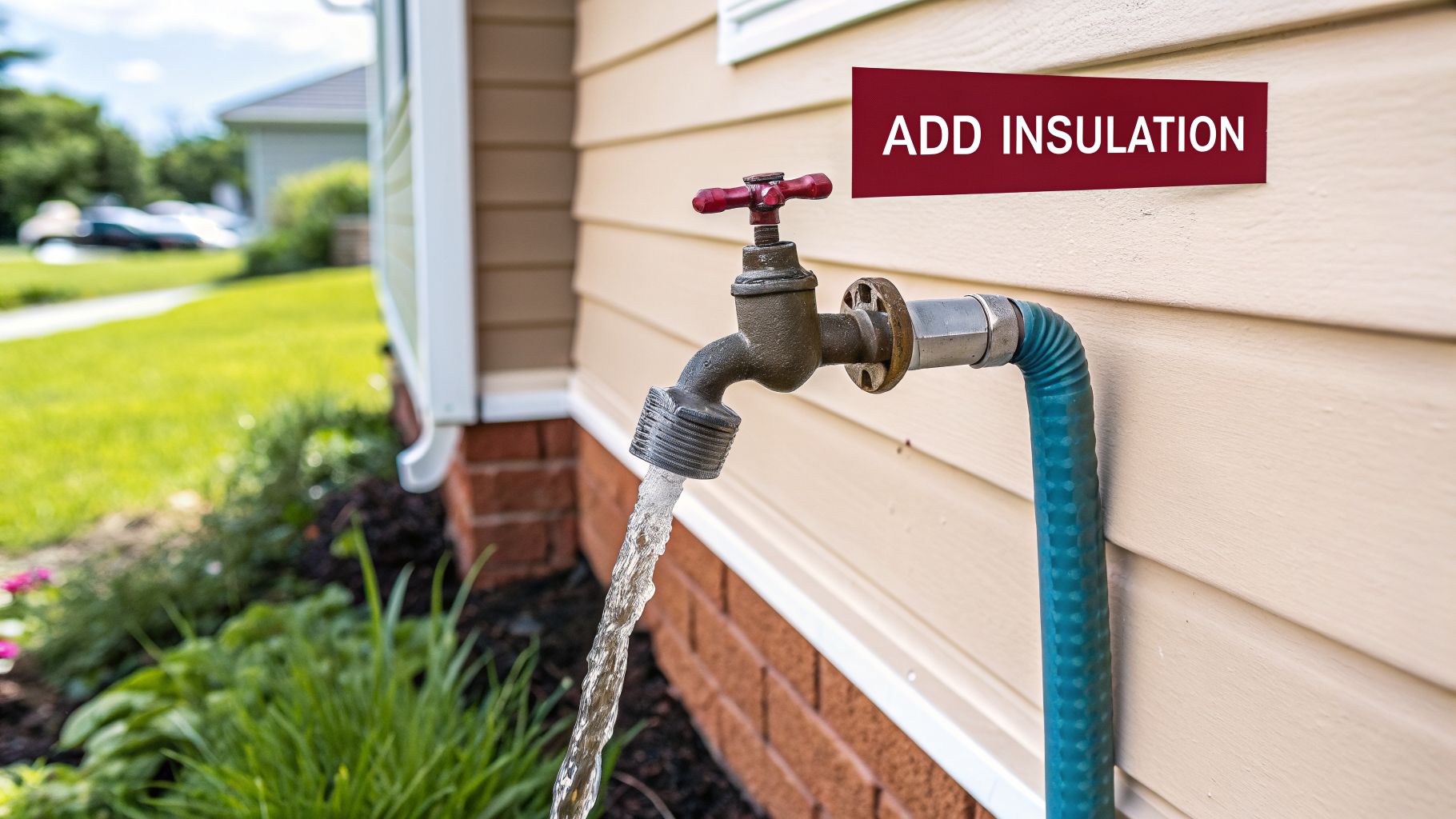
Even with a properly winterized frost-free faucet, we always recommend adding one more layer of defense: an insulated faucet cover. Think of it as a small, inexpensive winter jacket for your spigot.
For just a few dollars, an insulated cover shields your faucet from biting wind chill and deep freezes. It creates an insulating pocket of air that acts as a buffer, preventing the metal components from reaching the same dangerously low temperatures as the surrounding air.
You can find these covers at any hardware store, and they usually come in two main styles:
- Hard Foam Domes: These are rigid, bell-shaped covers made from thick styrofoam. You just hook the attached cord onto the faucet handle and pull it tight against the house.
- Flexible Insulated Bags: These are soft, padded pouches that slip right over the faucet. You simply tighten a drawstring to secure it. They’re perfect for spigots in tight corners or awkward spaces.
Whether you live in Chester County, PA, or over by the Delaware River in New Jersey, adding an insulated cover is the smartest and easiest final step for how to winterize outdoor faucets. It’s a tiny investment that delivers robust protection and total peace of mind when a sudden cold snap hits.
Timing and Tools: Your Winterization Game Plan
When it comes to winterizing your outdoor faucets, timing is what separates a quick weekend task from a costly plumbing emergency. Wait too long, and you risk a burst pipe. Act too early, and you'll just have to turn the water back on to wash the car. So, when is the right time? The secret is to watch the forecast, not the calendar.
For those of us in areas like Camden, NJ, Norristown, PA, and Newark, DE, the sweet spot usually arrives between mid-October and early November. This is when you'll notice the overnight temperatures consistently dropping into the 30s. That's your cue. Don't wait for the first hard freeze to be on the five-day forecast.
Pinpointing the Perfect Time
A little frost on the grass isn't the real threat. The danger comes from the first sustained deep freeze—several hours below 32°F—that can turn any water trapped in your pipes into a solid block of ice. That ice expands, and that's when pipes burst.
My rule of thumb? Once the 10-day forecast starts showing consistent overnight lows in the 30s, it's time to act. In our experience working in Montgomery County, for example, that often happens right around mid-October. This gives you a nice buffer before the first hard freeze, which often hits the Delaware Valley by early November.
Gathering Your Tools and Supplies
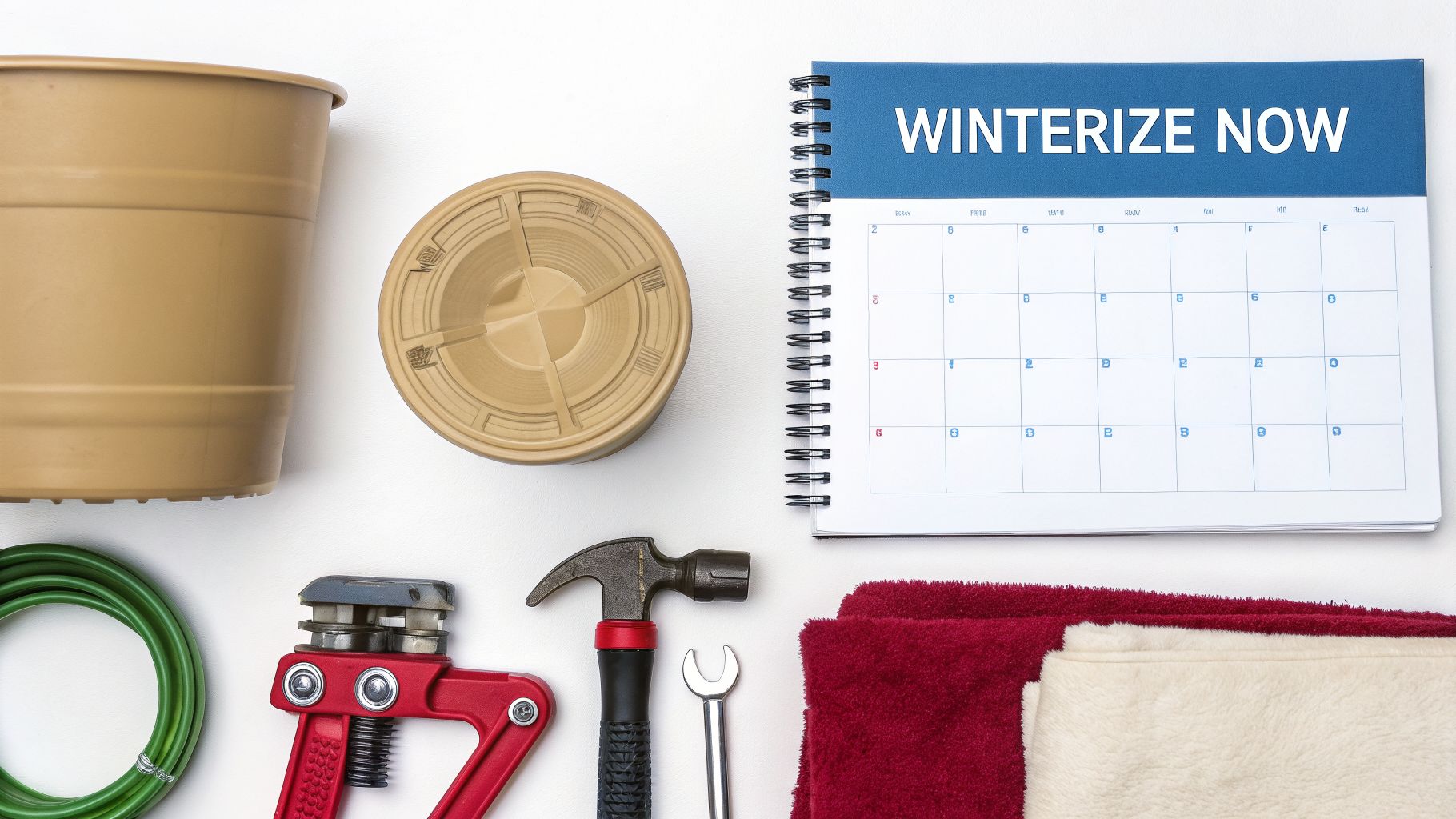
The good news is that you don't need a plumber's toolkit to get this done. You probably already have everything you need lying around the house. Taking a few minutes to gather these items beforehand makes the whole process a breeze—we're talking 15 minutes, tops.
Here’s what you'll want to have on hand:
- A Bucket: Simple, but essential for catching the water you’ll drain from the pipe.
- Old Towels or Rags: For mopping up the inevitable dribbles and wiping the faucet dry before you insulate it.
- Insulated Faucet Covers: These foam or soft-shell "mittens" are cheap and absolutely non-negotiable. They’re your final line of defense.
- A Small Flashlight: Your shut-off valve is probably hiding in a dark corner of your basement or a cramped crawl space. A flashlight is a must.
If you're staring at a wall of pipes and can't find the right valve, our guide on what a main water valve looks like can point you in the right direction. Having these few things ready to go will save you from a frantic scramble when the first real cold snap hits.
Common Problems and When to Call a Plumber
Even when you do everything right, winterizing your outdoor faucets can throw you a curveball. What looks like a simple weekend task can sometimes unearth a bigger issue that needs a professional’s eye. Honestly, knowing when to put the tools down and pick up the phone is just as crucial as knowing the steps in the first place.
Trying to force a stuck valve or ignoring a drip that just won't quit can escalate a small problem into a full-blown plumbing emergency. That’s a risk you don’t want to take, especially with a cold snap looming over New Castle County, DE, or the suburbs of Philadelphia like West Chester or Media.
When Your Interior Shut-Off Valve Misbehaves
So, you're down in your basement in Chester County, PA, you've located the shut-off, and you give it a turn. Nothing. It won't budge. Or maybe worse, you turn it, and a steady trickle of water starts weeping from the handle. Both are giant red flags telling you to stop immediately.
- A Stuck Valve: If the handle is rusted solid, do not force it. We've seen homeowners put a wrench on it for extra torque, only to snap the valve stem right off. That creates an uncontrolled water leak inside your house. This is especially common in older homes with gate valves that haven't been touched in a decade.
- A Leaking Valve: If water seeps out from around the handle's base (the packing nut) when you turn it, the internal seals have rotted away. You might be able to tighten the nut for a temporary fix, but it’s a clear warning that the valve is on its last legs and could fail completely at any moment.
For either of these issues, the only safe bet is to call a licensed plumber. We can swap out that old, faulty valve for a modern, reliable one that gives you proper control and peace of mind.
Water Keeps Dripping Outside
You've turned the inside valve as far as it will go, but the spigot outside is still dripping. Not just a few final drops, but a steady, persistent drip. This is a classic sign that your interior shut-off valve isn't creating a complete seal. A worn-out washer or corrosion inside is letting water sneak past.
Don't ever ignore a persistent drip. It means the pipe is still being fed water, and it will absolutely freeze, expand, and burst—just as if the valve were still wide open. This is one of the most deceptive problems we run into in homes from Delaware County to Bucks County, PA.
This isn't something you can fix from the outside. The problem is with the indoor valve, and it will need to be professionally repaired or replaced.
My Home Doesn't Have an Interior Shut-Off Valve
Sometimes the problem isn't that the valve is broken, but that it doesn't exist at all. If you’ve searched your basement or crawl space high and low and can't find a shut-off for each outdoor faucet, you're not alone. Many older homes were built without them, leaving your pipes completely exposed. You have no way to isolate your outdoor lines from the main water supply.
This is definitely not a DIY fix. A professional plumber needs to come in and install dedicated shut-off valves for your spigots. Think of it as an essential home-protection upgrade. It makes winterizing a breeze and is your first line of defense against a catastrophe. If a pipe does burst, that valve is the only thing that will stop a flood. To see what that looks like, check out our guide on how to fix burst pipes.
Don't wait for an emergency to find out your home is unprotected. Call an expert to get your plumbing properly equipped for winter.
Common Questions We Hear About Winterizing Faucets
As plumbers, we get a lot of the same questions every fall from homeowners all over the Greater Philadelphia area. From Wilmington, DE, all the way up to Doylestown, PA, these are the things people worry about most when it comes to their outdoor faucets.
Do I Really Need to Cover My Frost-Free Faucets?
The short answer is yes, you absolutely should. I know, the name "frost-free" is a bit misleading, but these faucets aren't invincible. We've seen them fail during the kind of brutal cold snaps and high winds that are common around here.
Think of an insulated cover as a cheap insurance policy. For just a few bucks, it creates a pocket of dead air that acts as a buffer against sub-zero wind chills. It's a tiny investment that can save you from a major headache, whether your home is in Chester County, PA, or right on the Delaware coast.
What Happens If I Forget to Disconnect My Garden Hose?
This is, without a doubt, the #1 mistake we see homeowners make, and it’s often the costliest. When you leave a hose attached, you're essentially trapping a column of water inside the faucet and the pipe. It has nowhere to go.
That trapped water is a ticking time bomb. When it freezes, it expands with incredible force—enough to crack the faucet body or, even worse, split the copper pipe running inside your heated wall. You might not even notice the damage until spring, when you turn the water on and discover a hidden leak that has been causing water damage and mold for months.
A single forgotten hose is all it takes to defeat a frost-free faucet's design. The trapped water freezes, expands, and exerts enough pressure to split copper pipes, turning a simple oversight into a potential basement flood.
I Cannot Find My Interior Shut-Off Valve. What Should I Do?
First off, don't panic—but don't put it off, either. Start by looking in the most likely spot: in your basement or crawl space, on the ceiling or wall directly behind the outdoor spigot. You're searching for a small, round wheel handle (a gate valve) or a straight lever handle (a ball valve).
If you've hunted everywhere and come up empty, your house might not have one. This isn't unheard of, especially in older homes, but it's a serious risk. In this case, your best move is to call a professional plumber right away. We can trace the water line and install a modern shut-off valve, which is a must-have safety feature for any home in our climate. It’s a pretty straightforward job for a pro and will make winterizing a breeze for you from then on.
Is It Okay to Leave the Outdoor Faucet Handle Open All Winter?
Yes! In fact, once you’ve turned off the indoor valve and drained the line, leaving the outdoor spigot open is a great final step.
This simple action ensures that any stray drops of water can drip out instead of freezing. It also prevents any pressure from building up inside the pipe over the winter. It's a little extra layer of protection that costs nothing and keeps the line completely empty and pressure-free until spring.
Protecting your home from a frozen pipe disaster is all about getting ahead of the first deep freeze. If you're dealing with a stuck valve, can't find your shut-offs, or just want the peace of mind that the job is done right, don't leave it to chance.
The team at Precision Plus Plumbing is here to help homeowners across New Castle County, DE, South Jersey, and the surrounding PA counties. Schedule your service today and rest easy knowing your home is ready for winter.