
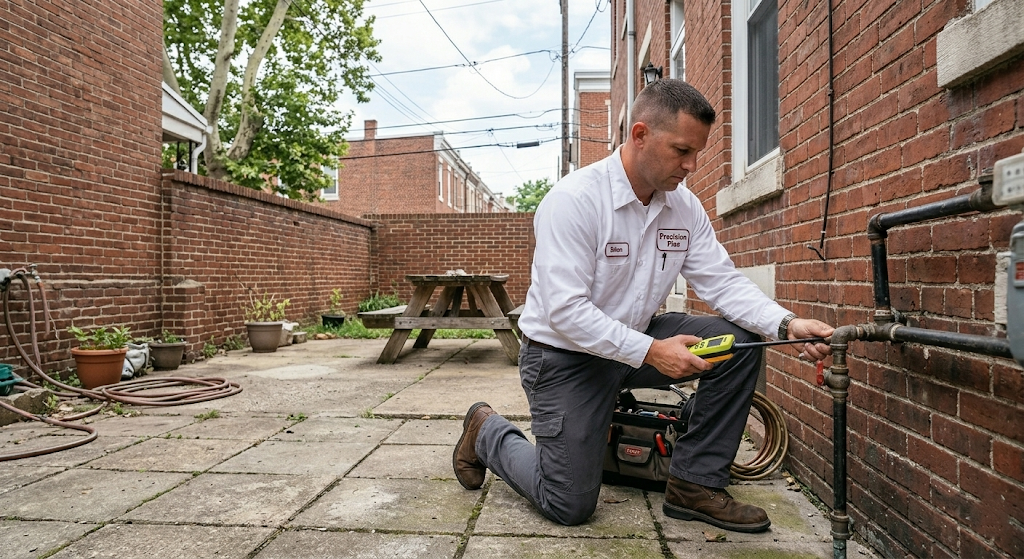
If you’re thinking about adding a fire pit to your backyard in Gloucester County NJ, outdoor gas line installation for fire pits is the critical step that makes it all possible safely, legally, and permanently. At Precision Plus Plumbing, we handle this work every day for homeowners across the county, and we want you to understand exactly what’s involved before you dig a single inch of soil.
Key Takeaways
- A licensed master plumber is legally required to install outdoor gas lines in Gloucester County NJ. This is not optional work for a handyman or general contractor.
- South Jersey Gas is the local utility serving Gloucester County. All outdoor gas line work must comply with their standards and be coordinated properly before and after installation.
- Trenching depth matters. Underground gas lines for fire pits in NJ must be buried at a minimum depth to meet code. Shallow lines are a serious safety and code violation.
- Permits are required from Gloucester County municipalities before any outdoor gas line work begins. Skipping permits creates liability and can prevent you from selling your home.
- Material selection is regulated. Not every type of pipe is approved for buried outdoor gas lines. Approved options include CSST and Schedule 40 black steel pipe with proper protection.
- Deptford and Washington Township homeowners have specific local inspection requirements that our team navigates for you every time.
- Precision Plus Plumbing shows up ready to work, not to sell. Our team handles permits, trenching coordination, South Jersey Gas compliance, and the full installation from start to finish.
Why Gloucester County Homeowners Are Adding Gas Fire Pits in 2026
The outdoor living trend has never been stronger. Homeowners in Deptford, Washington Township, Woodbury, Sewell, and throughout Gloucester County are investing in their backyards like never before, and a gas fire pit is consistently one of the top upgrades on that list.
Unlike wood-burning fire pits, a natural gas fire pit connected to your home’s gas supply turns on with the flip of a switch. No hauling logs. No lingering smoke. No waiting for embers to cool. Just clean, adjustable flame whenever you want it.
But here’s what many homeowners don’t realize until they start making calls: getting that fire pit connected to natural gas isn’t a DIY weekend project. Outdoor gas line installation for fire pits in Gloucester County NJ is a specialized trade job that requires a licensed master plumber, a permit, coordination with South Jersey Gas, and proper trenching and materials. Done right, it’s an investment that pays off in safety and years of enjoyment. Done wrong, it’s a serious hazard.
That’s exactly why homeowners across Gloucester County call us.
What Outdoor Gas Line Installation for Fire Pits in Gloucester County NJ Actually Involves
Let’s walk through the full scope of what this work entails, so you go in with clear expectations.
The job starts at your home’s existing gas supply, whether that’s your meter or a tee off an existing interior gas line. From that point, we route a new gas line through your home, out through the foundation or a penetration point, and underground across your yard to the fire pit location.
Along the way, we handle every element: sizing the line correctly for adequate BTU delivery, choosing the right pipe material, trenching to the correct depth, installing proper tracer wire so the line can be located in the future, protecting the pipe at penetration points, and connecting everything at the fire pit end with an approved shutoff valve and flexible connector.
The result is a permanent, utility-grade gas supply to your fire pit that meets all New Jersey Uniform Construction Code (UCC) requirements and South Jersey Gas standards.
Trenching and Burying: The Underground Work That Protects Your Family
The trenching phase is often the part homeowners underestimate. This isn’t just digging a ditch. It’s precision work that determines whether your gas line is safe for decades or becomes a problem the first time someone drives a landscape spike into the wrong spot.
In New Jersey, underground gas lines serving outdoor appliances like fire pits must be buried at a minimum depth established by state code and South Jersey Gas specifications. Generally, this means at least 18 inches of cover in most residential yard applications, with deeper requirements in areas subject to vehicle traffic or heavy equipment. We always verify the specific depth requirement for your property and installation type.
We also require a utility locate (call 811) before any trench is opened. This is both a legal requirement and a safety step that identifies buried electric, water, sewer, and telecommunications lines. In established neighborhoods like those throughout Deptford and Washington Township, where homes have accumulated decades of underground infrastructure, this step is non-negotiable.
Inside the trench, we bed the pipe properly, install tracer wire above the line, backfill in appropriate lifts, and compact to minimize settling. The surface is restored as closely as possible to its original condition.
Materials Approved for Outdoor Gas Line Installation in Gloucester County NJ
Not every gas pipe you see in a hardware store is approved for buried outdoor use. The material requirements for underground residential gas lines are specific, and using the wrong product is a code violation that will fail inspection.
For outdoor gas line installation for fire pits in Gloucester County NJ, the most commonly used approved materials include:
- CSST (Corrugated Stainless Steel Tubing) with appropriate jacket: Flexible, fast to install, and well-suited for routing through tight spaces. Must be properly bonded per New Jersey code and manufacturer requirements.
- Schedule 40 black steel pipe with protective coating or sleeve: The traditional choice for buried gas lines. Requires wrapping or sleeving to resist corrosion in soil.
- Polyethylene (PE) pipe: Used by South Jersey Gas for their distribution mains and sometimes applicable for certain exterior residential runs depending on configuration and local approval.
We select the right material for your specific installation based on the route, soil conditions, length of run, and BTU requirements for your fire pit. There’s no one-size-fits-all answer here.
South Jersey Gas Compliance and the Utility Coordination Process
South Jersey Gas serves the majority of natural gas customers throughout Gloucester County, including homeowners in Deptford, Washington Township, Glassboro, Mantua, and Monroe Township. Any time you add a new gas appliance or extend your gas supply, South Jersey Gas has a stake in that work.
Here’s what that means practically for your fire pit project:
- Your existing gas meter and service line must have adequate capacity to support the added load. We perform a load calculation to verify this before starting any work.
- If your current service is undersized, South Jersey Gas may need to upgrade your meter or service connection. We communicate with the utility on your behalf to identify whether this applies to your situation.
- After installation, South Jersey Gas may need to be notified of the new appliance or connection depending on the scope of work. We handle this coordination for you.
- All work must meet South Jersey Gas published requirements for customer-owned piping in addition to New Jersey state code.
Working with South Jersey Gas isn’t adversarial. It’s part of the process, and our team has done it hundreds of times. We know what they look for, how to communicate with them efficiently, and how to keep your project moving without unnecessary delays.
Permits for Outdoor Gas Line Installation for Fire Pits in Gloucester County NJ
This is where homeowners sometimes push back: “Do I really need a permit just for a fire pit?” The answer is yes, absolutely, and here’s why it matters to you personally.
In Gloucester County, gas line work requires a mechanical or plumbing permit from your local municipality’s construction department. In Deptford Township, Washington Township, and virtually every other municipality in the county, this is enforced. The permit triggers an inspection by a licensed construction official who verifies that the work meets code before the gas is turned on.
Skipping the permit creates real problems:
- If there’s a gas leak, fire, or explosion, your homeowner’s insurance may deny the claim because unpermitted work was involved.
- When you sell your home, unpermitted gas work can surface in a buyer’s inspection and derail your closing.
- You could be required to dig up and redo the entire installation at your own expense.
We pull the permit for you as part of our process. You don’t have to figure out the local construction department, fill out forms, or schedule the inspection yourself. We manage it all.
Why Only a Licensed Master Plumber Should Handle This Work
In New Jersey, gas line installation is licensed work. Only a licensed master plumber or a plumber working under a master plumber’s license can legally install, modify, or extend gas piping in a residential setting. This isn’t a formality. It exists because gas work, done wrong, kills people.
A master plumber has passed rigorous state examinations covering gas system design, pressure testing, code compliance, and safety. Derrick Jackson of Precision Plus Plumbing passed the master plumber exam in the late 1990s, making him one of the youngest individuals to ever earn that credential. In 2026, with over 25 years of field experience, he and the Precision Plus team bring that same level of expertise to every outdoor gas line installation for fire pits in Gloucester County NJ.
When you hire us, you’re not getting a crew who figured this out on YouTube. You’re getting licensed professionals who do this work every week, who know South Jersey Gas requirements by heart, and who stand behind every installation with their license on the line.
Serving Deptford, Washington Township, and All of Gloucester County
Gloucester County is home to some of the fastest-growing residential communities in South Jersey. Deptford Township, with its mix of established neighborhoods and newer developments, and Washington Township, one of the largest municipalities in the county by population, represent two of our most active service areas for outdoor gas line work.
Homeowners in these communities are investing heavily in outdoor living spaces, and fire pits are a centerpiece of that investment. We’ve run gas lines across all types of Gloucester County properties: small suburban lots where routing requires creativity, larger rural properties where the trench run is longer, and everything in between.
We’re also fully familiar with the local construction departments and inspection processes specific to Gloucester County municipalities. That familiarity speeds up your project and prevents the delays that come from working with a contractor who doesn’t know the local landscape.
You can learn more about how we serve this area on our Gloucester County NJ service area page.
The Precision Plus Plumbing Process for Fire Pit Gas Line Installation
We keep things simple because you shouldn’t have to manage the complexity. Here’s what working with us looks like from start to finish:
- Initial assessment: We visit your property, evaluate the route from your gas supply to the fire pit location, assess your existing service capacity, and give you a clear scope of work and price.
- Permit application: We apply for the required permit from your local Gloucester County municipality. We handle the paperwork.
- Utility locate: We call 811 and wait for all underground utilities to be marked before any digging begins.
- Trenching and installation: Our team opens the trench, installs the properly sized gas line with all required materials, tracer wire, and protective measures, then backfills and restores the surface.
- Pressure testing and inspection: We pressure test the line before covering it and coordinate the required municipal inspection. South Jersey Gas is notified as required.
- Final connection and commissioning: We connect your fire pit with an approved flexible connector and shutoff valve, verify proper operation, and walk you through everything you need to know.
No salesmen. No upselling. Just skilled tradespeople who show up, do the work right, and leave your property cleaner than they found it.
If you’re ready to get started or just want to understand your options, visit our gas line services page for more detail on what we offer. You can also explore everything we do for backyard projects on our outdoor living services page.
A concise, 5-step guide to installing outdoor gas lines for fire pits in Gloucester County, NJ. Ensures safety, code compliance, and reliable heat for your outdoor space.
What to Expect After Your Gas Line Is Installed
Once the installation is complete and inspected, your fire pit becomes a permanent, reliable feature of your outdoor living space. Unlike propane setups that require tank refills and have limited burn time, a natural gas fire pit connected to your South Jersey Gas supply runs as long as you want it to, at whatever flame height you set.
There is virtually no maintenance required on the gas line itself under normal circumstances. We install everything with longevity in mind: corrosion-resistant materials, proper depth, and quality fittings that won’t fail under normal service conditions.
If you ever sell your home, a properly permitted gas fire pit with a documented installation is a genuine selling feature. Buyers in Deptford, Washington Township, and throughout Gloucester County recognize the value of a move-in-ready outdoor space.
Conclusion
Outdoor gas line installation for fire pits in Gloucester County NJ is not a project to hand off to whoever gives you the lowest number. It’s skilled trade work that requires a licensed master plumber, proper permits, South Jersey Gas coordination, correct materials, and precise trenching. Done right, it transforms your backyard and adds lasting value to your home. Done wrong, it creates safety risks, insurance problems, and expensive do-overs.
Precision Plus Plumbing has been doing this work the right way for over 25 years. We serve homeowners throughout Gloucester County, including Deptford and Washington Township, and we bring the same master-level expertise to every job regardless of size. Contact us today to schedule your assessment and take the first step toward the backyard fire pit you’ve been planning.
Visit our Precision Plus Plumbing homepage to learn more about who we are and how we work.
Frequently Asked Questions
How deep does a gas line need to be buried for an outdoor fire pit in New Jersey?
In New Jersey, underground gas lines for residential outdoor appliances like fire pits are generally required to be buried a minimum of 18 inches deep in standard yard conditions. Areas subject to vehicle traffic require greater depth. Your licensed master plumber will verify the exact requirement for your specific installation and local municipality in Gloucester County.
Do I need a permit for outdoor gas line installation for a fire pit in Gloucester County NJ?
Yes. Any gas line installation in Gloucester County NJ requires a permit from your local municipal construction department, whether you’re in Deptford, Washington Township, or another area. The permit triggers a required inspection that confirms the work meets New Jersey Uniform Construction Code standards. Precision Plus Plumbing pulls the permit for you as part of the job.
Can I install my own outdoor gas line for a fire pit in NJ?
No. New Jersey law requires that gas line installation be performed by a licensed master plumber or under a master plumber’s direct supervision. This is a legal requirement, not just a recommendation. Unpermitted, unlicensed gas work also voids homeowner’s insurance coverage and creates serious liability.
How do I know if my existing gas service from South Jersey Gas can handle a fire pit?
A licensed master plumber performs a load calculation that accounts for all existing gas appliances in your home plus the BTU demand of the fire pit you’ve selected. If your current meter or service line is undersized, South Jersey Gas can upgrade it. Precision Plus Plumbing handles this assessment and any necessary coordination with the utility.
How long does outdoor gas line installation for a fire pit typically take in Gloucester County?
The installation itself typically takes one day once permits are in hand and utilities are located. The total timeline from initial assessment to final inspection generally runs two to three weeks in Gloucester County, depending on permit processing times at your local municipality. We keep you informed throughout the process.
What kind of pipe is used for buried outdoor gas lines going to a fire pit?
Approved materials for outdoor gas line installation for fire pits in Gloucester County NJ include properly jacketed CSST, Schedule 40 black steel pipe with corrosion protection, and in some configurations, polyethylene pipe. The right choice depends on your specific installation, trench route, and local code requirements. We select the appropriate material for your project during the initial assessment.
Is outdoor gas line installation for a fire pit worth it compared to propane in South Jersey?
For most Gloucester County homeowners who plan to use their fire pit regularly, natural gas is worth the upfront installation cost. Natural gas from South Jersey Gas is typically less expensive per BTU than propane, you never run out mid-use, and there are no tanks to refill or store. The permanent connection also adds value to your property in a way a propane setup does not.
About the Expert: Derrick Jackson, Master Plumber
Derrick Jackson is one of the youngest individuals to ever pass the rigorous Master Plumber exam, achieving this milestone in the late 1990s. Today, he proudly leads the team at Precision Plus Plumbing, a trusted name in gas leak detection and repair across Philadelphia, PA, surrounding Pennsylvania counties, New Castle County Delaware, and New Jersey. With over 25 years of hands-on experience, Derrick and his team work directly with major gas utilities including PGW, PECO, PSE&G, South Jersey Gas, and Delmarva to help families get their gas safely restored. Unlike other companies, Precision Plus shows up ready to work, no salesmen, just experts.