
That moment you discover water—pooling on the floor, dripping from the ceiling—is pure panic. Whether it's a burst pipe in your Chester County home or a failed water heater in your Wilmington, DE basement, what you do in the next few hours is absolutely crucial. It will set the stage for your entire insurance claim.
When you're staring at a growing puddle, your first thought might not be about paperwork, but your insurance company is watching. They expect you to act quickly to stop the problem from getting worse.
Your Immediate Response to Water Damage
The shock can be overwhelming, but you need to push past it and take control. Think of it as triage for your home. Your fast, smart response can make a huge difference in how much damage you end up with and, just as importantly, how smoothly your insurance claim goes.
Stop the Bleeding: Mitigate Damage Now
Every homeowner's policy has a clause that's some version of a "duty to mitigate." In plain English, it means you have to take reasonable steps to prevent more damage. Failing to do this is one of the fastest ways to get a claim denied.
Here’s what that looks like in the real world:
- Find the Main Water Shut-Off: Before you even grab a mop, kill the water supply to your house. If you know the leak is from a specific toilet or sink, you can use its local shut-off valve, but the main valve is your failsafe.
- Cut the Power: Water and electricity are a deadly combination. If there’s standing water anywhere near outlets, appliances, or your breaker box, shut off the electricity to that area immediately. Don't step in the water until you're certain the power is off.
- Get Water Out: If it's safe, start removing the water. Use a shop vac, mops, buckets—whatever you have. Pull soaked rugs and move furniture and other belongings to a dry spot.
From your insurer's point of view, they need to see you did everything you could to stop the bleeding. Taking these steps proves the damage was from a "sudden and accidental" event, which is the magic phrase for most covered water claims.
Make Two Critical Phone Calls
Once you’ve contained the immediate emergency, it’s time to call for backup. You have two calls to make, and you should make them almost simultaneously.
First, call your insurance agent to get the claim process started. The second call should be to a 24/7 water damage restoration professional, like us at Precision Plus. A certified team can be there in a flash—often within the hour—to begin professional water extraction and start the drying process. In cases of significant damage, knowing the basics of water damaged floor repair can help you understand what the pros will be doing.
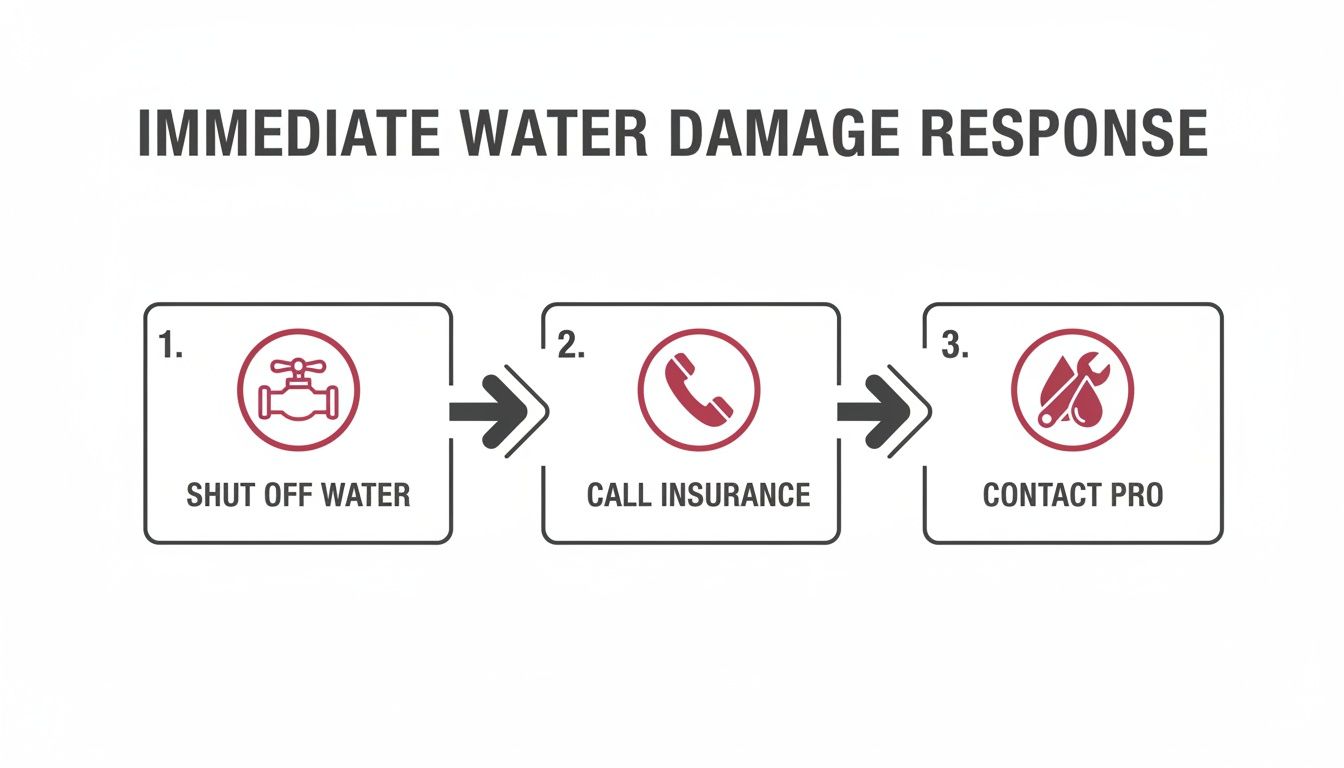
This isn’t just a suggestion; it’s your game plan for a successful claim.
Water damage is unfortunately common and incredibly expensive. Throughout our service area, from Cherry Hill to Wilmington, these incidents are a top source of homeowners insurance claims. That's why insurers have strict rules. Most policies demand you report the damage within 24-48 hours. Don't wait. For a deeper dive into what to do right after a flood, check out our guide on the first steps to take after water damage occurs.
How to Document Your Water Damage Claim
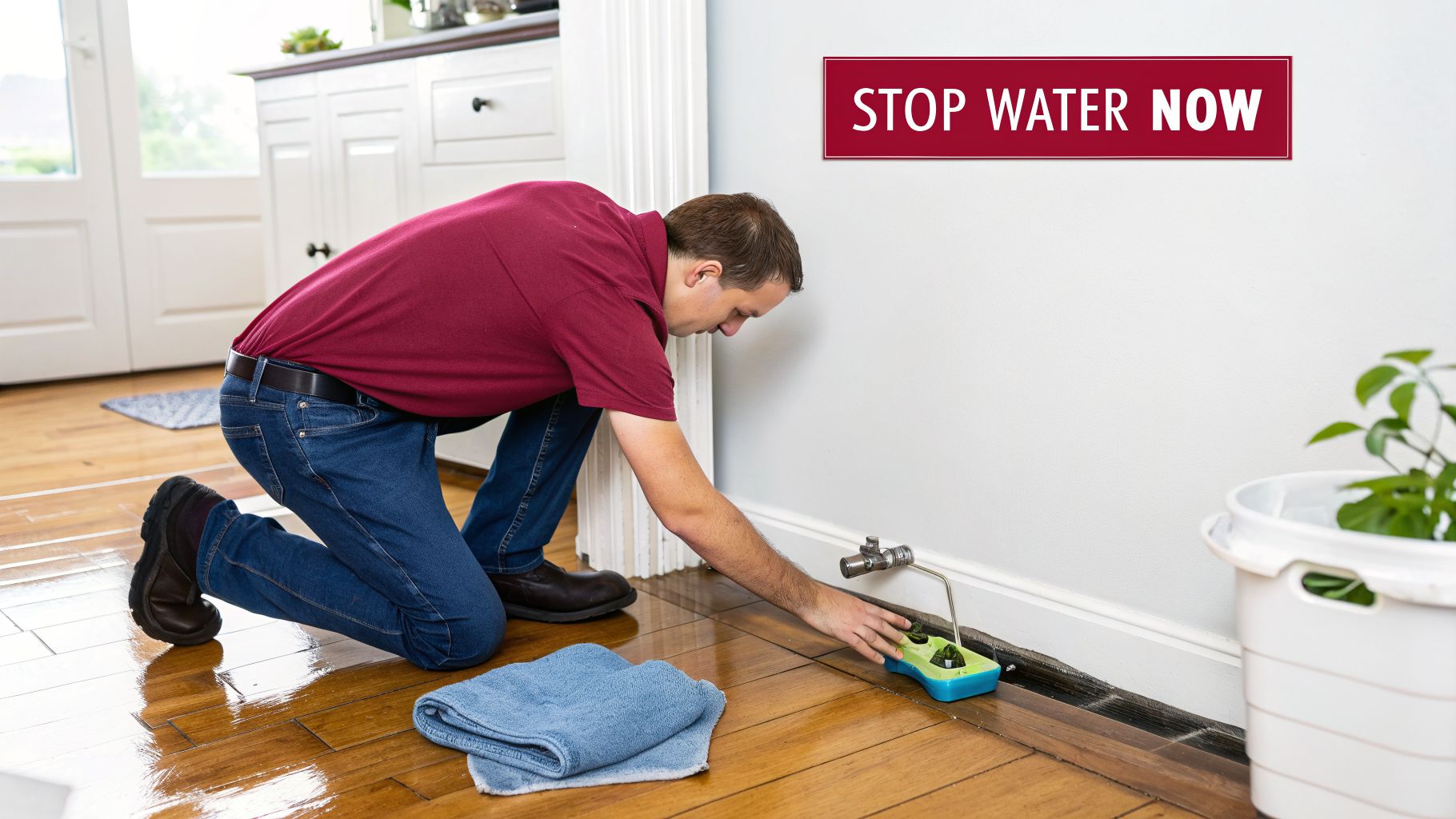
Alright, the immediate crisis is over. The water is off, and you've taken a deep breath. Now comes the single most important part of this whole ordeal: gathering proof. I've seen it time and again—the number one reason claims get delayed, underpaid, or even denied is weak documentation. The evidence you collect now is the bedrock of your claim and your best leverage for getting a fair settlement.
Think of yourself as a crime scene investigator. Your job is to build a rock-solid case that shows exactly what happened and what was lost. This isn't just about snapping a few pictures. It's about telling a complete story that leaves no doubt in the adjuster's mind.
Build Your Visual Case
Photos and videos are your star witnesses. An adjuster showing up at your Doylestown home a few days from now won't see the initial flood; they’ll just see the aftermath. Your visual record is the only thing that proves the true extent of the damage from the very beginning. Be strategic.
First, get the big picture. Stand in the doorway of every affected room and take wide shots from each corner. This shows the overall scope. For instance, if a toilet overflowed in your upstairs bathroom in a Montgomery County colonial, you need photos showing how the water traveled down the hall, seeped through the ceiling, and pooled in the living room below.
After you've captured the scene, move in for the details. Take close-ups of the source, if you know it—that burst washing machine hose or the rusted-out pipe under the sink. Get right up close to the warped baseboards, the bubbling paint on the drywall, the soaked carpets, and every piece of furniture that got wet. A great trick is to place a ruler or tape measure in some photos to show the high-water marks on the walls.
Pro Tip: Don't forget to shoot video. Walk through the damaged areas with your smartphone and talk through what you're seeing. State the date and time, describe any smells (like mildew or must), and zoom in on specific damage as you explain it. A narrated video creates a powerful, real-time account that's tough for an insurer to argue with.
Document Every Single Item You Lost
Next up is the tedious but crucial task of listing every single thing that was damaged or destroyed. This is how you put a dollar value on your loss. Your insurance company won’t just write a blank check; you have to justify every penny.
Go room by room, making an exhaustive list. For a flooded basement in Newark, Delaware, your inventory might look something like this:
- Structural Damage: Saturated drywall, ruined insulation, waterlogged carpet and padding, warped paneling.
- Personal Belongings: Boxes of holiday decorations, stored winter clothing, a cherished vinyl record collection, power tools.
- Major Appliances: The furnace, water heater, washer, and dryer.
Getting this inventory right is absolutely critical. It’s what helps an insurer separate a "sudden and accidental" event (which is usually covered) from a problem they might argue was due to a lack of maintenance. Your detailed list, backed by photos, makes that distinction clear. You can find more expert advice on why properly documenting your claim is crucial on Crestviewpa.com.
To make sure you don't miss anything, a checklist can be your best friend. It guides you through the process so you can present a complete and organized case to your insurer.
Essential Documentation Checklist for Water Damage Claims
| Documentation Type | What to Capture | Why It's Important |
|---|---|---|
| Photos (Wide Shots) | Entire rooms from multiple angles. | Establishes the overall scale and scope of the damage. |
| Photos (Close-Ups) | Individual damaged items, water lines on walls (with a ruler), the source of the leak. | Provides specific, undeniable proof of what was lost and how high the water reached. |
| Video Walk-Through | A narrated tour of all affected areas, including basements and crawl spaces. | Creates a dynamic, time-stamped record and captures details that still photos might miss. |
| Written Inventory | A detailed, room-by-room list of all damaged items, including model/serial numbers. | Translates visual evidence into a comprehensive list of losses for valuation. |
| Proof of Ownership | Original receipts, credit card statements, manuals, or photos of items before the damage. | Proves you owned the items you are claiming and helps establish their value. |
| Expense Receipts | Invoices for emergency plumbers, mitigation supplies (fans, tarps), and temporary living costs. | Ensures you get reimbursed for all out-of-pocket costs related to the incident. |
| Communications Log | Dates, times, names, and notes from every call and email with your insurer. | Creates an official timeline and holds all parties accountable for what was said and promised. |
Following this checklist helps ensure nothing falls through the cracks, making your claim stronger and the process smoother.
Keep a Running Tally of Your Expenses
Remember, your "loss" isn't limited to the property that was ruined. It also includes every dollar you spend because of the incident. Start a dedicated folder (physical or on your computer) and save every single receipt. This is non-negotiable if you want to be reimbursed.
Be sure to track costs for things like:
- Emergency Services: The invoice from the 24/7 plumber you called at 2 a.m. to stop the gushing pipe.
- Mitigation Gear: Receipts for the shop vac, fans, or dehumidifiers you bought in a panic.
- Additional Living Expenses (ALE): If your home is unlivable, keep all hotel bills and even receipts for meals.
Many homeowners in Chester and Delaware Counties live in beautiful older homes where tracing a leak can be a real challenge. In these cases, our guide on professional leak detection in the Philadelphia area can be a lifesaver, and that professional service is often a cost you can include in your claim. Just as important, keep a log of every conversation with your insurance agent and adjuster—note the date, time, and what was discussed. This simple logbook can be invaluable if disputes arise later.
Working with Adjusters and Restoration Experts
Once your claim is filed, your phone will start ringing. You’re about to get familiar with two key people: the insurance adjuster and the restoration expert. It's crucial to understand that they have very different jobs, and knowing how to work with both will make or break your claim.
The insurance adjuster is on the insurance company's payroll. Their job is to evaluate the damage, figure out what caused it, and then determine how much the insurer owes you based on your policy. A restoration expert, on the other hand, works for you. At Precision Plus, our mission is to get your home back to the way it was, fighting for the full scope of work needed to make that happen.
The Adjuster's On-Site Visit
The adjuster's visit is your first big test. This is their chance to gather the facts that will shape their settlement offer. You absolutely need to be there for it.
Walk them through your home and point out every single thing you documented. You’ll see them pull out some tools of the trade:
- Moisture Meters: They'll stick these into your drywall, floors, and wood trim. The probes give a precise reading of how much water is trapped inside, helping them map out the extent of the damage.
- Thermal Imaging Cameras: These cameras are fantastic for spotting what the eye can’t see. Wet spots show up as cooler areas, revealing hidden water pockets behind walls or under floors.
When the adjuster shows up, whether you're in Norristown, PA, or over in Cherry Hill, NJ, have your documentation organized and ready to go. Handing them a neat folder with your photos, videos, and inventory list sends a clear message: you’re serious and organized. It gives them the evidence they need to justify approving your claim.
Here's a crucial piece of advice from my experience: The adjuster works for the insurance company. They're professionals, but their first report might only cover the most obvious, surface-level damage. They aren't necessarily looking for problems that might pop up later, like hidden mold from moisture they missed.
Having a Professional Advocate on Your Side
This is exactly why having a professional restoration company in your corner is a game-changer. We do a lot more than just run fans and dehumidifiers; we become your expert advocate. I've seen it a hundred times with homeowners from Wilmington, DE, to Bucks County, PA—they're stressed out, and a lowball offer from the insurance company feels like the end of the road.
It’s not.
Our job is to make sure the "scope of work" is complete and accurate. As the adjuster is building their report, we're building our own, using the same professional-grade moisture meters and thermal cameras. Our report outlines every single step required to restore your home, especially the details that insurers often try to dispute. To see what a full-scale restoration looks like, check out our guide to water damage restoration services.
Having our own parallel documentation is your most powerful tool. When the adjuster’s estimate comes in low, we don't just complain—we counter it with our own report backed by hard data.
For example, here's where we often go to bat for homeowners:
- Hidden Moisture: An adjuster might approve replacing the bottom two feet of drywall because it feels damp. Our thermal camera might show moisture has wicked up another two feet inside the wall. If you don't remove it all, you're getting mold.
- Mold Remediation: Mold can take root in just 24-48 hours. If a claim gets delayed, a water problem quickly becomes a much bigger mold problem. We make sure the potential need for testing and remediation is addressed from day one.
- Matching Materials: Your kitchen has beautiful custom cabinets, but the lower ones are ruined. The adjuster offers to only replace the damaged ones, creating a mismatched mess. We argue that to restore the home to its "pre-loss condition"—as most policies require—the entire set must be replaced.
We speak the same technical language as the adjuster and submit our findings directly to the insurance company on your behalf. This takes the fight off your shoulders and puts an expert in your corner, ensuring the final settlement is enough to cover the true cost of getting your home back to normal.
Understanding Your Policy to Maximize Your Payout

After you've filed a water damage claim, your homeowners policy suddenly becomes the most important document you own. Let's be honest, it’s a dense read, packed with legal jargon that can make your eyes glaze over. But you have to push through it. Taking the time to understand what's inside is the only way you can effectively advocate for the full and fair settlement you're entitled to.
Your entire claim really boils down to two words: sudden and accidental. This is the specific language insurers use to define a covered event. Think of it as something that happens out of the blue, not as a result of neglect. A pipe that freezes and bursts in your Chester County home during a cold snap? That’s a textbook example of sudden and accidental damage.
What they won't cover is damage that happens slowly over time. That's considered a maintenance problem. For instance, a small, dripping leak under your sink that you’ve noticed for months finally causes the cabinet floor to rot. An insurer will almost certainly deny that claim, arguing that the damage could have been prevented with basic upkeep.
Decoding Your Coverage Types
To know what to ask for, you first need to know what you’re paying for. Your standard policy likely has three main buckets of coverage that become critical after a water disaster. Getting a handle on these is essential as you prepare to file your claim.
Here’s what these coverages typically mean for a homeowner in our local area:
Dwelling Coverage (Coverage A): This is for the structure of your house itself. It pays for repairs to things like drywall, flooring, built-in cabinets, and anything else permanently attached to the home.
Personal Property Coverage (Coverage C): This part of your policy covers your stuff—the things you’d pack in a moving truck. We’re talking about furniture, electronics, clothing, and all your other belongings that were damaged or destroyed.
Additional Living Expenses (ALE) (Coverage D): If the water damage is bad enough that your home is unlivable during repairs, ALE steps in. It covers the cost of staying in a hotel or a short-term rental, plus other related expenses that go above and beyond your normal monthly bills.
Let’s put this into a real-world scenario. Imagine the supply hose on your washing machine gives out in the second-floor laundry of your Doylestown, PA, home. Your Dwelling Coverage would pay to replace the saturated subfloor and repair the water-stained ceiling in the kitchen below. Personal Property Coverage would handle the cost of the ruined antique area rug in the living room. And if the repairs force you to move out for two weeks, ALE would cover your hotel bill.
The average insurance payout for water damage can be substantial, but don't get too attached to a single figure. Payouts can range from a few thousand dollars for a minor leak to tens of thousands for major damage. Your final check depends entirely on the scale of the damage and the specific limits outlined in your policy.
Reviewing Your Settlement Offer
At some point, the insurance adjuster will present you with a settlement offer. This document details exactly what the insurance company proposes to pay for. Whatever you do, don't just sign off on it without a close look.
Scrutinize every line item. Did they undervalue anything? Did they miss something completely? For example, maybe they budgeted to replace only the lower kitchen cabinets, but the water damage makes it impossible to find a match for the uppers. Or did they account for the specialized contractor you’ll need to repair the historic plaster in your old Delaware County home? These details matter.
This is the moment your thorough documentation becomes your greatest asset. If the offer seems low, you need to dispute it formally. Draft a clear, professional letter or email that references their offer and lays out your evidence—your photos, your detailed inventory list, and competing estimates from your own contractors. Point to the specific line items you believe are wrong and state the amount you think is fair. Learning to advocate for yourself is the most critical part of filing a water damage claim and getting the outcome you deserve.
What to Do If Your Claim Is Denied or Disputed
Getting that denial letter from your insurance company can feel like a punch to the gut. You’ve already dealt with the stress of the water damage itself, and now a denial—or a settlement offer that’s shockingly low—just adds a serious financial sting. But this isn't the end of the road. It’s time to push back, and to do it smartly.
An insurer’s initial “no” is often just their opening move in a negotiation. It's not the final word. I’ve seen countless homeowners in our area, from Wilmington, DE, to Doylestown, PA, successfully contest these decisions. The secret is figuring out why they denied the claim and then building a rock-solid case with hard evidence.
Understand the Reason for the Denial
Think of that denial letter as your game plan. It’s not just bad news; it’s required to state the specific reason for their decision, which almost always points back to some fine print in your policy.
You’ll usually see one of a few common reasons:
- Gradual Damage: They're arguing the problem was a slow, long-term leak or a maintenance issue you should have fixed, not something “sudden and accidental.”
- Inadequate Documentation: The insurer claims you didn’t provide enough proof of the damage, its cause, or the value of your lost items.
- Late Notification: They believe you waited too long to report the incident, which violates the "duty to mitigate" clause in your policy.
- Coverage Exclusions: The specific cause of the water, like a sump pump failure or groundwater flooding, is explicitly excluded from your policy coverage.
Once you know their argument, you can start crafting your counter-argument. This is where all that documentation you gathered on day one becomes your most powerful tool. Those time-stamped photos and the video you narrated are your best proof that the damage was, in fact, sudden and unexpected.
Don't let the legal jargon intimidate you. An initial denial is a business decision, not a personal attack. Your job now is to calmly and methodically take apart their reasoning with the facts you’ve collected.
Launch Your Formal Appeal
Responding to a denial needs to be formal and, most importantly, in writing. A frustrated phone call won’t accomplish anything and leaves no record. You need to create a new paper trail showing you’re officially disputing their decision.
It’s time to draft a professional "letter of appeal." Start by clearly stating that you are appealing the decision on Claim #[Your Claim Number]. Then, go point-by-point through their reasons for denial and present your counter-evidence. For instance, if they cited “gradual damage,” you should refer them directly to your plumber’s invoice that clearly states “emergency burst pipe repair” and includes the date and time.
Your appeal letter is your chance to tell your side of the story, backed by proof. Structure it logically:
- Start with the basics: your name, policy number, claim number, and the date of the loss. Make it clear this is a formal appeal of their decision.
- Directly quote the reason they gave you for the denial, pulling the exact wording from their letter.
- Next, present your counter-argument. This is the core of your letter. Refer to the specific photos, videos, repair invoices, and professional reports you’ve already sent or are including with the letter.
- State what you believe is a fair resolution. This should be a specific dollar amount based on the contractor estimates you've secured.
- Finally, request a re-evaluation of your claim and a written response within a reasonable timeframe, like 30 days.
Send this letter via certified mail with a return receipt requested. This gives you undeniable proof that they received it. This formal step often gets the claim file off the first adjuster’s desk and onto a supervisor's for a fresh look.
When to Bring in Reinforcements
What if your appeal is also denied, or the insurance company simply refuses to negotiate fairly? Don’t give up. It’s just time to escalate and bring in some professional help.
Hiring a public adjuster is a powerful next move. A public adjuster is a state-licensed insurance pro who works for you, not the insurance company. They're experts in deciphering policy language and negotiating claims. They will perform their own detailed damage assessment, take over all communications with the insurer, and fight to get you the maximum possible payout. In return, they take a percentage of the final settlement.
Bringing in a public adjuster levels the playing field, giving you an expert advocate who ensures you aren’t left shouldering a massive financial burden on your own.
Navigating Your Water Damage Claim: Questions We Hear All the Time
When you're standing in a soaked living room, your head is spinning with questions. We get it. After helping countless homeowners navigate this mess in New Castle County, Delaware, New Jersey, and across the PA suburbs, we've heard every worry imaginable.
Let's clear up some of the biggest concerns you probably have right now.
How Quickly Do I Need to File a Claim?
This is something I can't stress enough: you have to act fast. Most insurance policies demand "prompt notification." In the real world, that means calling your agent within 24 to 48 hours of discovering the water.
Waiting is one of the easiest ways to get a claim denied. If the insurer can argue that your delay allowed the problem to get worse—say, by letting mold take hold—they might refuse to pay. So, if a pipe bursts in your Delaware County home, make two calls right away. First to a 24/7 emergency restoration team like us, and then immediately to your insurance company.
Is Filing a Claim Going to Make My Rates Skyrocket?
It’s the question on every homeowner's mind, and it's a valid concern. Filing a single water damage claim might lead to a premium increase. While there's no set amount, it’s important to see the bigger picture.
You have to weigh that potential rate hike against the very real cost of repairs. If you're looking at thousands of dollars in damage that blows way past your deductible, filing a claim is almost always the smart financial play. Trying to pay for major structural repairs out-of-pocket just to dodge a small rate increase rarely adds up.
Our Advice: Don't let the fear of a minor premium bump stop you from using the insurance you pay for. The cost of professional restoration work will almost always dwarf any change to your rates.
What’s the Difference Between Water Damage and Flood Damage?
This is where so many homeowners get tripped up. Your standard homeowners policy is designed to cover water damage from "sudden and accidental" sources inside your house. Think burst pipes, a failed washing machine hose, or an overflowing toilet.
Flood damage is completely different. It's defined as water that enters your home from the ground up, like from a storm surge, an overflowing creek, or heavy surface runoff. Your standard policy will not cover this. For that, you need a separate flood insurance policy, which most people get through the National Flood Insurance Program (NFIP).
Do I Have to Use the Restoration Company My Insurer Recommends?
Absolutely not. Your insurance company will likely have a list of "preferred vendors" they'll suggest, but you are never obligated to use them. In fact, it's often better for you to choose your own trusted, local restoration company.
Think about it: a preferred vendor works closely with the insurance company, which can create a conflict of interest. An independent contractor, like Precision Plus, works for you. Our loyalty is to you and your home. We'll advocate for you, deal directly with the adjuster, and fight to make sure the job is done right—not just for the cheapest price.
When your home is hit with water damage, you need a team that's not only fast and skilled but is truly in your corner. For 24/7 emergency service across the Greater Philadelphia area, Precision Plus Plumbing is the name homeowners trust. We manage everything from the immediate cleanup to coordinating with your insurer. You don't have to go through this alone—visit us online or call us for immediate help.