

Finding a water leak hiding inside a wall is a lot like being a detective. It usually starts with noticing something just a little bit off—a faint, musty smell you can't air out, a soft spot on the drywall, or a mysterious stain that appears out of nowhere. These are your first clues, and learning to read them is the key to catching a small problem before it becomes a full-blown disaster.
Spotting the First Signs of a Hidden Wall Leak
That subtle odor in the hallway or the slight discoloration behind a picture frame isn't just an eyesore. Think of it as an early warning flare from a hidden water leak. A slow, persistent drip can silently cause thousands of dollars in structural damage and create the perfect breeding ground for unhealthy mold long before you see a single drop of water.
What to Look For: The Visual Clues
Your eyes are your best first-line defense. The most common signs are often right in front of you, but they can be easy to dismiss if you aren't actively looking.
Keep an eye out for these red flags:
- Stains and Discoloration: This is the classic calling card of a water leak. You'll see yellowish or brownish stains on walls or ceilings. They often start small and then spread out over time, sometimes creating a distinct "map" shape as the water saturates the drywall.
- Damaged Paint or Wallpaper: Water behind a wall will quickly ruin the finish. Look for paint that’s bubbling, peeling, or flaking. If you have wallpaper, it might start to warp, pull away at the seams, or develop blisters as the moisture destroys the adhesive.
- Warped or Swollen Drywall: Go ahead and touch the suspicious area. If a section of your wall feels soft, spongy, or looks like it's bowing outward, that's a serious sign. It means the gypsum board has absorbed a lot of water and its integrity is compromised.
It's also important to distinguish a pipe leak from other moisture problems. For instance, heavy condensation on ceilings can sometimes create damp spots on the upper parts of walls. And since water can travel down from the ceiling into a wall cavity, you should always investigate further. Our guide on the common signs of water damage in a ceiling can help you trace the source.
Clues You Can Hear and Smell
Sometimes, the strongest evidence isn't visible at all—you have to trust your nose and ears.
A persistent, earthy smell that lingers even after you've cleaned is a dead giveaway for hidden moisture and the mold or mildew that comes with it. In a quiet house, you might even hear the leak. The best time to listen is late at night when everything is off. Get close to the wall and listen for any faint dripping, hissing, or running water sounds.
Here's a breakdown of the common sensory clues that point to a potential water leak inside your walls.
Quick Guide to Spotting a Hidden Wall Leak
| Clue Category | What to Look, Listen, or Smell For | What It Means |
|---|---|---|
| Visual | Yellow or brown stains, peeling paint, warped wallpaper, or swollen, soft drywall. | Water is saturating the drywall from behind, causing visible damage to the surface. |
| Auditory | Faint dripping, hissing, or running water sounds inside the wall, especially when fixtures are off. | A pressurized pipe or a drain line is actively leaking. |
| Olfactory | A persistent musty, damp, or earthy smell that doesn't go away. | Moisture has been present long enough for mold or mildew to begin growing. |
Paying attention to these signs allows you to act quickly, often saving yourself from more extensive and expensive repairs down the road.
Key Takeaway: Never ignore the small stuff. A slow leak is often more destructive than a sudden pipe burst because it gives rot and mold weeks or even months to develop completely unnoticed.
The cost of inaction can be staggering. The U.S. Environmental Protection Agency (EPA) reports that household leaks can waste nearly 1 trillion gallons of water nationwide every year. A seemingly minor wall leak can easily cost between $5,000 and $10,000 in repairs if it's left to fester for just a few weeks.
Getting Hands-On: Your Visual and Manual Inspection
So, you’ve spotted a suspicious stain or caught a whiff of something musty. Your next step is to get hands-on and confirm what’s really going on behind that wall. This isn't about demolition yet; it’s about gathering solid evidence without making a bigger mess. A little careful detective work here can save you a world of trouble later.
Your best bet is to start right at the heart of the problem—the center of that water stain or the spot where the paint is flaking the most. From there, you'll work your way outward. Your sense of touch is about to become your most valuable tool.
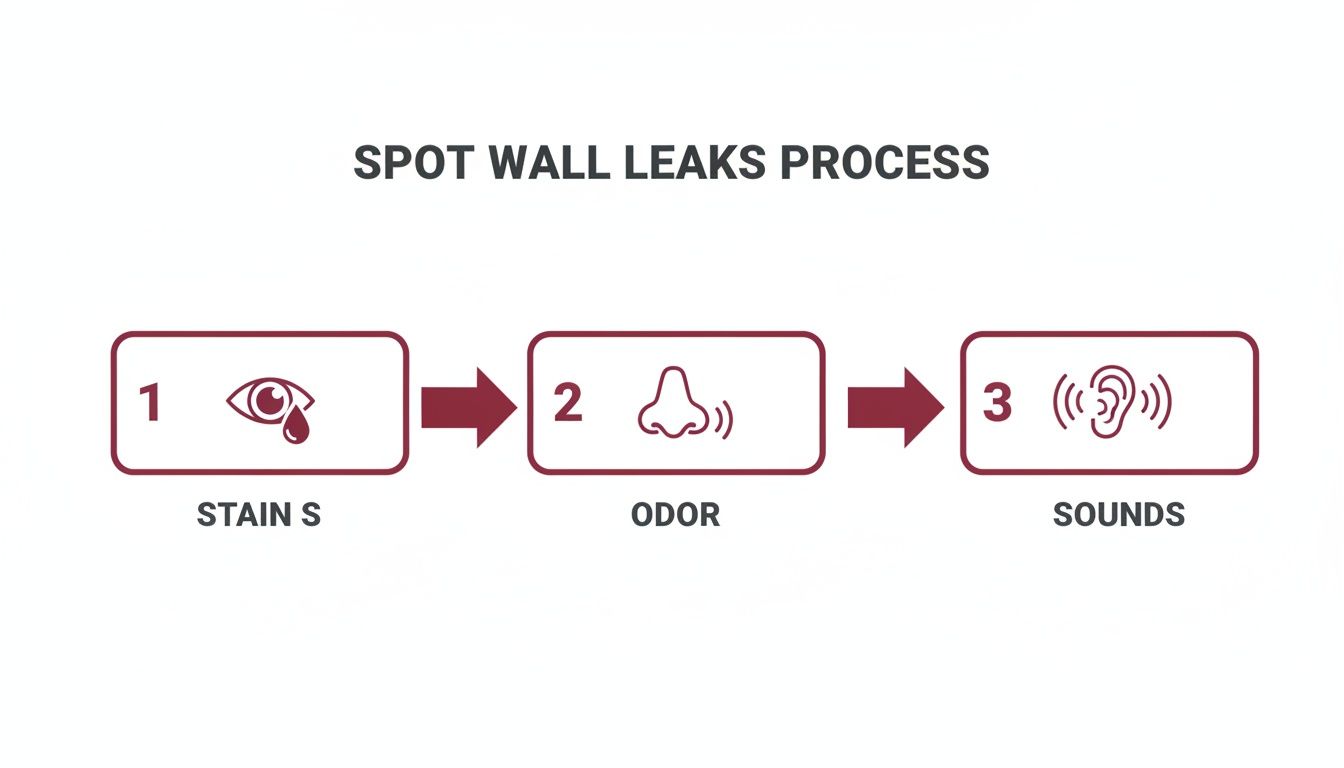
Think of it like this: your eyes, nose, and ears work together to build a complete picture of the leak before you ever pick up a tool.
Feel for Hidden Moisture
Start by gently pressing on the drywall around the area you suspect is wet. A wall holding water feels completely different from a dry one. Be on the lookout for these tell-tale textures:
- Soft or Spongy Spots: When drywall gets saturated, it loses its firmness and feels soft, almost like a sponge. If the wall gives easily under your fingers, you've likely found the wet zone.
- Coolness to the Touch: A damp spot on a wall will often feel noticeably colder than the surrounding dry areas. This is due to the simple science of evaporative cooling.
- Bubbles or Blisters: Run your hand flat across any painted surfaces. If you feel bubbles or blisters, it means water has seeped between the paint and the drywall, causing them to separate.
Finding any of these signs is a pretty clear confirmation of moisture. The next question is whether the leak is happening right now.
Pro Tip: Here’s a classic, low-tech trick we use. Tightly tape a small, clear square of plastic wrap over the most suspicious part of the wall. Check back in a few hours. If you see condensation droplets forming on the inside of the plastic, you have proof that moisture is actively evaporating out of the wall.
Confirm an Active Leak with the Water Meter Test
Before you start thinking about cutting into drywall, there’s one incredibly reliable DIY test you should perform: the water meter test. It’s the single best way to know for sure if you have an active leak anywhere in your plumbing system.
It's simple but requires you to be methodical. Here's how it's done:
- First, make absolutely sure all water in the house is turned off. That means every faucet is shut tight, and appliances like the dishwasher and washing machine are completely off. Don't forget to make sure no toilets are running or refilling.
- Next, find your water meter. It’s usually in a concrete box near the curb or sometimes in a basement or utility closet.
- Look for a leak indicator. Most modern meters have a small red or black triangle or a little star-shaped wheel that spins whenever water is flowing. If everything is off in the house but that little dial is moving, you have an active leak.
- If your meter doesn’t have an indicator, just jot down the numbers on the dial. Wait at least two to three hours without using any water, then check it again. If the number has gone up, even a little, water is flowing somewhere it shouldn't be.
While this test confirms a leak exists, it won’t tell you if it's in the wall or somewhere else. Still, it’s a powerful piece of information. Another trick we sometimes use in the field is pressing a simple stethoscope against the wall to amplify the faint sound of dripping or running water. It's surprisingly effective.
Professionals take this a step further with advanced acoustic devices that can find leaks in metal pipes with over 99% accuracy. This is critical in older cities like Philadelphia, where aging infrastructure from the early 1900s can be responsible for up to 40% of leaks according to some industry market analysis.
Using Technology to Pinpoint the Leak Source
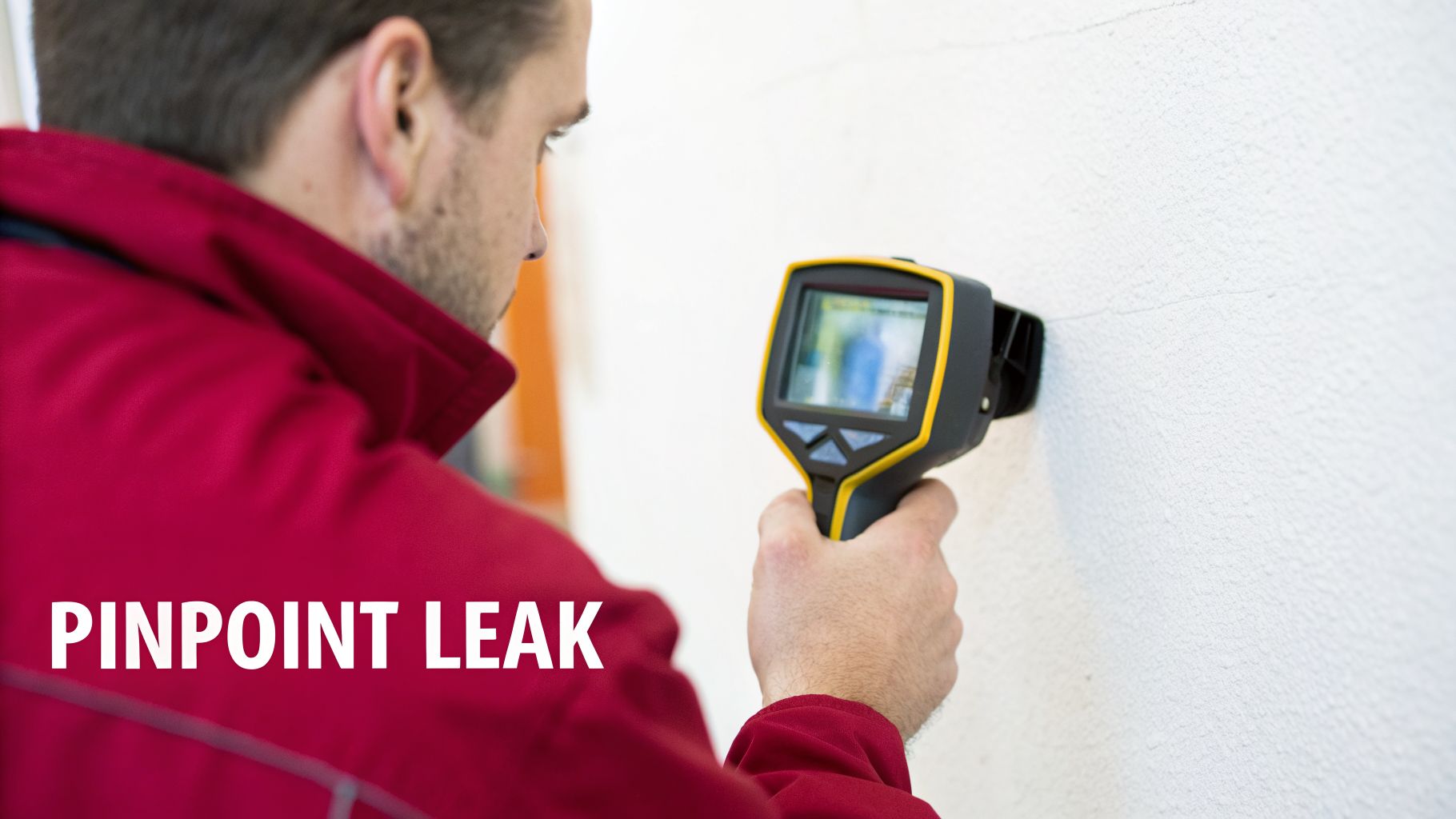
So, you've confirmed there's moisture, but you're still staring at a perfectly intact wall wondering where the water is actually coming from. This is where the real detective work begins. Instead of taking a sledgehammer to the drywall and hoping for the best, it’s time to bring in some technology.
Specialized tools let you "see" behind the wall without causing unnecessary damage. They turn your suspicions—a damp spot or a musty smell—into hard data. This is how pros find a water leak in a wall with surgical precision.
Mapping Moisture with a Meter
A moisture meter is your best friend for this part of the job. It's a simple handheld device that measures moisture levels in materials like drywall and wood. By taking readings across the affected area, you can essentially create a map of the water damage, tracing it back to the point of highest concentration. That's almost always where your leak is hiding.
You'll find two common types of these meters:
- Pin Meters: These have a couple of small metal probes that you press into the drywall. They give you a very specific, numerical reading of the moisture content right at that spot.
- Pinless Meters: These work by pressing a sensor pad against the wall. They’re great for quickly scanning a large area to find the general vicinity of the moisture without leaving any marks.
In my experience, using both is the most effective approach. I always start with a pinless meter to get the lay of the land and identify the wettest zones. Then, I switch to a pin meter to zero in on the exact epicenter.
Seeing Through Walls with Thermal Imaging
An infrared camera, or thermal imager, is a true game-changer for finding hidden water leaks. It doesn’t actually "see" water. Instead, it sees temperature. As water evaporates from inside the wall, it cools the surface of the drywall, something you’d never notice with your bare hands.
A thermal camera displays these tiny temperature differences as a color map. The hidden, waterlogged area will show up as a dark, cool shape against the warmer, dry wall around it. It’s an incredibly powerful visual that often points directly to the problem.
Pro Tip: If you suspect a hot water line is leaking, run the hot water in a nearby sink or shower for a few minutes. This makes the leak light up like a flare on the thermal camera, making it much easier to spot. It’s a simple trick that makes finding the water leak in the wall a whole lot faster.
There's a reason thermal imaging is a cornerstone of professional leak detection. In fact, scanning walls with an infrared camera is so effective it can identify up to 95% of concealed leaks on its own. When combined with other methods like the video pipe inspections used by teams like Precision Plus Plumbing, this technology can cut repair costs by as much as 50%. You can find out more about these advanced detection systems and the impact they're having on the industry.
Gathering this kind of concrete data is everything. It eliminates the guesswork, telling you exactly where the problem is and how big it is before you ever pick up a tool. This means a targeted, clean repair instead of a messy, expensive demolition project.
Advanced Leak Detection With Sound and Pressure
So, what happens when a leak is buried so deep that a visual check or even a thermal camera comes up empty? This is when we switch from looking to listening. For those really stubborn leaks, especially the ones hidden deep inside a home’s plumbing network, it’s time to use the same principles the pros rely on: sound and pressure.
These methods are all about isolating parts of your plumbing system and listening for clues. They help you pinpoint the problem, going from a vague suspicion of a leak "somewhere in that wall" to knowing with confidence it's "in the hot water line feeding the master bathroom." Getting that specific is how you avoid tearing out more drywall than you absolutely have to.
Tune In to the Sounds of a Leak
It might sound old-school, but your ears can be one of the best tools for finding a water leak. A pressurized pipe with even a pinhole leak will often make a faint but distinct sound—a slight hiss, a whoosh, or a very faint, steady drip. If your house is dead quiet, you might just hear it on your own. But amplifying that sound is where the magic happens.
You don't need to shell out a ton of money on fancy equipment to get started. Here are a couple of low-tech tricks that work surprisingly well:
- A Mechanic's Stethoscope: You can grab one of these for less than twenty bucks. Press the diaphragm firmly against the wall and slowly move it around the area where you suspect the leak. The spot where that hissing or dripping is loudest is your prime suspect.
- The Drinking Glass Trick: Don't have a stethoscope handy? No problem. Grab a simple drinking glass. Place the rim flat against the wall and press your ear to the bottom of the glass. The glass acts as a crude amplifier, channeling vibrations from inside the wall and making those faint sounds much easier to hear.
This technique works because sound travels through solid materials like drywall and studs. By listening closely, you're essentially creating a sound map to track the leak. It’s a core component of what we call acoustic leak detection.
The Logic of a Pressure Test
While listening gets you into the right neighborhood, a pressure test gives you a definitive "yes" or "no." This test is designed to confirm whether a specific section of your plumbing has a breach. It’s a methodical process of elimination.
Let's say you think the leak is somewhere in the pipes that serve your upstairs bathroom. You’d start by shutting off the main water supply to the whole house. Next, you would close the individual shut-off valves for every other sink, toilet, and appliance. This effectively isolates the plumbing for just that bathroom, creating a sealed loop.
Expert Insight: A pressure test is the gold standard for confirming a hidden leak. When that needle on the pressure gauge starts to drop, it’s undeniable proof that water is escaping somewhere in that isolated section—even if you can't see or hear a thing.
Once the section is isolated, you attach a pressure gauge to an accessible spot, like the hot water supply for the washing machine. Then, you introduce a small amount of pressure into the line (professionals use a specialized hand pump) and watch the gauge. If the pressure holds steady for 15-20 minutes, that line is solid. If it drops, you've found your leaking circuit.
This is exactly how our technicians at Precision Plus Plumbing zero in on complex problems. Our 24/7 emergency teams use advanced ultrasonic detectors that build on this very principle, achieving over 99% accuracy in metal pipes with the help of sophisticated AI models. This push for efficiency isn’t just a local trend; Europe's Water Framework Directive has championed similar non-invasive technologies, which has helped make advanced IoT sensors more common in U.S. services. With the market for water leakage testers projected to hit USD 2.20 billion by 2025, it’s clear how valuable this kind of accurate, non-destructive approach has become. You can read more about the growing demand for this technology.
Knowing When to Call a Professional Plumber
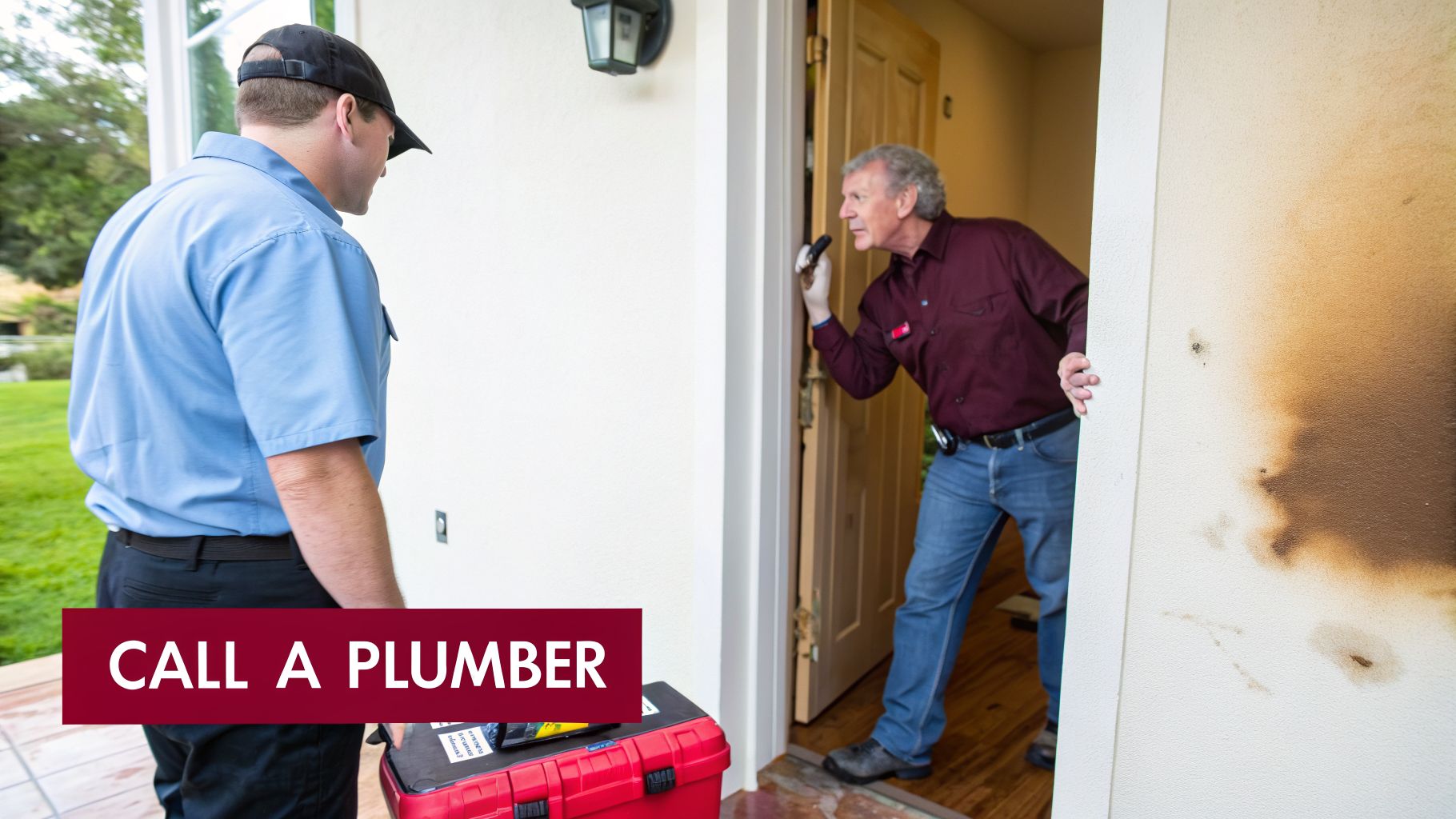
While it’s great to play detective and confirm you have a leak, there's a definite point where DIY efforts should stop. Knowing when to pick up the phone and call a pro isn't giving up—it's the smartest move you can make to protect your home from a much bigger, more expensive disaster.
Trust me, trying to fix a hidden pipe yourself can go sideways fast, turning a contained problem into a full-blown flood. Certain signs aren't just clues; they are blaring alarms that you need an expert, and you need one now.
Unmistakable Signs You Need an Expert
If you run into any of these situations, stop what you’re doing and call a licensed plumber immediately. Don't wait to see if it gets worse.
- Large or Rapidly Spreading Stains: A small, contained water spot is one thing. But if that stain on your wall or ceiling is growing bigger by the day—or even by the hour—you have a serious, active leak on your hands.
- Signs of Structural Damage: Look at your ceiling. Is it sagging, bowing, or looking weighted down? This is an extremely dangerous sign. It means the drywall and the wood joists behind it are saturated and could collapse.
- Moisture Near Electrical Fixtures: Water and electricity are a deadly mix. If you spot any dampness or dripping near outlets, light switches, or your breaker box, you have a severe electrical hazard. Shut off the power to that part of the house at the circuit breaker and call for help.
- A Distinct Sewage Odor: A musty, earthy smell usually points to mold from a clean water leak. But if you smell raw sewage, that’s a whole different problem. It means a drain or sewer line has broken, releasing toxic blackwater full of bacteria and pathogens into your home.
Crucial Safety Warning: A sagging ceiling can collapse with almost no warning, bringing down drywall, insulation, and gallons of trapped water. If you see this, get everyone out from under it immediately and call an emergency plumber. That room is no longer safe.
Why Calling a Pro Is Your Best Bet
Hiring a professional service like Precision Plus Plumbing is about more than just getting a pipe fixed. It’s about bringing in a team that can manage the whole crisis, which is a massive relief when you're stressed and staring at a water-damaged wall.
Homeowners who tackle these jobs themselves often discover the problem is far worse than they imagined. One leak can easily hide another.
A professional team brings advantages a DIY approach just can't compete with:
The Right Tools for the Job
Pros show up with the gear needed to find a water leak in a wall without just tearing everything apart. We're talking thermal cameras, sensitive acoustic sensors, and tiny video cameras that can pinpoint the source through a tiny hole.
Experience That Prevents Bigger Problems
Licensed plumbers know how your home's systems are supposed to work together. We know how to safely shut everything down and can diagnose the issue correctly the first time. For instance, knowing how to properly use different shut-off valves is second nature. To get familiar yourself, you can read our guide on how a simple shut off valve for a toilet works.
Full-Service Restoration
Fixing the leak is only the first step. When the damage is extensive, you need proper restoration. This might involve anything from industrial-strength drying to learning how to repair plaster to make your walls look new again. A full-service company can handle it all, including mold remediation.
Help With the Insurance Claim
Navigating a water damage claim can be a bureaucratic nightmare. Experienced plumbing companies will often work directly with your insurance provider, properly documenting everything to streamline the claims process for you. That service alone can save you a world of headaches.
Common Questions We Hear About Wall Leaks
Even with a solid plan, you're bound to have questions when you suspect a leak is hiding in your wall. It’s a stressful situation, and over the years, we've found that most homeowners ask the same things. Here are some straightforward answers based on our experience in the field.
Can a Small Leak Really Cause Big Problems?
Absolutely. It’s one of the biggest misconceptions we run into. A massive pipe burst is dramatic, for sure, but a slow, hidden drip is often far more destructive over the long haul.
Think of it as a silent saboteur. A slow leak can go unnoticed for weeks or even months, quietly rotting your home's wood framing, compromising its structural integrity, and creating the perfect damp, dark playground for toxic mold to thrive.
We've seen it time and again: a small leak that might have cost $500 to fix in the first week can easily spiral. Leave it for a month, and you could be looking at a $10,000 restoration project that includes mold remediation and major structural repairs. Its quiet nature is exactly what makes it so dangerous.
Will Homeowners Insurance Cover a Wall Leak?
This is the million-dollar question, and the answer is almost always a frustrating one: it depends.
Most standard homeowners' insurance policies will cover the damage from a sudden and accidental leak. The catch? They often do not cover the cost of repairing the pipe itself.
Here’s how that usually plays out:
- What's Covered: Your policy will likely pay to tear out and replace the damaged drywall, dry out the structure, replace soaked insulation, and repaint.
- What's Not Covered: The actual plumbing repair—the few hundred dollars you pay the plumber to fix the broken pipe—is typically considered routine maintenance, and that cost falls on you.
- The Gray Area: If the leak was caused by a slow drip that shows obvious signs of neglect (like old corrosion you should have dealt with), your entire claim could be denied.
An Insurance Pro Tip from the Field: Document everything. Before anyone touches a thing, take photos and videos of the damage. Keep a detailed log of every conversation and save every receipt from your plumber. This paperwork is your best ammunition when filing a claim.
How Long Does It Take for Mold to Grow?
Mold grows shockingly fast. Given the right conditions—moisture, a food source like drywall paper, and darkness—spores can take root and start colonizing in as little as 24 to 48 hours. This is why moving quickly is so critical.
By the third day, a significant mold problem could already be brewing inside your wall, completely out of sight. That musty odor you might notice? That's often the first and only clue that a mold colony is already well-established. If you think water has been sitting for more than a day or two, professional mold testing should be part of the plan.
The full recovery timeline can vary quite a bit, which we break down in our article about how long water damage restoration takes.
Is Cutting into the Drywall the Only Way to Be Sure?
Not anymore, thankfully. While opening up the wall is the only way to physically make the repair, modern tech allows a pro to confirm a leak's location with incredible accuracy beforehand. We use tools like thermal imaging cameras, sensitive acoustic listening devices, and moisture meters to map out the wet area and pinpoint the source.
This means a skilled plumber can cut a small, precise access hole right over the problem instead of making a huge mess with exploratory demolition. It minimizes the cleanup, cuts down on repair costs, and gets your life back to normal much faster. We once helped a homeowner, Juan, in Portland who had two other plumbers fail to find his leak—it took the right tools and experience to open the wall in the exact right spot on the first try.
When your DIY detective work hits a dead end, or you'd just rather have the peace of mind that comes with professional leak detection, don't wait. The 24/7 emergency team at Precision Plus Plumbing uses advanced diagnostic tools to find and fix hidden leaks with minimal disruption. We can handle everything from detection to restoration and even help you navigate the insurance process. For a fast, reliable solution, visit https://www.precisionserviceexperts.com to schedule your service.