
That cold shock when you're expecting a hot shower is a universal feeling of dread. Whether you're in Wilmington, DE, or Cherry Hill, NJ, realizing your water heater isn't working can instantly throw a wrench in your day. But before you panic and assume a massive repair bill is coming, take a breath.
More often than not, the problem is something simple. In many cases, you can diagnose and even fix the issue yourself in just a few minutes, no tools required. It all starts with knowing where to look, and that first step depends entirely on what kind of water heater you have.
Is Your Water Heater Gas or Electric?
The very first thing you need to figure out is your heater’s fuel source. This is the crucial fork in the road for troubleshooting.
- Electric water heaters often have issues tied to their power supply. The most common culprit? A tripped circuit breaker.
- Gas water heaters typically run into problems with their fuel delivery. The usual suspect here is a pilot light that has gone out.
Before you touch a thing, just listen. A healthy gas heater makes a distinct "whoosh" sound when the burner kicks on. An electric one is almost completely silent. If you don't hear the sounds you're used to, that's your first big clue.
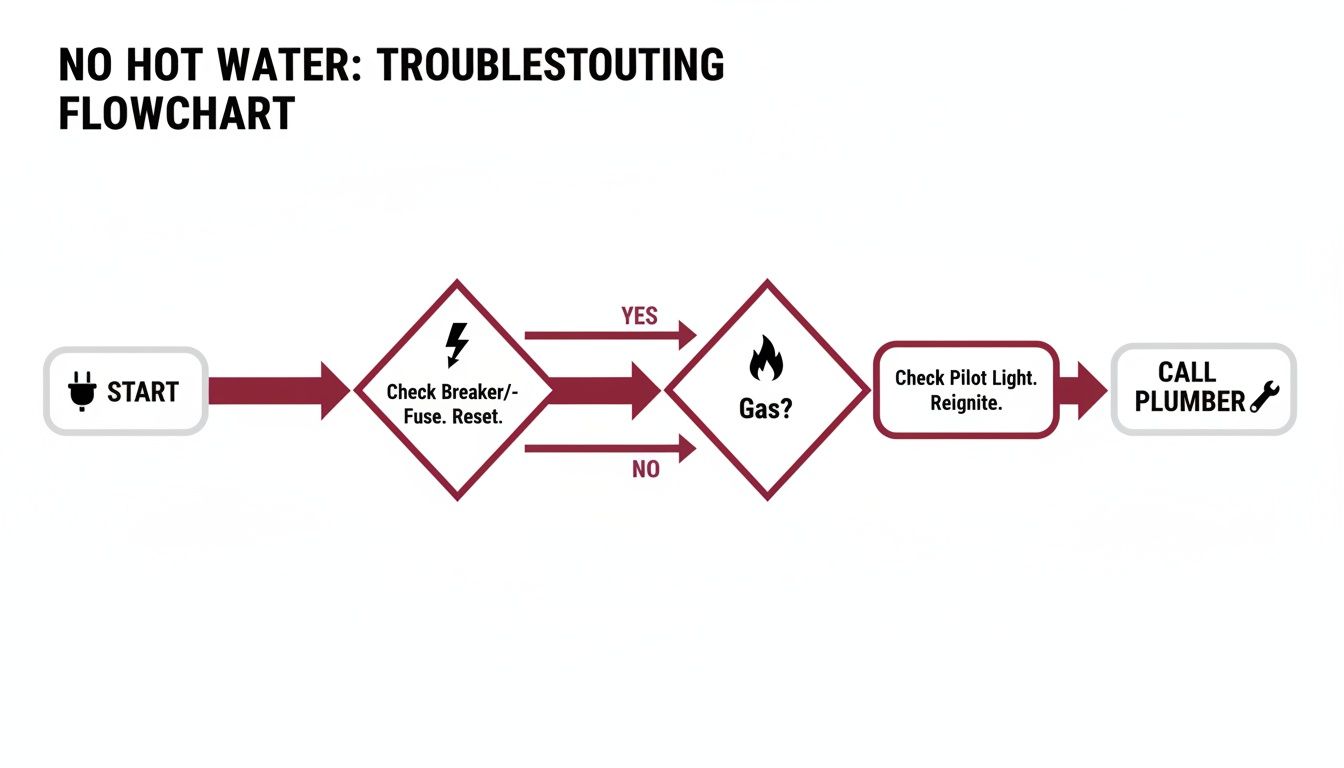
Quick Diagnostic Check Gas vs Electric Water Heater
To help you get started, here’s a quick breakdown of where to look first based on your heater type. Think of this as your initial diagnostic check before you get your hands dirty.
| Symptom or Check | Gas Heater Action | Electric Heater Action |
|---|---|---|
| Primary Power Source | Check that the pilot light is lit. Look through the small viewing window near the bottom of the tank. | Go to your home's main electrical panel and check for a tripped breaker. It's usually a double breaker. |
| Resetting the Unit | Follow the instructions on the tank to relight the pilot light. Turn the gas control knob to "PILOT." | Flip the tripped breaker firmly to the "OFF" position, then back to "ON." |
| Thermostat | Ensure the temperature dial hasn't been accidentally turned down to "PILOT" or a very low setting. | Check the upper and lower thermostats on the tank itself. The reset button may have tripped. (Power must be off first!) |
Running through these basic checks can save you the cost and hassle of an unnecessary service call. For example, a homeowner in Bucks County, PA, might find their electric heater just needs a breaker reset, getting the hot water back on in seconds. Meanwhile, someone in an older Chester County, PA, home might just need to relight their gas pilot light.
Pro Tip: If you reset the breaker or relight the pilot and the problem happens again within a day or two, it’s a clear sign of a bigger issue. A breaker that keeps tripping could mean a faulty heating element, while a pilot that won't stay lit often points to a bad thermocouple.
These initial steps are powerful. You’ll either solve the problem on the spot or gather critical information that helps a professional diagnose it faster. If you’ve tried these quick fixes and the water is still cold, you know it's time to call for backup.
And if you get the heat back on but find the flow is weak, you might be dealing with sediment buildup. You can find more information in our guide on how to fix low hot water pressure.
For those times when a simple fix isn't enough, you need reliable, 24/7 emergency service. The experts at Precision Plus Plumbing are always ready to help homeowners across New Castle County, DE, Bucks County, PA, Montgomery County, PA, Delaware County, PA, Chester County, PA, and South Jersey get their hot water flowing again.
Safe DIY Troubleshooting You Can Try Now
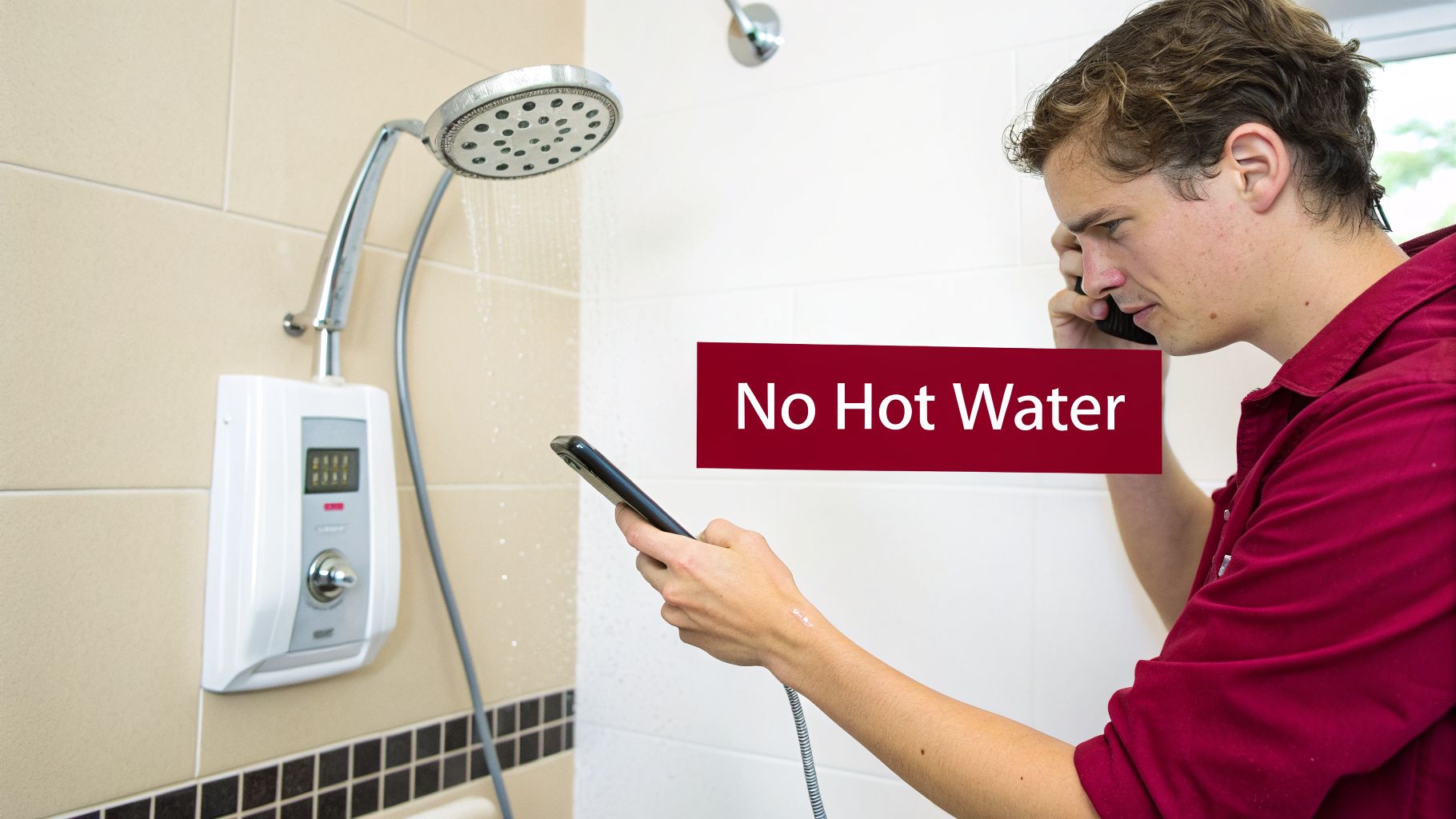
Alright, so you've confirmed the unit has power and the gas is on, but the water's still cold. You’re not out of options yet. Don't worry. There are a couple of common issues that homeowners can safely tackle themselves, and they often get the hot water flowing again without needing a service call.
Let’s walk through the two most frequent culprits we see in the field: a pilot light that’s gone out on a gas heater, and a tripped reset button on an electric one. Both are simple fixes once you know what you’re looking for.
For Gas Water Heaters: The Pilot Light
Think of the pilot light as the heartbeat of your gas water heater. It’s a tiny, constant flame that ignites the main burner when the tank needs to heat up. If that flame goes out, nothing happens. No flame, no hot water. Simple as that.
We get calls about this all the time. A homeowner in Doylestown, PA, might find their pilot light has been extinguished by a strong draft on a windy day. It happens. The good news is, relighting it is usually a quick fix.
How to Check and Relight Your Pilot Light
First, find the access panel near the bottom of the tank—it's usually a small metal plate with a little glass window. Peer through that window. You should see a small, steady blue flame. If it’s dark, the pilot is out.
Now, look for a label on the tank with relighting instructions. Every model is slightly different, so always follow the manufacturer's directions printed on your specific unit. They’ll guide you, but the process generally looks like this:
- Find the gas control knob on the front of the heater. Turn it to the "PILOT" setting.
- Press and hold the knob down. This allows gas to flow to the pilot assembly.
- While holding the knob, push the igniter button (it's usually red or black). You may need to click it a few times until you see the flame ignite through the viewing window.
- Keep holding the knob down for a full 30-60 seconds after the flame is lit. This is crucial—it heats up a safety device called a thermocouple. If you let go too soon, the flame will go right back out.
- Slowly release the knob. If the flame stays lit, you've done it!
- Turn the knob to the "ON" position. You should hear a satisfying "whoosh" as the main burner kicks on to start heating the water.
Safety First: If You Smell Gas
If you smell a strong odor of rotten eggs at any point, STOP what you are doing. That smell is a warning. Do not try to light anything. Leave the house immediately, opening doors behind you to help ventilate, and call your gas company or 911 from a safe distance.
For Electric Water Heaters: The Reset Button
Electric models don't have pilot lights, but they have their own common trip-up: the high-temperature cutoff switch. We just call it the reset button.
This is a safety feature that cuts power to the heating elements if the water gets dangerously hot. This can be caused by anything from a power surge during a storm (a frequent occurrence in places like Media, PA) to a faulty thermostat.
Locating and Pressing the Reset Button
- Safety is everything here. Go to your circuit breaker and turn off the power to your water heater.
- Look for one or two small access panels on the side of the tank, usually held on with a couple of screws. Remove the panel(s).
- Gently move the insulation aside. You should see a thermostat and, typically just above it, a small red button labeled "RESET."
- Press the button firmly. You should hear or feel a distinct "click," which tells you it has been reset.
- Tuck the insulation back, screw the panels on, and then head back to the breaker to restore power. Give it an hour or two for the water to heat back up.
These traditional storage-tank heaters are still very common in our local service areas. They’re popular because they’re generally reliable. But on older units (10-15 years), parts like thermostats can fail, causing the overheating that trips the reset switch.
If you find yourself constantly relighting the pilot or hitting that reset button, it’s a red flag. That means there's an underlying problem that needs to be addressed. For more in-depth troubleshooting, you can check out our guide on how to fix a water heater. But when the simple fixes don't cut it, it's time to call in the pros.
Warning Signs That Demand a Professional Plumber
Look, I'm all for homeowners tackling a few basic fixes. But when it comes to water heaters, some problems are non-negotiable red flags. These aren't just minor inconveniences; they're serious warnings that require an expert's eye immediately.
Knowing how to spot these signs is about more than just getting your hot water back—it's about protecting your home from catastrophic damage and keeping your family safe. If you notice any of the following, your next move shouldn't be to grab a wrench. It should be to call Precision Plus Plumbing.
The Most Urgent Sign: Water Leaks of Any Kind
If you see water pooling around the base of your heater, you have a problem. Period. It doesn't matter if it's a tiny puddle or a steady drip—any sign of a leak is a critical issue.
From our experience, leaks can come from a few places, and where the water is coming from tells us a lot about the urgency:
- Pressure Relief Valve: A small drip from the temperature and pressure (T&P) valve might just mean it's doing its job. But if it's a constant stream? That signals dangerously high pressure or temperature inside the tank.
- Pipe Fittings: Water dripping from the connections where pipes enter or leave the unit could just be a loose fitting. That's a relatively quick fix for a professional plumber.
- The Tank Itself: This is the one we all dread. If you see water weeping from the body of the tank or notice rusty streaks running down the side, the tank's inner lining has failed. Internal corrosion has won, and a total rupture is imminent.
A leaking tank is not a "wait and see" situation. It's a ticking time bomb that could burst at any moment, releasing 40, 50, or even 80 gallons of water into your home. This is the kind of emergency we handle 24/7 across Montgomery County, PA, New Castle County, DE, and the surrounding towns.
Alarming Noises From Inside the Tank
Your water heater should be a quiet workhorse. If it suddenly starts making loud, strange noises, it's screaming for help. Don't ignore it.
A common culprit, especially here in Chester County, PA, where we have a lot of hard water, is sediment buildup. Minerals like calcium and magnesium settle at the bottom of the tank over the years, hardening into a rocky layer. This leads to some very distinct and troubling sounds:
- Popping or Banging: Often called "kettling," this happens when water gets trapped under that sediment layer. It boils into steam and creates violent pops as it escapes, putting immense stress on the tank walls.
- Rumbling or Gurgling: A low rumble often means that sediment is just swirling around in the tank as it heats up. This kills your heater's efficiency and drastically accelerates wear and tear.
- Hissing: A hiss can be a dead giveaway for a small leak, where water is hitting a hot surface and turning to steam. It could also point to excessive pressure building inside the tank.
If you're hearing any of these sounds, your water heater is struggling. Pushing it to keep running is a recipe for a premature failure and a potential flood.
Gas Leaks: A Clear and Present Danger
This is the most critical warning of all. If you smell gas—that unmistakable rotten egg or sulfur smell—you need to act immediately. Gas leaks are incredibly dangerous and can lead to fires or explosions. Our team has extensive experience with these situations, and understanding the risks is vital. For more details, you can read our guide on what to do during a PGW gas leak in Philadelphia.
Many older gas units are hitting the end of their lifespan, and we see it every day. For homeowners in the Greater Philadelphia area, New Castle County, DE, and South Jersey—our service zone—this means more aging gas units are on the verge of failure. It's why Precision Plus Plumbing has been expertly handling urgent, no-hot-water calls 24/7 since 1999.
When the hot water goes out, understanding the causes and solutions for common hot water problems can help you decide your next move. If you see any of the definitive signs above, it’s time to call in the experts at Precision Plus Plumbing.
Repair or Replace: Understanding Your Options
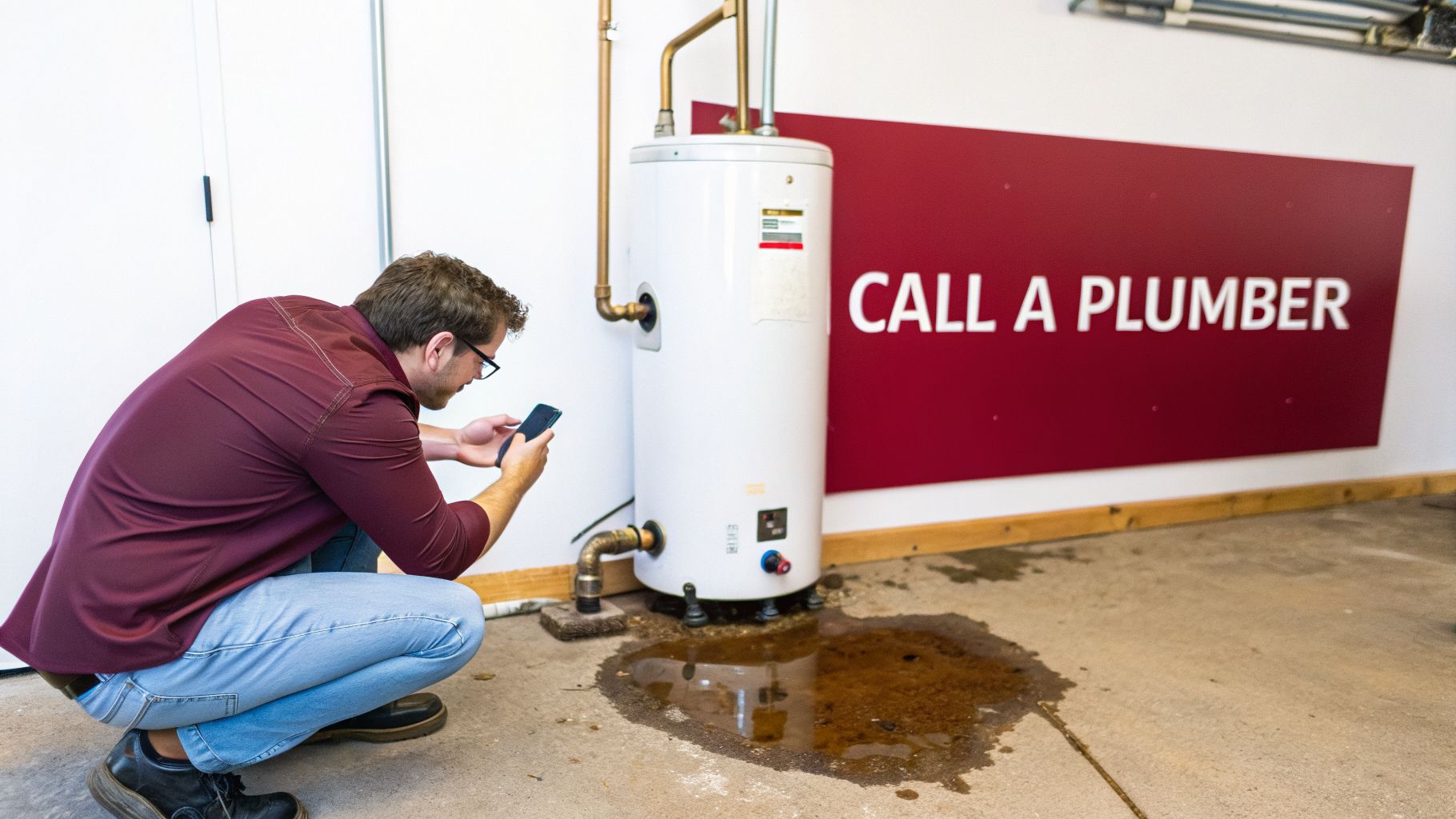
When your water heater finally gives out, you're hit with the big question: should you repair it or replace it? We see homeowners from Bucks County, PA, to South Jersey wrestling with this all the time, usually when they're in a hurry for a hot shower.
The first step is always getting a professional, honest opinion. A simple fix on a newer unit is a no-brainer. But if we're talking about a major part failing on an older tank, the math starts to look very different. That's why we always give you clear, upfront pricing on any repair, so you can make an informed choice without any pressure.
Key Factors in Your Decision
While every situation is unique, a few rules of thumb can help you see the path forward. I always tell my customers to look at these three things together.
- The Age of Your Unit: This is the big one. Most traditional tank water heaters are built to last 8-12 years. If your unit is creeping up on that decade mark (or has already passed it), a major repair is often just throwing good money after bad.
- The Cost of the Repair: We use the 50% rule. If a repair costs 50% or more than a new water heater, replacement is almost always the smarter long-term financial decision.
- Its Recent Track Record: Are you on a first-name basis with your plumber? If you've had to call for service once or twice in the last year, your heater is sending you a clear message. Those small repair bills add up fast.
Think about it this way: a family in Norristown, PA, has a 12-year-old water heater. The gas control valve is shot, and the repair will be $700. That's a huge chunk of what a brand-new, more efficient unit would cost. In that case, we’d strongly recommend putting that money toward a replacement, because another old part is bound to fail soon.
Your water heater’s age is its most telling statistic. A unit over 10 years old that suddenly fails is not just having a bad day—it's likely reaching the end of its engineered service life.
The Benefits of an Upgrade
If all signs point to replacement, try to see it as an opportunity. It's your chance to upgrade your home’s efficiency, lower your bills, and get better performance. Today’s water heaters are light-years ahead of the models sold a decade ago.
Should your water heater be beyond repair, understanding the process of replacement starts with choosing the right water heater.
Exploring Modern Options
- High-Efficiency Tank Heaters: Even today's standard tanks come with much better insulation and smarter burners, saving you money right out of the box compared to your old unit.
- Tankless Water Heaters: These heat water the instant you need it, so you never run out. While the upfront cost is higher, they can last 20+ years and trim your water heating costs by up to 30%.
- Heat Pump Water Heaters (Hybrid): This is the top-tier for efficiency. They pull heat from the surrounding air and can slash water heating expenses by over 60%, offering a fantastic return on investment over time.
We've definitely seen a shift in what people are asking for. Tankless heaters, for instance, are becoming incredibly popular as folks look for both endless hot water and relief from high energy bills. With utility costs on the rise in our region, we're getting more calls for these upgrades from Greater Philadelphia to Newark, DE, every time an old tank fails. You can discover more insights about tankless water heater market trends.
We know an unexpected replacement can be a real financial burden. That's why we offer flexible financing options. Our "service now, pay later" plans help you get the best solution for your home right away without having to compromise.
Why Your Neighbors Choose Precision Plus Plumbing
When your hot water suddenly disappears, you’re not just looking for any plumber. You need a trusted, local expert who can be there fast. For homeowners from Delaware County, PA, to New Castle County, DE, that’s been us—Precision Plus Plumbing—since 1999. We're not some faceless national chain; we’re your neighbors, with deep roots right here in the community.
That local experience really makes a difference. We know the unique plumbing challenges across the area, from the hard water in Chester County that’s tough on appliances to the quirks of the older homes you’ll find in Montgomery County. When you call us because your hot water heater isn’t working, you’re getting a team that’s already in your neighborhood and ready to respond 24/7.
It’s About More Than Just the Repair
The ‘plus’ in our name is there for a reason. We’ve always believed a service call should do more than just solve the immediate crisis—it should help you avoid the next one. That’s why our technicians never just fix the problem and leave.
Every single visit includes a few complimentary extras we provide to help protect your home’s entire plumbing system. Think of them not as upsells, but as part of our standard of care.
- Preventative Drain Treatments to help keep things flowing smoothly long after we’re gone.
- A Lint Trap for your washing machine hose to stop clogs before they start.
- Free Water Quality Testing to spot minerals or contaminants that could be damaging your pipes and shortening the life of your appliances.
This is exactly why your neighbors in Wilmington, DE, and across Bucks County, PA, call us first. They know our focus is on their long-term peace of mind, not just a quick fix.
We Handle the Entire Crisis, Not Just the Plumbing
A failed water heater can quickly escalate from an inconvenience into a full-blown emergency, with leaks causing serious water damage. The last thing you want is the headache of calling a plumber, then a water removal company, and then a restoration service.
With Precision Plus Plumbing, you only need to make one call. We handle it all. Our expertise goes beyond plumbing—we’re also a top-tier water damage restoration service, making us the #1 local alternative to national franchises like Servpro.
From the moment we arrive, our goal is to lift the entire burden from your shoulders. We don’t just repair or replace the water heater; we manage the whole situation from start to finish.
First, we stop the emergency by shutting off the water and power to make the area safe. Our technician will then diagnose the issue and give you clear, upfront options for repair or replacement. If the tank has leaked, our certified restoration team gets to work immediately on water extraction and drying to prevent any chance of mold. We'll even coordinate directly with your insurance company for any water damage claims.
It all comes down to trust and showing up when we say we will—backed by our ironclad On-Time Guarantee. When you’re stressed out over a broken water heater, you need a team that solves the entire problem, professionally and completely. That’s the Precision Plus promise.
Your Water Heater Questions Answered
When you're without hot water, you’ve got questions, and you need answers fast. Having served this area since 1999, we’ve heard just about everything. Here’s a rundown of the most common questions we get from homeowners across the Greater Philadelphia region when their water heater gives them trouble.
How Long Should My Water Heater Last in the Philadelphia Area?
Generally, you can expect a standard tank-style water heater to last about 8-12 years. However, that's not always the full story. Here in places like Delaware and Chester Counties, we deal with a lot of hard water, which can definitely shorten that lifespan if the unit isn't maintained.
That mineral buildup settles in the tank, forming a layer of sediment that forces the heater to work overtime just to do its job. It's a major cause of premature failure. If your heater is creeping past the 10-year mark and starting to act up, a replacement is often a smarter investment than another repair. We can give you an honest opinion based on the unit's condition and the water quality right in your neighborhood.
What Does It Mean if My Hot Water Is Rusty or Smells Bad?
This is one you can't ignore. If your hot water suddenly looks like iced tea or has a "rotten egg" smell, you've got a serious problem brewing inside the tank. It almost always means the sacrificial anode rod—a metal rod designed to corrode so your tank doesn't—has completely disintegrated.
Once that rod is gone, the tank itself begins to rust from the inside out. This is a critical warning sign that the tank's structural integrity is shot, and a leak or even a burst could be imminent. Turn off the water and call for help immediately. It's exactly why we offer 24/7 emergency service throughout New Castle County, DE, and South Jersey.
Is a Loud Banging Noise From My Water Heater an Emergency?
Yes, treat this as an urgent matter. Those loud, unsettling bangs or pops are a phenomenon we call "kettling." It’s caused by a hardened layer of mineral sediment at the bottom of the tank. Water gets trapped underneath, superheats into steam, and then erupts through the sediment.
Each one of those pops puts a huge amount of stress on the tank's welds and seams, drastically increasing the risk of a rupture. The safest thing you can do is shut off the power (for electric) or gas (for gas heaters) and give us a call to take a look.
My Pilot Light Keeps Going Out. What Should I Do?
Relighting a pilot light once in a blue moon is one thing. But if you find yourself doing it repeatedly, stop. It’s a clear signal of an underlying issue that needs a professional eye.
From our experience, it usually boils down to one of three culprits:
- A failing thermocouple: This is a safety device that shuts off gas flow if the pilot flame goes out. When it goes bad, it shuts the gas off even when the flame is perfectly fine.
- A dirty pilot orifice: Soot and debris can easily clog the tiny opening where the gas comes out, leading to a weak, sputtering flame that's easily blown out.
- A draft problem: Sometimes, a strong downdraft in your chimney or vent pipe is all it takes to extinguish the pilot light.
Messing with gas components is not a DIY job. For your own safety, let a licensed professional handle this. Our certified technicians can safely get to the bottom of it and make the right repair.
When your hot water heater is not working, you need reliable help, and you need it now. Precision Plus Plumbing provides 24/7 emergency service across New Castle County, DE, Bucks County, PA, Montgomery County, PA, Delaware County, PA, Chester County, PA, and South Jersey to get your hot water—and your life—back to normal. For an honest diagnosis and expert repair or replacement, contact our team today.