

You hear the rain picking up, and that familiar thought starts to bubble up: is the sump pump going to hold up? It’s a feeling every homeowner knows. Sump pump problems have a nasty habit of showing up at the worst possible time, turning a heavy downpour into a full-blown basement emergency. The most common culprits? A sudden power outage, a nasty clog, or a simple mechanical breakdown.
Your First Line of Defense Against a Flooded Basement
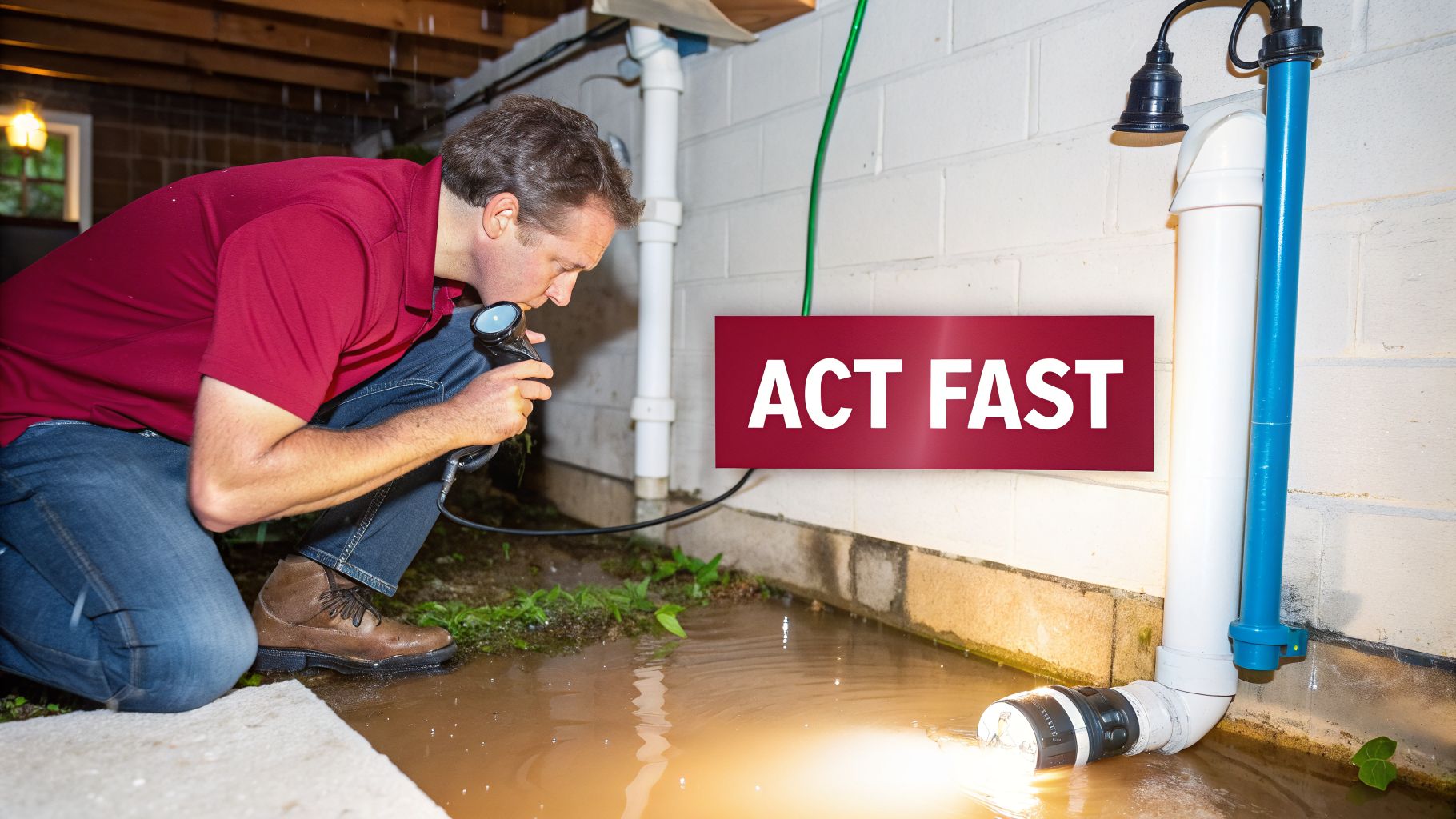
That pit in your stomach is a feeling we know all too well here, from West Chester in Chester County, PA, all the way to Wilmington in New Castle County, DE. You listen to the storm outside and just hope that little pump in the corner of your basement is ready to do its job. Your sump pump is the unsung hero of your home, silently pumping groundwater away from the foundation. But when it quits, the damage is fast, messy, and expensive.
Picture a classic Delaware Valley thunderstorm rolling in. Rain is hammering down in towns like Cherry Hill, NJ, overwhelming the gutters and saturating the ground around your house. This is your sump pump’s moment to shine. If it doesn't kick on, you're not just dealing with a puddle—you could be facing inches of water, ruined furniture and memories, and the creeping threat of mold.
Why Your Local Geography Matters
Here in Bucks and Montgomery County, PA, with cities like Doylestown and Norristown known for their older homes and variable water tables, intense storms aren’t unusual. A reliable sump pump isn't just a nice-to-have; it's a necessity. The same goes for our neighbors across South Jersey and down through Delaware County. We see the same issues pop up time and again, including:
- Sudden Power Outages: The knockout punch of a bad storm. Without a battery backup, your primary pump is useless the second the lights go out.
- Clogged Pumps and Lines: Think of it like a plumbing heart attack. Silt, dirt, and small debris can build up over time and choke the system right when you need it most.
- Mechanical Failure: Every machine has a lifespan. After years of hard work, motors burn out and parts simply wear down.
Should the worst happen and your pump fails, having a detailed record of your possessions on a home inventory app for insurance can make a world of difference when it’s time to file a claim.
Since 1999, Precision Plus Plumbing has been the go-to 24/7 expert for communities from Doylestown to Wilmington. We’ve seen firsthand the challenges our local weather throws at homes, and we're always ready to roll when sump pump problems strike.
The Six Most Common Sump Pump Problems
When your sump pump gives up the ghost, especially during a downpour, the first question is always, "Why now?" The good news is that most failures aren't some deep, dark mystery. After years of emergency calls all over New Jersey, Pennsylvania, and Delaware, we've found that the culprits are usually one of a handful of common issues.
Think of it like troubleshooting a car that won't start—once you know what to listen and look for, you can often pinpoint the problem yourself. Let's walk through the six most frequent reasons your pump might have failed, so you can understand what's happening in your basement.
1. Power Outages: The Storm's Knockout Punch
This one is the most straightforward cause. Your primary sump pump is an electrical appliance, and when a storm knocks out your power, it knocks out your pump, too. It’s the equivalent of your home’s flood defense getting KO'd right as the main event begins.
The real danger here is the timing. You need that pump most when the rain is coming down the hardest, which is exactly when power grids are most vulnerable. For homes in places like Wilmington, DE, or West Chester, PA, a powerless pump during a Nor'easter means rising groundwater has an open invitation to come right into your basement.
2. Float Switch Failures: The Traffic Cop Asleep on the Job
Your pump’s float switch is the traffic cop for your sump pit. It’s a simple device, usually a hollow ball, that floats on the water. As the water level rises, so does the float, which flips a switch telling the pump to turn on. As the water drains, the float drops and turns the pump off.
A float switch failure is one of the most common—and frustrating—sump pump problems we see. It can get tangled in the pump's own power cord, pinned against the side of the pit, or just plain wear out.
When this little mechanism fails, the signals get crossed, with disastrous results.
- Stuck in the 'Off' Position: Water fills the pit, but the float never rises to send the "on" signal. The water just keeps coming until it spills out and floods the floor.
- Stuck in the 'On' Position: The pump runs continuously, even after the pit is empty. This "dry running" will quickly overheat and destroy the motor, leaving you unprotected for the next rainfall.
3. Clogged Pumps and Lines: The Plumbing Heart Attack
A sump pump is built to handle water, not sludge. Over time, all sorts of gunk—dirt, gravel, leaves, and other debris—can find its way into the sump pit. Eventually, the pump sucks this debris in, creating a clog that stops it dead. It’s like a heart attack for your basement's plumbing; the main artery is blocked, and water can't get through.
The discharge line that carries water outside can also get blocked by sediment or freeze solid. Industry service logs show that simple debris and neglect are behind a significant number of failures during peak rainy seasons. This is a huge risk, as many homes in our service area deal with standing water issues. In flood-prone areas like Media in Delaware County, PA, and across Montgomery County, PA, a clog can quickly lead to an overflow that invites mold. You can dig deeper into these issues by reviewing read additional insights on sump pump failure and property damage.
4. An Undersized Pump: The Overwhelmed Employee
Not all sump pumps have the same muscle. Having a pump that's too small for your home is like asking one employee to do the work of a whole team. It might keep up just fine during a light drizzle in Cherry Hill, NJ, but it will be completely overwhelmed by a true gully washer.
When a major storm hits, water pours into the sump pit faster than the undersized pump can push it out. The water level inevitably rises and overflows into your basement. This is a classic problem in homes where a basic, contractor-grade pump was never upgraded to handle the local water table or today's heavier rainfall patterns common in the Delaware Valley.
5. Old Age and Wear: The Burnout
Like any machine with moving parts, a sump pump doesn’t last forever. The average pump is engineered to last about 7 to 10 years. After thousands of cycles, the motor bearings and impeller just wear out.
An old pump is like a veteran athlete playing on borrowed time; it gets noisier, runs less efficiently, and might start failing intermittently before it finally quits for good. If your pump is pushing a decade old, you're rolling the dice every time it rains in communities like Newark, DE or Media, PA.
6. Frozen Discharge Lines: The Winter Menace
For those of us in Pennsylvania, Delaware, and New Jersey, winter brings a sneaky threat: the frozen discharge line. This is the pipe that carries water from the pump out of your house. If the end of that pipe is blocked by a snowdrift or if standing water inside it freezes solid, you have an impenetrable ice plug.
When the pump kicks on, it has nowhere to push the water. It strains against the blockage, and the immense backpressure either forces water back into your basement or completely burns out the pump’s motor. This winter menace is a top cause of pump failures during those mid-winter thaws when melting snow creates a sudden flood of water with no place to go.
When that dreaded sound of water in the basement hits your ears, it’s easy to panic. Especially when you see a storm brewing over your home in Wilmington, DE, or West Chester, PA. But before you call for backup, a few quick, safe checks can often tell you exactly what’s gone wrong.
Think of this as your own triage process. You’re gathering clues to figure out if it’s a simple fix or a job for the pros. No special tools are needed, and your safety is the top priority.
Safety First: Your Non-Negotiable First Step
Let's be crystal clear: standing water and electricity can be a deadly mix. Before you even get close to the sump pit, you need to make sure the area is electrically safe.
- Never, ever step in standing water where live electrical cords or outlets might be submerged.
- If you can get to your breaker box without walking through water, find the circuit for your sump pump and shut it off.
- If you're even slightly unsure which breaker it is, or if the panel itself is in a wet spot, stop. Do not go any further. Your safety is worth more than any pump.
Take A Look: What The Sump Pit Is Telling You
Once the power is confirmed off, you can start your detective work. Carefully lift the lid off the sump pit and take a good look inside. What do you see?
Often, the problem is staring you right in the face. A pit filled with mud, gravel, or other gunk is a major red flag. This debris can easily jam the pump's moving parts or, even more commonly, clog the intake screen and stop the pump cold.
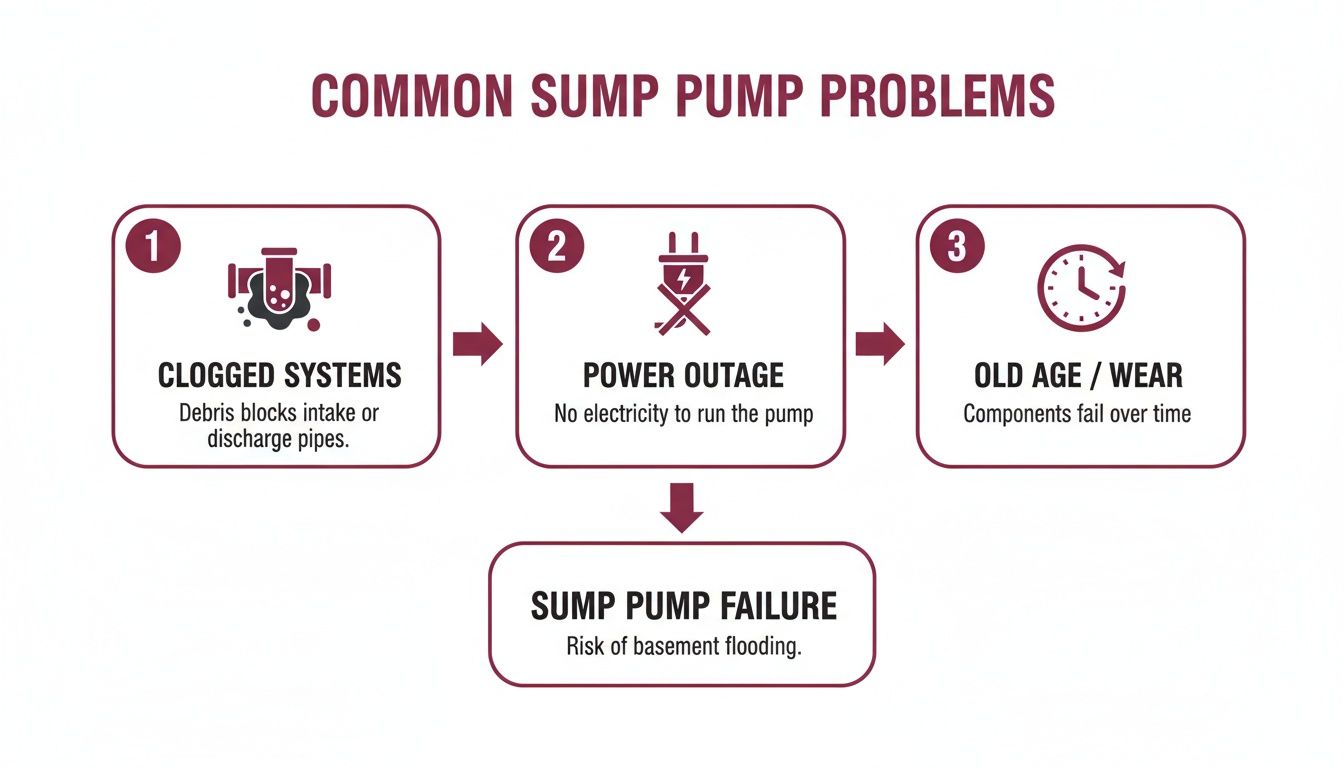
As you can see, a simple clog or power flicker can quickly cascade into total failure and a flooded basement. It's a chain reaction you want to stop early.
Sump Pump Problem Diagnostic Checklist
When your sump pump acts up, knowing where to start can be overwhelming. Use this quick-reference table to match the symptoms you're seeing with the most likely culprits and learn what to check first.
| Symptom | Potential Problem | What to Check |
|---|---|---|
| Pump won’t turn on | Power failure, jammed float switch, or burned-out motor. | Is the pump plugged in? Is the breaker tripped? Is the float switch stuck? |
| Pump runs constantly | Stuck float switch, undersized pump, or check valve failure. | Is the float switch tangled? Is water flowing back into the pit from the discharge pipe? |
| Pump runs but doesn't remove water | Clogged discharge line, airlock, or impeller damage. | Is the discharge pipe outside blocked or frozen? Can you hear the motor humming but not pumping? |
| Loud grinding or rattling noises | Debris in the impeller or a failing motor bearing. | Look for gravel or small objects in the pit. Listen closely for the source of the noise. |
| Pump cycles on and off rapidly | Check valve failure or an incorrectly set float switch. | Watch the pump cycle. Does water rush back into the pit right after it shuts off? |
This checklist is your first line of defense. By methodically checking these items, you can often pinpoint the issue and decide whether it's a DIY fix or a job that needs a professional plumber.
Testing the Float Switch: The Five-Gallon Bucket Test
If the pit looks clean, the next suspect is the float switch. This is the trigger that tells your pump it’s time to get to work. After making sure it's safe to turn the power back on, you can run a simple test.
Just grab a five-gallon bucket and slowly pour water into the pit. As the water rises, it should lift the float. You're waiting for that satisfying "click" and "whir" as the pump kicks on. If it activates and starts pumping, the switch is doing its job. If the pit fills up and nothing happens, the float is likely stuck or has failed.
I can't tell you how many service calls we get in places like Doylestown, PA, and Cherry Hill, NJ, that turn out to be a simple stuck float. It gets tangled in the power cords or wedged against the side of the basin, and the pump never gets the signal to turn on.
Listen for Trouble and Check the Exit
Sometimes the pump runs, but it sounds terrible. That’s a clear cry for help. Loud, grinding noises almost always mean debris has been sucked into the impeller (the pump's "fan"). A rattling sound, on the other hand, could mean the whole unit is vibrating because it has shifted and isn't sitting flat anymore.
Finally, take a walk outside to the spot where the discharge pipe exits your foundation. Make sure it isn't clogged with mulch, dirt, or leaves. In winter, this is a huge problem area. An ice plug can form inside the pipe, completely blocking water from escaping. This forces the pump to work against a wall of ice, which can quickly burn out the motor—a common emergency we see during cold snaps across Bucks, Montgomery, and Delaware Counties.
Proactive Sump Pump Maintenance to Prevent Flooding
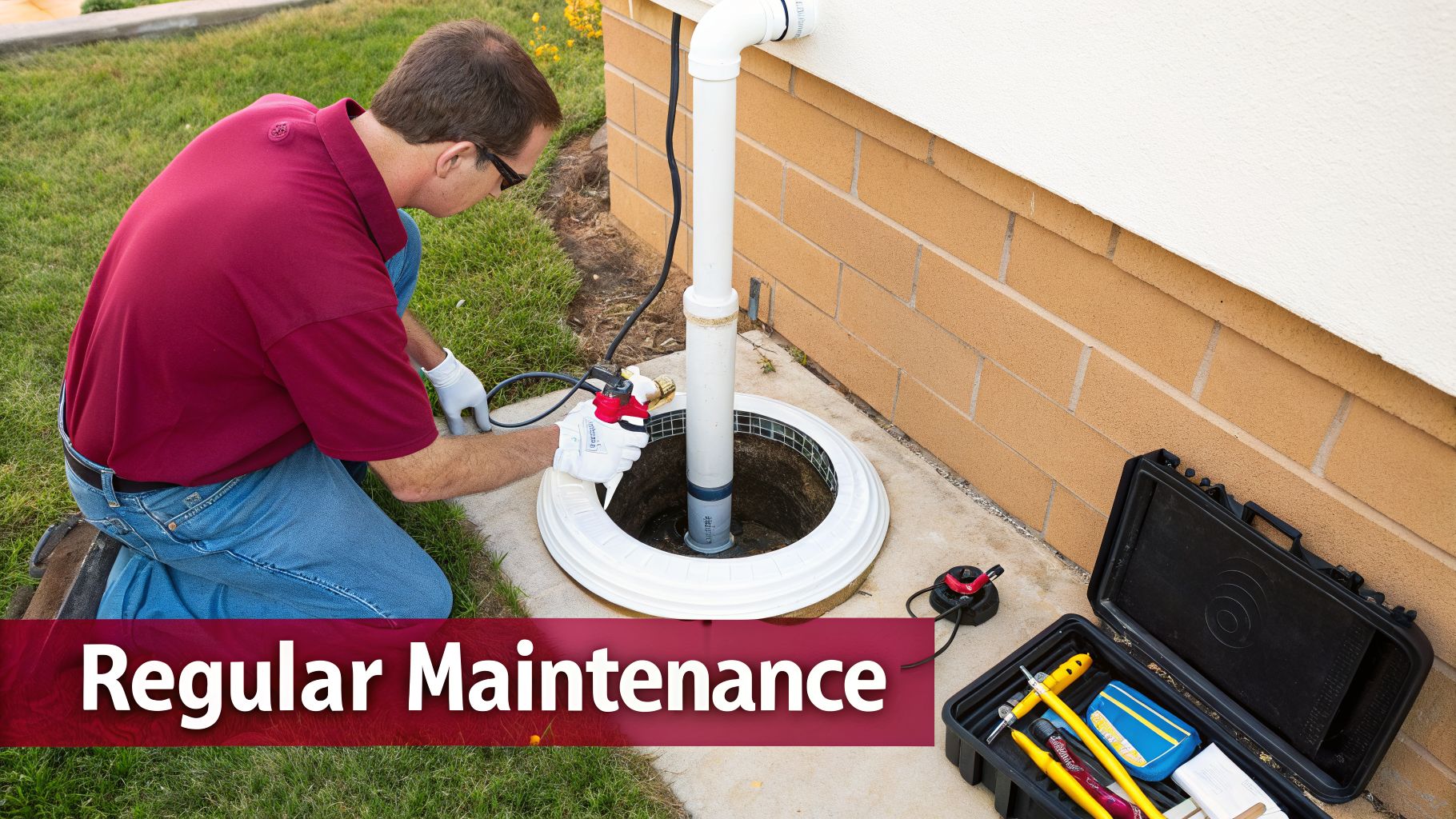
When it comes to sump pump problems, the best-case scenario is preventing them from happening in the first place. Nobody wants to be scrambling in a panic during a torrential downpour. Proactive maintenance is all about giving yourself peace of mind, knowing your basement’s first line of defense is ready for action.
This isn't some massive, time-consuming chore. Think of it as a small investment to protect your home’s foundation and everything you store in the basement. A simple, seasonal schedule is all it takes for homeowners from South Jersey to the Philadelphia suburbs to stay ahead of potential disasters.
And the stakes are higher than you might think. A staggering number of basements in our service area will eventually experience water damage, with sump pump failures being a top culprit. If you don’t have a battery backup, your pump has a 100% chance of failing during a power outage, and the average water damage claim can be substantial.
Your Quarterly Maintenance Checklist
A well-cared-for sump pump is a reliable one. We recommend a quick check-up every three to four months, paying special attention before the rainy spring and the first freeze of winter. This simple routine is your best bet for catching problems early.
- The Bucket Test (Quarterly): This is the most important check you can do. Pour a 5-gallon bucket of water into the sump pit. You’re watching to make sure the float switch rises, the pump kicks on, the water drains quickly, and the pump shuts off.
- Clean the Pit (Annually): At least once a year, you’ll want to disconnect the pump (always shut off the power at the breaker first!) and get all the silt, gravel, and gunk out of the basin. This debris is what clogs and jams the pump’s internal parts.
- Inspect the Discharge Line (Seasonally): Take a walk outside to where the discharge pipe exits your foundation. Is it blocked by mulch, leaves, snow, or ice? If water can't get out, it's coming right back in.
- Test the Battery Backup (Twice a Year): If you have a battery backup system—and you should—test it. Unplug the main pump, then perform the bucket test to ensure the backup unit does its job. You need to know that second pump will fire up when a storm knocks out the power in New Castle County, DE.
Deep Cleaning the Sump Pit and Impeller
Over time, your sump pit naturally collects dirt, small stones, and all sorts of muck that washes in with the groundwater. When the pump tries to suck this debris up, it can easily damage or jam the impeller—the small, fan-like part that actually propels the water out.
Giving the pit a deep clean once a year is a smart move. After you’ve shut off the power and removed the pump, a wet-dry vac is your best friend for clearing out the bottom of the basin. While the pump is out, check its intake screen for any blockages and clean it off. This one task prevents the #1 cause of mechanical failure: a system choked with debris.
We get countless calls in towns like Doylestown, PA, and Cherry Hill, NJ, for pumps that are humming but not moving any water. Nine times out of ten, a small stone or chunk of mud is wedged in the impeller. An annual cleaning almost always stops this from happening.
Smart Upgrades for Long-Term Peace of Mind
Beyond basic maintenance, a few key upgrades can add a powerful layer of protection. These are especially smart for homes in areas with high water tables or frequent power outages, which describes many communities in Bucks and Chester County, PA.
Water-Powered Backup Pumps
This is a fantastic and incredibly reliable alternative to a battery backup. A water-powered pump cleverly uses your home’s municipal water pressure to create suction and empty the sump pit. Since it doesn’t rely on electricity or batteries, it’s the ultimate fail-safe.
Smart Flood Alarms
Modern tech offers a huge advantage here. A smart flood alarm is just a small sensor you place near the sump pit. The moment it detects water where it shouldn't be, it sends an alert straight to your phone. This gives you a critical head start to solve the problem before it becomes a catastrophe. These simple tools can easily save you thousands in future damages.
Should You Repair or Replace Your Sump Pump?
So, your sump pump is on the fritz. Now you're facing the big question: do you pay for a repair, or is it time to replace the whole unit? It’s a tough spot to be in, especially for homeowners in places with high water tables like Cherry Hill, NJ, or throughout Bucks County, PA. In those areas, a working sump pump isn't just nice to have—it's the only thing standing between you and a basement full of water.
The decision really boils down to simple economics and a bit of foresight. A small, one-off repair on a fairly new pump is a no-brainer. But sinking hundreds of dollars into an old, unreliable pump? That’s often just throwing good money after bad. Making the right call now can save you a world of headaches and a lot of cash down the road.
Making the Call: Repair or Replace?
To figure out the smartest move, you need to step back and look at the big picture. Think about the pump's history, its age, and whether your home's needs have changed. A pump that did the job just fine five years ago might be completely outmatched by the challenges it faces today.
Answering these questions honestly will tell you whether a quick fix will solve your problem or if it’s just a band-aid on a much bigger issue.
- How old is it? Seriously, what year was it installed?
- What’s its track record? How many times has it failed you in the last couple of years?
- Is it keeping up? Does it seem to struggle or run constantly during heavy rain?
The Age of Your Sump Pump
Let's start with age, because it’s the single biggest factor. A sump pump failure isn't a minor inconvenience; it's a direct threat to your home's foundation. Most sump pumps are built to last about 7 to 10 years. After that, crucial components start wearing out, leading to problems like a motor that won't shut off or, worse, one that won't turn on at all. If you want a deeper dive, you can read additional insights on sump pump failure and property damage.
For anyone living in high-water-table areas like South Jersey or New Castle County, DE, that lifespan can feel even shorter. When groundwater is constantly pushing against your foundation, your pump works overtime. If yours is creeping up on that 10-year mark, replacing it isn't just a good idea—it's a smart, preventative investment.
The Repair vs. Replacement Cost Analysis
Now, let's do the math. A single repair, like swapping out a broken float switch, might only set you back a few hundred dollars. That seems reasonable. But what happens when the check valve goes six months from now? And the motor starts making a grinding noise a few months after that? You get caught in a frustrating and expensive cycle of repairs.
Here’s a great rule of thumb we use in the field: the 50% rule. If a single repair costs more than 50% of what it would cost to buy and install a brand-new pump, it's time to replace it.
This is especially true for any pump that's over five years old. Choosing replacement gets you a modern, more efficient unit with a fresh warranty. You completely reset the clock on its lifespan and buy yourself priceless peace of mind.
When Your Home's Needs Change
Life happens. Maybe you've recently finished your basement in Delaware County, PA, which means you have a lot more to lose in a flood. Or perhaps you've noticed the storms in your Montgomery County neighborhood have become more intense over the last few years.
These are clear signs that your home's needs have outgrown your old pump's capabilities. A pump that was "good enough" a decade ago could be dangerously undersized for today's weather and your home's current value. In this case, you're not just replacing a part; you're upgrading your home's entire defense system. Installing a new, more powerful pump—ideally with a battery backup—is the only move that makes sense to protect your property.
When You Need Emergency Sump Pump Service
Knowing how to troubleshoot common issues is a fantastic skill for any homeowner. But some sump pump problems aren't just minor annoyances—they're full-blown emergencies. When a storm is rolling into Chester County, PA, or a big thaw is hitting New Castle County, DE, you need to know when to stop tinkering and pick up the phone.
These are the absolute red flags that mean your basement is in immediate danger. If you find yourself in this situation, it's also helpful to know what comes next. We've put together a guide on how long water damage restoration takes to give you a clearer picture of the process.
Red Flags That Require an Immediate Call
If you notice any of the signs below, it’s time to call in a professional right away. Delaying can be the difference between a simple pump swap and a major basement restoration.
The Pump Won't Turn On: This is the most critical failure. If water is rising in the sump pit but the pump is completely silent, you have an active flooding situation on your hands.
Loud, Grinding, or Rattling Noises: A healthy pump has a quiet, consistent hum. Any sudden shrieking, grinding, or clattering sounds often point to a catastrophic mechanical failure, like a shattered impeller or burned-out motor bearings.
The Circuit Breaker Keeps Tripping: A pump that repeatedly trips its dedicated circuit breaker is a major hazard. This signals a serious electrical short that creates both a flood risk and a potential fire risk.
You Can See Water on the Floor: The second you spot water spreading across your basement floor, your pump has already failed its one and only job. Every minute you wait is another minute that water is seeping into your home's foundation, drywall, and framing.
For homeowners from Bucks County, PA, to South Jersey, these red flags are your cue to call for emergency service. Waiting can turn a simple pump replacement into a full-scale water damage restoration project.
Your 24/7 Emergency Solution
At Precision Plus Plumbing, we know that sump pump disasters don’t stick to a 9-to-5 schedule. That's why we offer 24/7 emergency availability for communities throughout our service area, including New Castle County, Delaware, New Jersey, Bucks County, PA, Montgomery County, PA, Delaware County, PA, and Chester County, PA.
Our trucks are always stocked with a wide range of pumps and components, which means we can resolve over 90% of issues in a single visit. When you see a red flag, don't hesitate. Whether you're in Wilmington, DE, or Doylestown, PA, one of our expert technicians is ready to get your home protected again—fast.
Frequently Asked Sump Pump Questions
We get a lot of great questions from homeowners about their sump pumps. From weird sounds to how often they should kick on, here are the straightforward answers to the things we hear most often from folks in New Castle County, DE, all the way to Bucks County, PA.
How Often Should My Sump Pump Run?
That's the million-dollar question, and the honest answer is: it completely depends. After a heavy spring downpour in Montgomery County, PA, it's perfectly normal for your pump to cycle on and off every few minutes. It's just doing its job moving all that groundwater away from your foundation.
On the flip side, during a dry stretch in August, your pump might not turn on for weeks. The real cause for concern is when its behavior doesn't match the weather. If your pump is running nonstop on a dry, sunny day or, even worse, staying silent during a storm, that’s a major red flag for sump pump problems.
Is a Battery Backup System Really Necessary?
We can't stress this enough: absolutely. The Delaware Valley gets its fair share of powerful thunderstorms and winter ice storms that can easily knock out power. Without electricity, your primary pump is just a piece of plastic in a hole, leaving a battery backup as your only line of defense against a flooded basement.
For any home with a basement in our service area—from Chester County, PA, to South Jersey—a battery backup isn't a luxury. It is an essential investment to protect your property when the power grid fails.
A pump failure can cause more than just immediate water damage. If you're left with a damp, earthy odor after a water scare, it’s worth investigating what that musty smell in your basement could mean.
What Kind of Noise Is Normal for a Sump Pump?
A happy, healthy sump pump makes a quiet, consistent hum when it's running. Any other noise is basically your pump trying to tell you something is wrong.
Listen for these warning signs:
- Grinding or Gravelly Sounds: This usually means the pump's impeller has sucked in small rocks or debris.
- Loud Rattling or Clanking: The pump has likely shifted and is now vibrating against the side of the sump pit.
- Gurgling Noises: This often points to a problem with the check valve or a blockage in the discharge line.
Don't just turn up the TV to drown it out. These sounds are early warnings that can help you prevent a much bigger mess.
When a sump pump issue turns into a water emergency, you need an expert you can count on, day or night. For 24/7 service and the peace of mind that comes with a job done right, contact the team at Precision Plus Plumbing. Visit us at https://www.precisionserviceexperts.com to schedule your service.