
A puddle of water at the base of your water heater isn't just a minor drip—it's a serious red flag. More often than not, a leak from the bottom means the tank's inner lining has rusted through, and a complete failure could be right around the corner. Acting fast is key to preventing a catastrophic flood.
Your Immediate Action Plan for a Leaking Water Heater
That sinking feeling you get when you spot water pooling around your heater is a universal one. But while your first instinct might be to panic, the next few minutes are crucial. Taking decisive action can be the difference between a manageable problem and thousands of dollars in property damage.
A water heater leaking from bottom is a clear signal that the unit's structural integrity has been compromised. This isn't a problem that will fix itself. This section is your emergency playbook for what to do right now, before you even pick up the phone to call a plumber.
The Financial and Structural Risks of a Bottom Leak
A leaking water heater is one of the most common—and costly—home emergencies we see. According to industry data, about 14,000 US homeowners deal with a water leak emergency every single day, with failing water heaters being a top cause.
The financial hit can be staggering. The average water damage claim from a failed tank is now $6,965 per incident. For anyone in the Greater Philadelphia area, understanding that a small leak can quickly escalate into a full-blown flood is the first step in protecting your home.
Key Takeaway: The moment you see water pooling under your tank, the clock is ticking. The internal corrosion causing the leak won't stop. It only gets worse, making a destructive tank rupture almost inevitable.
Your First 15 Minutes: What to Do Right Now
Before you do anything else, your priority is to contain the situation. These first steps are designed to secure the area and stop the problem from turning into a basement flood.
Your immediate response should focus on three critical goals:
- Shut off the power or gas: For an electric model, this prevents a serious shock hazard. For a gas heater, it stops a potential gas leak.
- Stop the water supply: Cutting off the water stops new water from filling the compromised tank and fueling the flood.
- Manage the immediate damage: Getting valuables off the floor and containing the water that has already escaped is vital.
A prolonged leak can cause deep-seated problems, so it’s important to know the common signs of water damage in walls and other structural materials. If you're wondering what the cleanup process looks like, check out our guide on the timeline for professional water damage restoration to understand what comes next. Taking these steps now will make the entire recovery process much faster and less expensive.
Perform An Emergency Shutdown To Prevent A Flood
The second you spot your water heater leaking from bottom, you’ve got to switch from finding the problem to controlling the damage. I’ve seen small leaks turn into full-blown basement floods faster than you’d think, turning a simple repair into a nightmare restoration job. Acting fast is your best bet to prevent serious water damage.
Your goal here is simple: cut the power (or gas) and the water feeding the unit. It’s not a complicated process, but every second counts. Let's get right into what you need to do to secure the area and stop a flood in its tracks.
Cut The Power Or Gas Supply
Before you do anything about the water, you have to deal with the biggest safety risks: electricity and gas. Water and live power are a dangerous mix, and a gas leak is even worse.
For Electric Water Heaters: Head to your home's main electrical panel. You're looking for the breaker labeled "Water Heater." This is usually a double-pole breaker, meaning it’s twice as wide as the others and often has two switches tied together. Flip it firmly to the "OFF" position. If your breakers aren't labeled (a common issue in older homes), you might have to shut off the main breaker for the whole house to be safe.
For Gas Water Heaters: On the unit itself, find the gas control knob, which is usually a dial near the bottom. Turn that dial to the "OFF" setting. You'll also want to close the manual gas shut-off valve on the supply line running to the heater. This is typically a handle that you turn a quarter-turn until it’s perpendicular to the gas pipe.
A Critical Safety Note: If you smell gas after shutting everything down, get out of the house immediately. Don't touch any light switches or electronics. Once you're a safe distance away, call your gas company's emergency line.
This simple infographic sums up the emergency protocol perfectly.
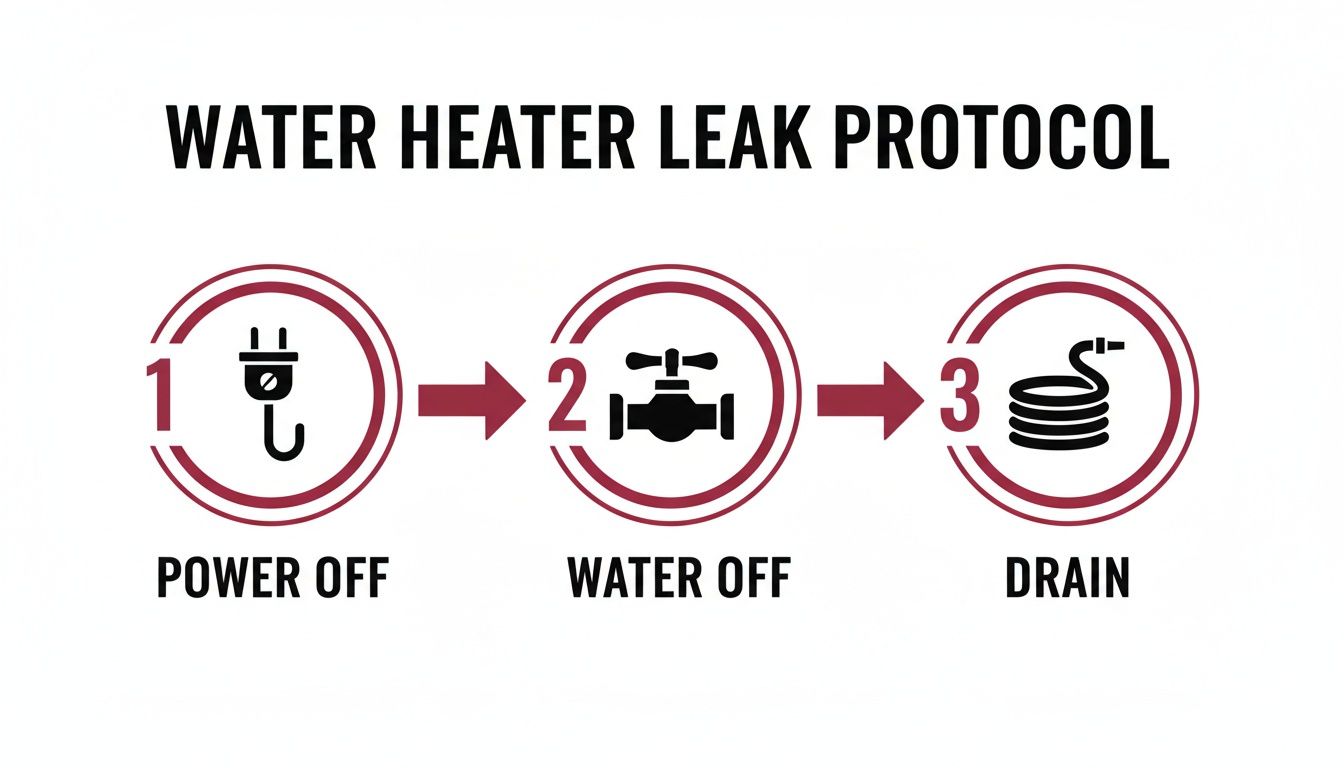
Following this sequence—Power Off, Water Off, Drain—is the most reliable way to contain the mess from a water heater leaking from the bottom.
Shut Off The Water Supply
With the energy sources secured, the next job is to stop more water from feeding the failing tank. This one move is what keeps a puddle from becoming several inches of standing water.
Find the cold water inlet pipe, almost always located on the top right side of the heater. There will be a shut-off valve on this line, either a wheel-style gate valve or a lever-style ball valve.
Here’s how to close it:
- For a gate valve (the wheel), turn it clockwise—righty-tighty—until it's snug.
- For a ball valve (the lever), turn it one-quarter turn so the handle is perpendicular to the pipe.
Once that valve is closed, you’ve cut off the water supply and isolated the leak. The problem won't get any bigger from here.
Drain The Tank To Relieve Pressure
Even with the water off, that tank is still holding 40, 50, or even 80 gallons of water. Since a leak from the bottom often points to a failing tank, getting that water out is key to relieving the pressure and preventing a complete rupture.
Look for the drain valve near the bottom of the heater—it looks just like an outdoor hose spigot. Grab a garden hose and attach it securely to the valve. Run the other end of the hose to a floor drain, a sump pump, or outside (make sure it's draining away from your foundation).
With the hose in place, open the drain valve by turning it counter-clockwise. Don’t be surprised if it’s stiff; you might need a pair of pliers to get it started.
Here’s a pro tip to speed things up: go to a sink inside your house and open a hot water tap. This lets air into the system, which breaks the vacuum and allows the water to flow out of the drain hose much faster. It can take 30-60 minutes to drain a full tank, but this step is absolutely vital when you have an active water heater leaking from bottom.
How To Find The Source of The Leak
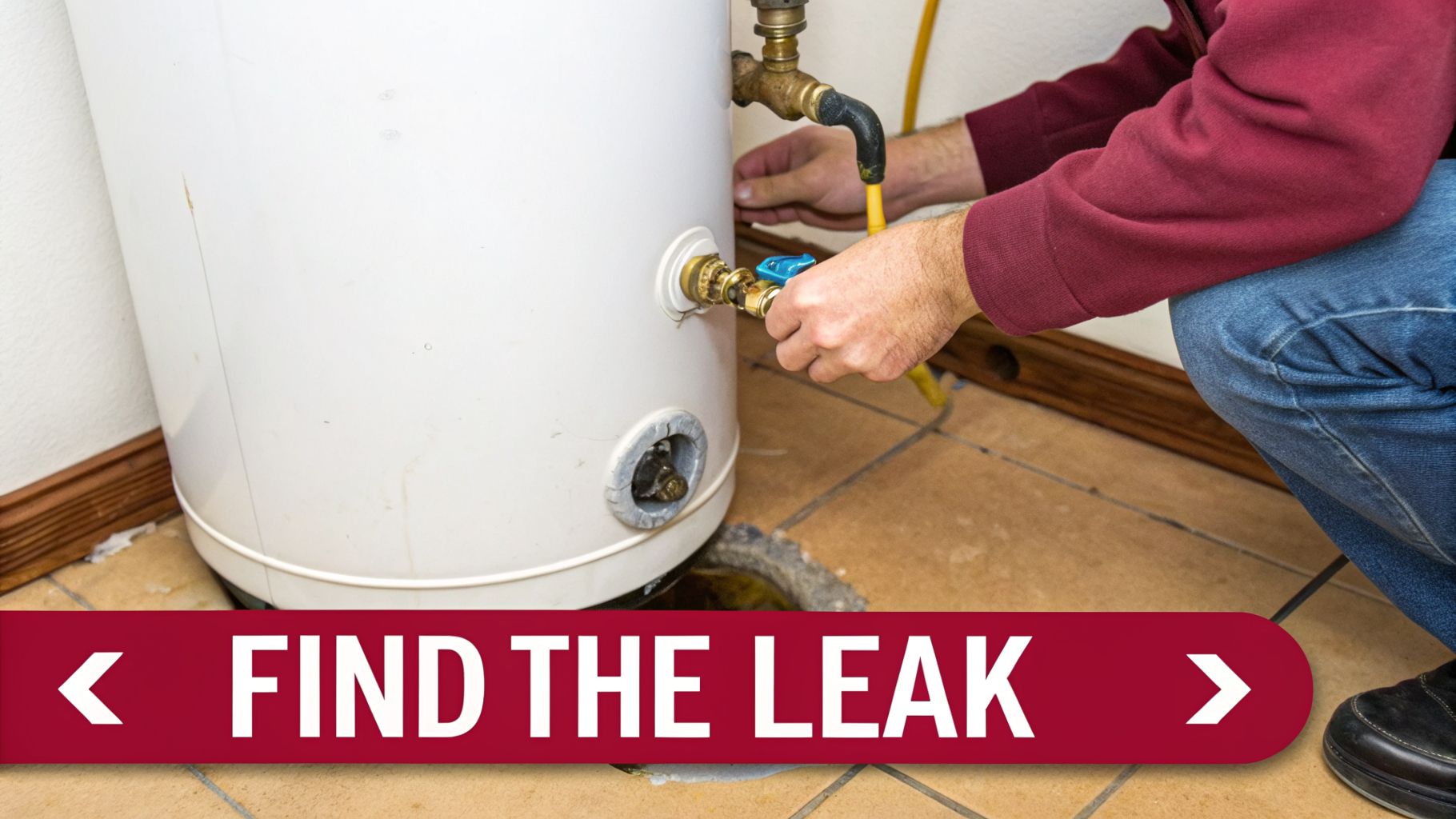
Alright, now that you've got the immediate flood risk under control, it's time to figure out exactly where that water is coming from. Seeing a water heater leaking from bottom is alarming, but it doesn't automatically mean you need a new unit. Often, the real leak is from a component on the heater, and gravity is just pulling the water down to the floor.
Your goal is to trace that water back to its source. Doing this little bit of detective work will tell you whether you're dealing with a simple fix or if it's time to start shopping for a replacement. Before you start, grab a good flashlight and a roll of paper towels—you'll need them.
Check the Obvious Suspects First
Before you assume the worst (a rusted-out tank), let's check all the external parts. Water is sneaky and will always follow the path of least resistance, so a tiny drip from the top can look like a major leak at the bottom. Start by thoroughly drying the entire outside of the water heater, including all the pipes and the floor around it.
Once everything is dry, watch it like a hawk. You're looking for the very first drop to reappear.
- Temperature & Pressure (T&P) Relief Valve: This is a critical safety valve, usually found on the top or side, with a discharge pipe that runs down toward the floor. If it's the culprit, you'll see water trickling out of the end of that pipe.
- Drain Valve: Look for the spigot-like valve near the very bottom of the tank. Over time, these can wear out and start to drip, either from the spout itself or from where the valve screws into the tank.
- Inlet and Outlet Connections: Check the hot and cold water lines at the very top of the tank. It's common for these connections to loosen or corrode, causing a slow leak that travels down the side of the tank.
If you spot water coming from any of these places, take a breath. It’s almost certainly a repair job, not a total replacement. But if all these parts are bone dry and a puddle is still forming, it points to a more serious internal problem.
Expert Insight: A constantly weeping T&P valve might not just be a faulty valve. It could be a symptom of excessive pressure building up in your tank or home plumbing. Simply replacing the valve might stop the drip for now, but you need to find out why it was activated to prevent a much bigger, more dangerous failure down the road.
The Paper Towel Test for a Leaking Tank
If you've checked all the external fittings and they’re dry, it's time to confirm if the tank itself has failed. When a water heater leaking from bottom is due to internal rust, you won't see a visible crack. The water seeps through the steel tank, soaks the insulation, and then drips out from underneath the outer metal jacket.
Here’s the definitive test: take a few dry paper towels and tuck them up under the bottom rim of the water heater's outer shell. Leave them there for 15-30 minutes.
If those paper towels come out wet, that’s your answer. The internal tank is breached. There's no way to patch or repair this kind of failure; a full replacement is your only option. Knowing how to diagnose different household leaks is an invaluable skill. If you're dealing with other water intrusion issues, guides like A Homeowner's Guide to Skylight Repairs can offer similar step-by-step advice.
What Your Findings Mean
To help you make sense of it all, here’s a quick chart to determine the source of your leak and what it means.
Identifying Your Water Heater Leak Source
Use this table to help determine where the water is coming from and what it likely means for your water heater.
| Symptom | Potential Cause | Likely Solution | Urgency Level |
|---|---|---|---|
| Water dripping from a pipe on the side of the tank. | Leaking T&P Relief Valve | Repair/Replacement | High |
| Water seeping from the spigot at the bottom. | Faulty Drain Valve | Repair/Replacement | Medium |
| Drips running down the side from the top connections. | Loose Inlet/Outlet Connections | Repair (Tightening) | Medium |
| Water seeping from under the heater's metal jacket. | Internal Tank Corrosion/Failure | Full Replacement | Critical |
For more complex diagnostics, especially if you have a gas unit, consulting a detailed gas hot water heater troubleshooting guide can provide extra insight.
Ultimately, knowing exactly where the water is coming from is everything. It's the difference between scheduling a quick service call and planning for a major appliance replacement.
Repair or Replace? Making the Right Call for Your Water Heater
So, you've managed to stop the water and you have a good idea of what's leaking. Now for the tough question every homeowner dreads: do you fix it or replace it? It's a tricky decision. You don't want to spend good money on a unit that's on its last legs, but you also don't want to replace a heater that just needs a simple, inexpensive fix.
If you discovered that the main tank itself has rusted through and is leaking, the decision is already made. There's no coming back from that. A breached tank cannot be repaired, and a full replacement is the only safe option.
But if the leak is coming from a component like the T&P valve or a plumbing connection, a repair is usually the way to go, especially on a younger unit. It really boils down to three things: the source of the leak, the age of your heater, and the cost. Let's walk through how to weigh these factors like a pro.
Cost Breakdown: Repair vs. Replace
Let's be honest—cost is usually the biggest factor. A straightforward repair will always be cheaper upfront than a brand-new installation. The catch? If your water heater is getting old, that "cheap" repair could just be the first of many.
Here's a look at some realistic 2026 cost estimates we see for common repairs:
- T&P Valve Replacement: This is a frequent fix and a crucial safety part. Expect to pay between $150 and $350. For an otherwise healthy tank, this is money well spent.
- Drain Valve Replacement: Another common source of drips. This repair typically runs from $175 to $400, depending on the valve type and how easy it is to access.
- Tightening Connections: If it's just a loose water line fitting, you might only be looking at a standard service call fee, which is a much smaller expense.
Those repair costs look pretty good next to the price of a full replacement. Installing a new, standard tank-style water heater is a much bigger investment.
A new standard tank water heater installation typically ranges from $1,200 to $2,500. This price includes the new unit, labor, and disposal of your old tank. Opting for a high-efficiency or tankless model will increase that initial investment.
Looking at the numbers alone, a small repair seems like a clear winner. But this is where the age of your unit becomes the all-important tie-breaker.
The 8 to 10 Year Rule
I often tell homeowners to think of their water heater's lifespan like a car's. You wouldn't sink a few thousand dollars into a new engine for a 20-year-old car with a rusted-out frame, right? The same logic applies here. Most traditional tank water heaters are built to last somewhere between 8 and 12 years.
This brings us to what we in the industry call the "8-10 Year Rule." It's a simple guideline we use every single day.
If your water heater is 8 years old or more and has a major part fail (something beyond a loose fitting), it's rarely a good idea to invest hundreds of dollars into a repair. The odds are just too high that another component is right behind it on the way out.
For instance, spending $300 to replace a valve on a 10-year-old heater might feel like a victory. But if the tank itself fails six months later—and it very well could—that $300 is gone for good. In that case, putting the money toward a new, more efficient unit is a much smarter long-term play.
When Repair Makes The Most Sense
Sometimes, a repair is absolutely the right call. If you find yourself in one of these situations, you can schedule a fix with confidence.
- The Heater is Young: If your unit is less than 5-6 years old, repairing it is almost always the best option. A leak on a young heater is typically due to a single faulty part, not a sign that the whole system is failing.
- The Leak is External: As you diagnosed earlier, water coming from the T&P valve, drain valve, or pipe fittings is an external problem. These parts are designed to be replaced without having to touch the tank itself.
- You've Kept Up with Maintenance: Have you been getting your unit professionally flushed every year? Good maintenance can stretch a heater's lifespan. Repairing a well-cared-for 9-year-old unit can be a perfectly reasonable decision.
Choosing between a repair and a full replacement can feel overwhelming. If you want to learn more about the specifics, our guide on how to fix a water heater breaks down the individual repair jobs in more detail. By taking an honest look at the cost, the age of your unit, and where the leak is coming from, you can make the most logical and cost-effective choice for your home.
Preventing Future Water Heater Leaks and Failures
After dealing with a mess like a water heater leaking from bottom, the last thing you want is a repeat performance. Thankfully, you can be proactive. A little bit of preventative maintenance goes a long way in extending your heater’s life and keeping you out of emergency mode.
The whole game is about stopping problems before they even start. By getting ahead of a water heater's two biggest enemies—sediment and corrosion—you can keep your unit humming along safely and efficiently for years. These simple checks can be the difference between getting a full decade out of your heater or facing another costly replacement way too soon.
Flush the Tank Annually
If you only do one thing for your water heater, make it this: flush the tank once a year. I can't stress this enough. It's the single most effective way to prevent the internal corrosion that causes most bottom leaks.
Over time, minerals and gunk from the water supply settle into a nasty sludge at the bottom of the tank. This layer causes a couple of big problems:
- It smothers the heating element or burner, forcing it to work overtime just to heat the water. This wastes a lot of energy.
- More critically, it traps water directly against the tank's steel bottom, which is a perfect recipe for rust and corrosion to eat right through the metal.
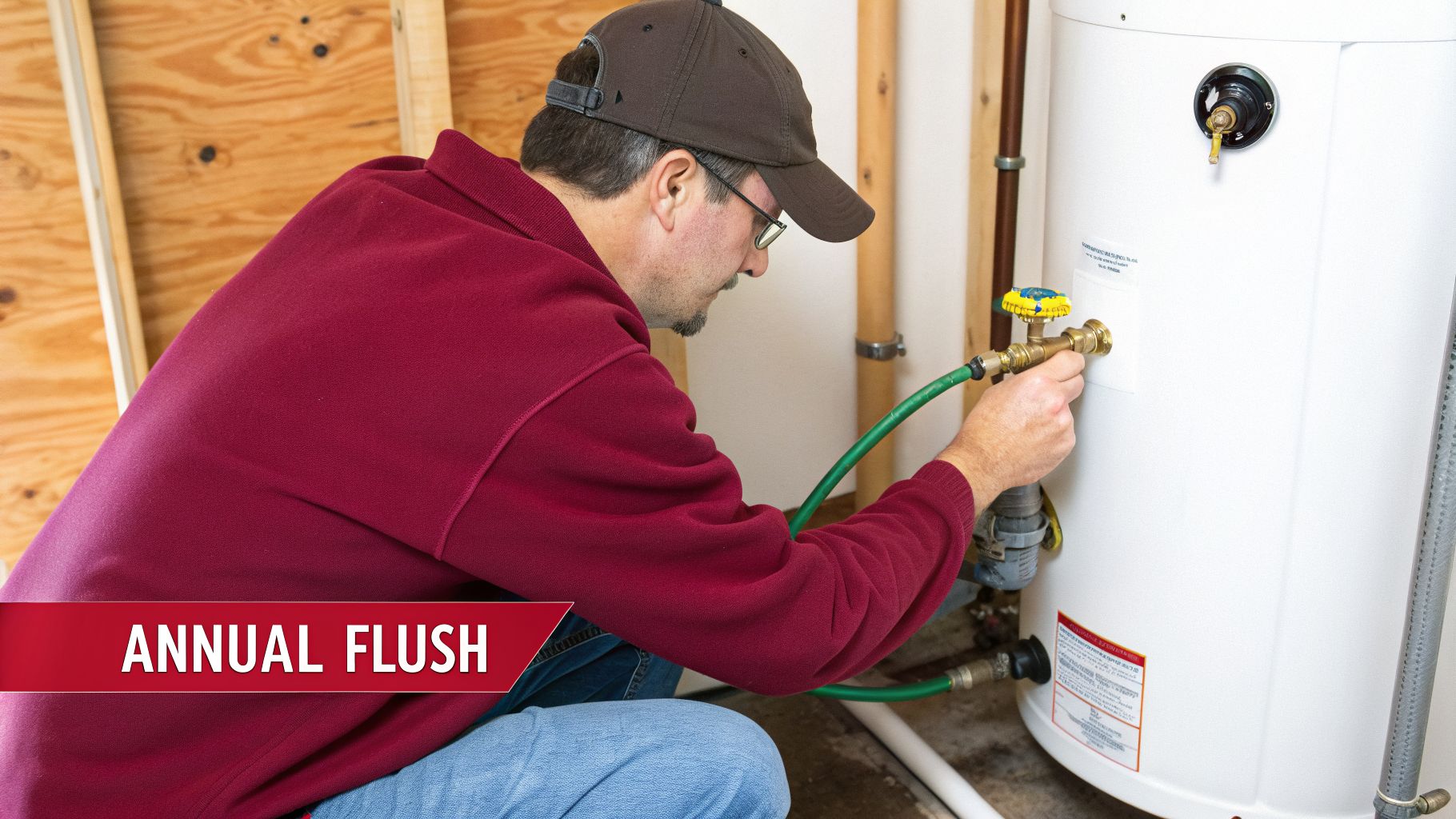
Flushing is pretty straightforward. You just hook up a garden hose to the drain valve, run it outside or to a floor drain, and let it run until the water comes out clear. This simple process clears out all that harmful sediment, protecting the tank's interior and keeping your heater from working itself to death. For anyone in the Greater Philadelphia area, where we have notoriously hard water, this annual flush is non-negotiable.
Inspect the Anode Rod
Tucked away inside your water heater is a hidden hero called the anode rod. It's a long metal rod, usually magnesium or aluminum, and its entire job is to rust so your tank doesn't. Think of it as a decoy that takes the hit from corrosive elements in the water.
The anode rod is your tank's first and best line of defense against rust. Once it's completely sacrificed, the water immediately starts attacking the tank's steel lining. That's when the clock starts ticking toward a leak.
You'll want to have the anode rod checked every 3 to 5 years. A good plumber can easily do this during a routine flush. If more than half of the rod is gone, or if it's caked in calcium deposits, it’s time to replace it. It's a cheap fix that can literally add years to the life of your water heater.
Install a Water Leak Detector
For the ultimate peace of mind, think about installing a water leak detector with an automatic shut-off valve. These smart little gadgets sit on the floor right next to your heater. The second they sense any moisture, they trigger an alarm and, more importantly, automatically close the main water valve to the unit. A potential flood is stopped before it can even begin.
This isn't just a gimmick; it's quickly becoming standard equipment for smart homeowners. The global market for these devices, valued at $1.3 billion in 2024 and projected to reach $2.2 billion by 2034, shows just how seriously people are taking water damage prevention. You can learn more about this growing market in this industry analysis of water leak detectors. When you consider that the water heater tank market is an $11.5 billion industry on its own, protecting that investment makes a lot of sense.
By combining an annual flush, regular anode rod checks, and a modern leak detector, you’re building a powerful defense against ever having a water heater leaking from bottom again.
Common Questions About A Leaking Water Heater
When you find your water heater is leaking from bottom, it’s natural to feel a wave of panic. That puddle on the floor brings a flood of questions about safety, cost, and just what on earth to do next. We get these calls every day, so let’s get right to the clear, direct answers you need in that stressful moment.
Having straightforward information is the first step to getting the situation under control. Knowing what to do—and what not to do—can be the difference between a simple fix and a major disaster.
How Long Will It Last Once It Starts Leaking From The Bottom?
This is always the first question, and the honest answer isn't comforting: it is completely unpredictable. When a tank is leaking from the bottom, it's almost always due to internal rust and corrosion, which means the structural integrity is gone. It's a ticking time bomb.
I’ve personally seen tanks go from a few drips to a full-blown flood in just a couple of hours. I've also seen a slow seep last a day or two before the bottom finally gives out. The only guarantee is that total failure is not a matter of if, but when.
Don't ever try to "wait it out." A water heater tank is under a lot of pressure. A sudden rupture can dump 40 or 50 gallons of water in just a few minutes, causing a catastrophic flood that will destroy drywall, flooring, and anything else in its path.
Can I Still Use Hot Water If It Is Leaking?
Let me be perfectly clear: NO. Absolutely not. Trying to get a little more hot water out of a leaking heater isn't just a bad idea; it's genuinely dangerous.
For one, if you have an electric model, you're mixing water and high-voltage electricity. That's a serious risk of electrocution. Secondly, every time you turn on a hot water tap, you're forcing cold water into the tank. This adds more pressure to the already-failing vessel and literally feeds the leak, speeding up the inevitable rupture.
For your own safety and to prevent massive property damage, you need to follow the emergency shutdown steps immediately. That means killing the power (or gas) and turning off the cold water supply valve to the tank.
Does Homeowner's Insurance Cover A Leaking Water Heater?
This is a very common point of confusion, and the answer has two distinct parts. In general, your homeowner's policy will not pay to replace the water heater itself. The appliance is considered your responsibility to maintain and replace when it wears out.
However, the good news is that most standard policies do cover the resulting water damage from a sudden and accidental failure. This is a critical distinction.
- What's typically covered: The cost to tear out and replace soaked drywall, repair ruined flooring or carpet, professionally dry out the structure, and handle any mold remediation.
- What's not covered: The cost of the new water heater and the labor for the installation.
We have a lot of experience helping homeowners in the Greater Philadelphia area with these situations. We can provide the detailed documentation your insurance company will need and even coordinate with the adjuster to make sure your claim for the water damage restoration is handled smoothly. Navigating an insurance claim adds another layer of stress, so having a professional advocate can make a huge difference. Still, it's always wise to review your specific policy to understand your exact coverage.