

Emergency Gas Pipe Repair — West Philadelphia
Gas Pipe Repair
in West Philadelphia
Victorian Risers, Multi-Unit Branch Lines, Conversion-Era Piping — Licensed Gas Pipe Repair for West Philly's Unique Housing Stock. Same-Day Emergency Service.
Gas piping in a West Philadelphia Victorian twin or multi-unit conversion isn’t like piping in a standard single-family home. It runs vertically through 3-4 story wall chases, branches to multiple apartments at each floor, and often contains a patchwork of materials from different eras — original 1890s black iron, 1960s galvanized additions from the first apartment conversion, and modern CSST added during a recent renovation. Every joint between eras is a potential failure point. Precision Plus Plumbing provides expert gas pipe repair across every West Philly neighborhood — for single-family Victorians, converted multi-units, and everything in between. We identify the pipe material, trace the routing through your building, and make code-compliant repairs that pass PGW inspection — typically same day.
- 4.9 Star Rating (312+ Reviews)
- Licensed & Insured
- Same-Day Service

Watch How Precision Plus Detects Gas Leaks
For West Philadelphia Landlords: Gas Pipe Maintenance Responsibilities
What You Own and What PGW Owns
PGW owns and maintains the gas main in the street. The service lateral from the main to your building’s meter is YOUR responsibility. All gas piping from the meter into the building — risers, branches, appliance connections — is YOUR responsibility to maintain. This includes piping inside tenant-occupied units.
Common Liability Triggers
- PGW finds a leak during routine inspection → building shutoff, all tenants affected
- Tenant-installed gas appliance with unapproved connector → code violation, shutoff
- Old conversion piping without individual unit shutoff valves → code violation
- Corroded riser or branch line causing gas smell → potential health liability
Proactive Maintenance Recommendation
Annual building-wide gas system inspection catches small problems before they become PGW shutoff events. Precision Plus offers annual maintenance agreements for multi-unit West Philly landlords — including inspection, minor repairs, and documentation for your insurance records.
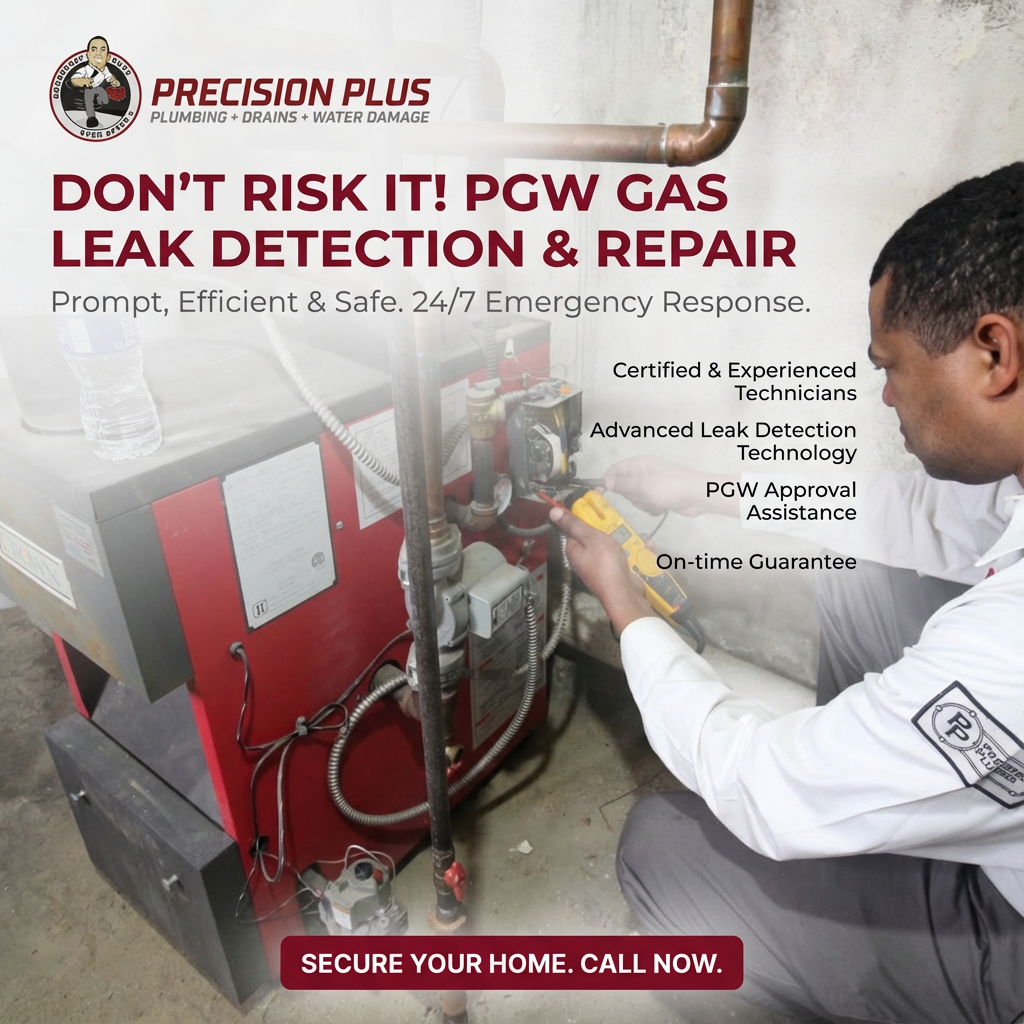
Repair, Replace, or Upgrade? A Gas Piping Guide for West Philadelphia Property Owners
1
Section Repair — Fix What's Broken
One corroded riser fitting, one failed transition joint, one leaking branch connection. Targeted repair, minimal disruption, lowest cost. Best when the overall system is sound and the failure is isolated.
TYPICAL COST: $200–$800
2
Branch Line Replacement — Upgrade One Unit's Piping
The branch line serving one apartment is corroded throughout or was installed with substandard materials during an old conversion. We replace the entire branch from the riser to the unit’s appliances — with new Schedule 40 pipe, individual shutoff valve, and code-compliant connections.
TYPICAL COST: $600–$1,500 per unit branch
3
Full Riser Replacement — The Building-Wide Solution
The main vertical riser is 100+ years old, corroding at multiple points, and failing pressure tests repeatedly. A full riser replacement — from basement meter to top-floor branch-off — is the most thorough and long-term solution. Includes new branch connections at each floor.
TYPICAL COST: $2,500–$6,000+ depending on building height and complexity
4
Multi-Unit Code Upgrade
Your building’s gas piping technically “works” but doesn’t meet current code — no individual unit shutoff valves, unapproved transition fittings, missing drip legs, improper support brackets. PGW can flag these during inspections. A proactive code upgrade prevents shutoffs and protects your liability.
TYPICAL COST: $1,000–$3,000 building-wide
Gas Piping in West Philadelphia Homes — A Building With Multiple Eras of Pipe
South Philadelphia row homes typically have one generation of gas piping — original black iron, top to bottom. West Philadelphia properties are different. A Victorian twin converted to apartments in the 1960s, partially renovated in the 1990s, and updated again recently may have three or four different pipe materials in the same building — each installed to the code standards of its era, each aging differently, and each requiring a different repair approach. For row home pipe materials and horizontal basement repairs, see our South Philadelphia gas pipe repair page.
Original Black Iron (1880s–1920s Victorian Era)
FOUND IN: Main risers, basement mains, original appliance connections in Victorian twins across Spruce Hill, Cedar Park, Walnut Hill
HOW IT FAILS IN WEST PHILLY: Vertical risers are longer (3-4 stories vs 2 in row homes), creating more joints and more stress points. Thread compound on joints installed 100+ years ago has fully dried out. Settling of tall Victorian structures puts shear stress on rigid vertical fittings.
REPAIR APPROACH: Cut out corroded sections, replace with Schedule 40 black steel, re-thread and re-seal all disturbed joints. In multi-story risers, work from basement up.
CONDITION: Most West Philly Victorian black iron is 100-140 years old — well past any reasonable service life.
Mid-Century Galvanized Additions (1950s–1970s Conversion Era)
FOUND IN: Branch lines added during apartment conversions — typically running from the main riser to individual unit’s stoves, heaters, and water heaters
HOW IT FAILS IN WEST PHILLY: Internal zinc coating has deteriorated, creating rust buildup that narrows the pipe and weakens walls. Transition fittings where galvanized meets original black iron are high-failure points.
REPAIR APPROACH: Section replacement with black steel (galvanized is no longer code-approved for new gas installations). Transition fittings replaced with code-compliant dielectric unions.
CSST — Corrugated Stainless Steel Tubing (1990s–Present)
FOUND IN: Recent renovations, new appliance runs, rerouted lines in updated apartments
HOW IT FAILS IN WEST PHILLY: Lightning damage if not properly bonded/grounded, puncture from nails or screws during renovation, improper fittings. In multi-unit buildings, CSST may be routed through wall cavities alongside electrical wiring — requiring proper separation per code.
REPAIR APPROACH: Replace damaged section with new CSST using manufacturer-approved fittings. Verify bonding/grounding. CSST requires certified training — not all plumbers are qualified.
Copper Gas Pipe (Various Eras)
FOUND IN: Occasionally in West Philly properties, usually for specific short runs to individual appliances
HOW IT FAILS: Pinhole leaks from corrosion, joint failures at flare fittings, incompatibility with certain gas types.
REPAIR APPROACH: Section replacement with approved copper or transition to black steel. Must meet current Philadelphia code for material type and fitting method.
Common Gas Pipe Problems in West Philadelphia Properties
These are the gas pipe repair scenarios we encounter most often across West Philly’s Victorian twins and multi-unit conversions:
Corroded Vertical Riser Sections
The main gas riser runs from the basement through 3-4 stories of wall chase. In Victorian buildings, this pipe has been inside a damp, unventilated chase for 100+ years. Corrosion at threaded joints within the chase is the most common — and most difficult to access — failure point in West Philly's tall properties. Repair requires opening the chase at the failure point, replacing the corroded section, and resealing the chase.
Multi-Era Transition Joint Failures
Where original black iron meets conversion-era galvanized, or where galvanized meets modern CSST, the transition fitting is subject to galvanic corrosion (dissimilar metals reacting), differential thermal expansion, and incompatible thread types. These joints fail under pressure test conditions and during normal use.
Conversion-Era Branch Line Deterioration
Branch lines added when a single-family Victorian was split into apartments are now 40-60 years old. They were often installed quickly and cheaply — undersized pipe, minimal fittings, no shutoff valves per unit. These lines develop leaks at fittings, at wall penetrations, and where they connect to the main riser. Repair often involves upgrading the branch to current code, including adding individual unit shutoff valves.
Concealed Pipe Runs Behind Plaster-and-Lathe
Victorian-era gas pipes run through internal wall chases and behind plaster-and-lathe walls that may contain ornate millwork, original crown molding, or decorative plaster. Accessing a concealed leak requires careful, minimal demolition — not tearing out an entire wall. We use thermal imaging and ultrasonic detection to pinpoint the exact location before cutting, minimizing damage to the historic fabric of the building.
Gas Supply Lines to Multi-Unit Heating Equipment
In converted multi-units, each apartment's furnace or boiler and water heater connects to the gas system via its own supply line. Over time, these connections — especially in damp basements — corrode, loosen, or develop leaks at the appliance valve. We repair both the pipe and the appliance connection in a single visit.
Underground Lateral Line Damage
The gas service lateral from the PGW street main to your building's meter runs under the sidewalk and front yard. West Philly's mature tree root systems, trolley vibration along Baltimore and Lancaster Avenues, and decades of freeze-thaw cycles can crack or shift this line. Lateral repair is the homeowner/landlord's responsibility — not PGW's — and requires excavation.
Gas Pipe Repairs in West Philadelphia — Our Work
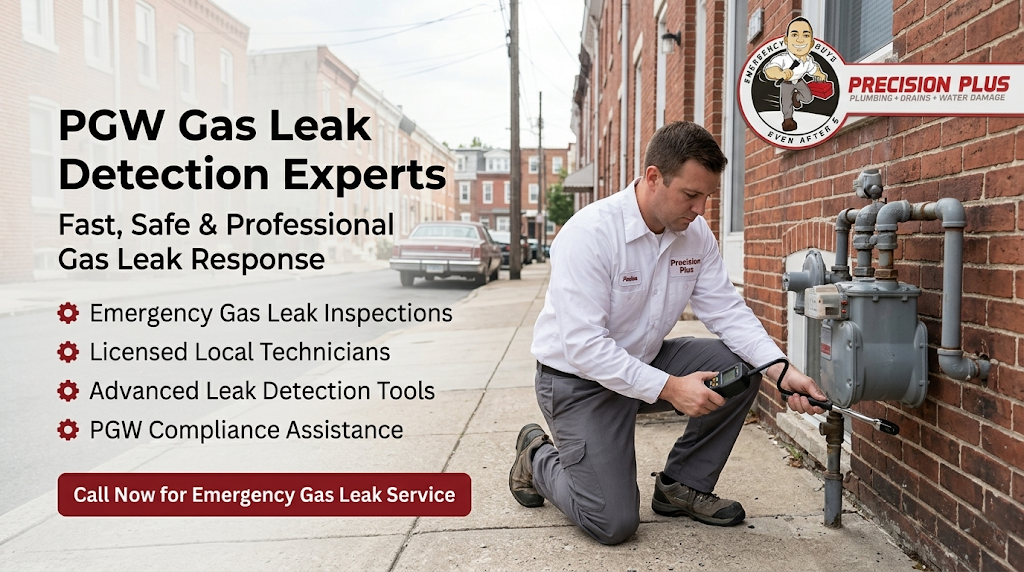
Spruce Hill — Full Riser Replacement in Victorian Twin
A 1895 Victorian twin had failed three consecutive pressure tests. The vertical riser — original black iron running through a plaster chase from basement to third floor — had developed corrosion at every floor penetration fitting. We replaced the full riser with new Schedule 40 black steel, added individual shutoff valves at each floor, and passed the building-wide pressure test on the first attempt. The job took two days and saved the owner from repeat emergency calls.
Cobbs Creek — Multi-Era Transition Failure in 3-Unit
A 3-unit conversion had a persistent gas smell that two previous companies couldn't locate. Our material survey found the leak at a galvanized-to-CSST transition fitting hidden behind a second-floor kitchen soffit. The fitting was a hardware-store compression coupling — not a code-approved transition. We replaced it with a proper dielectric union and CSST manufacturer fitting, tested, passed.
University City — Conversion Branch Line Upgrade
An investor-owned 4-unit near 40th Street had branch lines from a 1960s conversion serving each apartment — undersized galvanized pipe with no individual shutoff valves. PGW flagged the lack of shutoffs during an inspection. We replaced all four branch lines with properly sized black steel, added individual shutoff valves per unit, and brought the building to current code — preventing a potential building-wide shutoff.
Our Gas Pipe Repair Process for West Philadelphia Properties
From diagnosis to pressure test — every step handled by a licensed master plumber.
1
Emergency Response & Safety Assessment
Call 24/7. We dispatch a licensed plumber same-day. On arrival, we assess gas accumulation, ventilate if needed, and confirm the meter is off. In multi-units, we verify all units are safe before beginning diagnostic work.
2
Building-Wide Pipe Material Identification
We identify every pipe material in the building — original black iron risers, conversion-era galvanized branches, modern CSST additions, copper runs. We trace the gas routing through the building, including concealed vertical chases and floor penetrations. In multi-units, we inspect every unit's branch line and appliance connections.
3
Repair Plan & Upfront Estimate
Written estimate detailing what needs repair, what materials are used, and total cost. For multi-unit buildings with multiple issues, we present a prioritized repair plan. You approve before any work starts.
4
Code-Compliant Repair
We repair or replace failed sections using materials that meet current Philadelphia code. In West Philly multi-units, this commonly includes: riser section replacement, transition fitting upgrades between pipe materials, branch line replacement with proper shutoff valves per unit, and concealed chase access with minimal demolition.
5
Pressure Testing & Verification
After repair, we perform a full building-wide gas line pressure test" to verify zero leaks. In multi-units, this is a single system-wide test covering every unit's piping.
6
PGW Coordination & Service Restoration
If gas was shut off, we submit passing test results directly to PGW and coordinate meter reconnection. PGW restoration process handled for you — typically 24-48 hours.
West Philadelphia Property Owners Trust Precision Plus for Gas Pipe Repair
Trustindex verifies that the original source of the review is Google. Great service, very professiona,l on time, cleaned up afterwards, very respectable. I would definitely be calling him for all my needs. Before I go to anybody else for anything, i will call Precision Plus first. Five out of five stars for meTrustindex verifies that the original source of the review is Google. Precision Plus Plumbing came out the next day and quickly got to work. They showed real care for our children’s well-being and handled everything with professionalism and compassion. Highly recommend!Trustindex verifies that the original source of the review is Google. Derrick was very efficient and professional. He explained what needed to be done in detail and completed the job in a timely manner. I am very pleased with the result.Trustindex verifies that the original source of the review is Google. Derrick from Precision Plumbing, performed mold testing, was quick, professional and efficient!Trustindex verifies that the original source of the review is Google. Derrick was quick assessing my issues problem solved in no time great job thanks so muchTrustindex verifies that the original source of the review is Google. QUALITY 5 STARSTrustindex verifies that the original source of the review is Google. Great experience! Quick turnaround on a Saturday. Fixed the issue and was a pleasure to work with.
Gas Pipe Repair — West Philadelphia Neighborhoods
We repair gas pipes in single-family, twin, and multi-unit properties across all of West Philadelphia:
University City
Philadelphia, PA
Spruce Hill
Philadelphia, PA
Cedar Park
Philadelphia, PA
Cobbs Creek
Philadelphia, PA
Haddington
Philadelphia, PA
Overbrook
Philadelphia, PA
Walnut Hill
Philadelphia, PA
Angora
Philadelphia, PA
West Philadelphia
Philadelphia, PA
Whether you need emergency repair of a leaking riser, replacement of conversion-era branch piping, or a proactive code upgrade for your multi-unit — Precision Plus provides same-day gas pipe repair across all of West Philadelphia. For a full overview of our gas services, visit our West Philadelphia gas leak detection page.
Serving All of West Philadelphia for Gas pipe repair Emergencies
Precision Plus Plumbing responds to PGW gas shutoff emergencies across every zip code in Philadelphia. Whether you’re in a row home in West Philly, a twin in the Northeast, or a brownstone in Center City — we’ll be there same-day.

Derrick Jackson
Founder & Master Plumber
Since opening our doors in 1999, Precision Plus Plumbing has had one goal in mind: save busy homeowners time and frustration.
When you hire Precision Plus, you’re benefiting from a proven local business that knows your home, is familiar with older plumbing, and will educate you on what caused your problem — while discussing options on how to prevent them from happening again.
“We made the decision to provide clients with a unique experience that busy homeowners would be proud of. Our techs show up on time, do not smell like the sewer, and can resolve most problems on the initial service call.”
What started as a commitment to better service has grown into the area’s most trusted name for emergency plumbing, water damage restoration, and mold services — serving Pennsylvania, Delaware, and New Jersey.
Gas Pipe Repair FAQ — West Philadelphia
My West Philly Victorian has multiple types of gas pipe. Is that normal?
Very common. A typical West Philly Victorian twin that’s been converted or renovated may have original black iron risers (1880s–1920s), galvanized branch additions from a 1960s apartment conversion, and modern CSST from a recent renovation. Our inspection identifies every material before recommending repairs — because each type fails differently and requires different techniques
How do you access a gas pipe leak inside a Victorian wall chase?
We use thermal imaging and ultrasonic detection to pinpoint the exact location before cutting anything. Then we create the smallest possible access opening at the failure point — usually a panel that can be patched or covered with an access door. We do not tear out entire walls or damage ornate Victorian millwork unnecessarily.
I own a multi-unit — am I responsible for the gas pipes inside tenant apartments?
Yes. Philadelphia code places all gas piping maintenance — from the meter through every unit — on the property owner. This includes branch lines inside individual apartments, even if a tenant’s actions contributed to the problem. We provide documented invoices and repair reports for your records and insurance.
How much does gas pipe repair cost in a West Philly multi-unit?
Single fitting or joint repair: $200–$800. Full branch line replacement per unit: $600–$1,500. Full vertical riser replacement (3-4 stories): $2,500–$6,000+. Building-wide code upgrade (shutoff valves, transition fittings, support brackets): $1,000–$3,000. Written estimate before any work.
My building keeps failing pressure tests. What should I do?
Repeated failures usually indicate systemic issues — not just one bad joint. Common causes in West Philly multi-units: corroded riser at multiple floor penetrations, multiple conversion-era fittings at end of life, or improperly capped abandoned lines. A comprehensive building survey and planned repair/replacement is usually more cost-effective than repeated spot fixes. We provide a full assessment and quote for both approaches.
Can you repair CSST gas tubing?
Yes. We’re certified in CSST installation and repair. Damaged CSST sections are replaced with new tubing using manufacturer-approved fittings. We also verify that the CSST bonding/grounding meets current code — a common deficiency in older installations that increases lightning damage risk.
What's the difference between the gas pipe going to my building and the pipe inside?
PGW owns and maintains the gas main in the street. The service lateral (underground pipe from the main to your meter) is YOUR responsibility. All piping from the meter inward — risers, branches, connections — is yours to maintain. If the lateral fails, we diagnose and repair it with excavation.
Do I need a pressure test after gas pipe repair?
Yes. PGW and Philadelphia code require a certified pressure test after any gas pipe repair. We perform this as standard — building-wide in multi-units — and submit results to PGW for service restoration.
More Gas Services in West Philadelphia
Gas pipe repair is just one of the gas services we provide across West Philadelphia’s row home neighborhoods. Explore our other specialized services below.
PGW Gas Leak Repair
PGW shut off your gas? We repair, test, and coordinate restoration for the entire building.
Pressure Test Gas Line
Building-wide pressure testing for PGW restoration, permits, and new installations.
Gas Heater Repair
Furnace or boiler not firing? Same-day diagnosis and repair for West Philly homes.
Gas Water Heater Repair
No hot water? Gas water heater diagnosis, repair, and replacement.
Electric Water Heater Repair
Element failure, thermostat problems, or gas-to-electric conversion.
Leaking Gas Pipe in West Philadelphia? Don't Wait — Call Now.
Same-day repair for Victorian twins, multi-units, and every building type. Licensed since 1999.