

Certified Gas Line Testing — West Philadelphia
Gas Line Pressure
Testing in West Philadelphia
Building-Wide Pressure Testing for Victorian Twins, Multi-Unit Conversions, and PGW Restoration. Certified Results. Same Day.
Pressure testing a gas system in a West Philadelphia Victorian twin or multi-unit conversion is fundamentally different from testing a single-family home. Multiple apartments sharing one gas riser. Three-to-four story vertical piping runs concealed in plaster wall chases. Tenants on every floor who need to coordinate access. And one failed joint anywhere in the building means PGW won’t restore gas to ANY unit. Precision Plus Plumbing provides certified building-wide pressure testing across every West Philly neighborhood — with experience navigating the complexity that Victorian and multi-unit construction demands.
- 4.9 Star Rating (312+ Reviews)
- Licensed & Insured
- Same-Day Service



Watch How Precision Plus Detects Gas Leaks
For West Philadelphia Landlords: Pressure Testing Your Multi-Unit Property
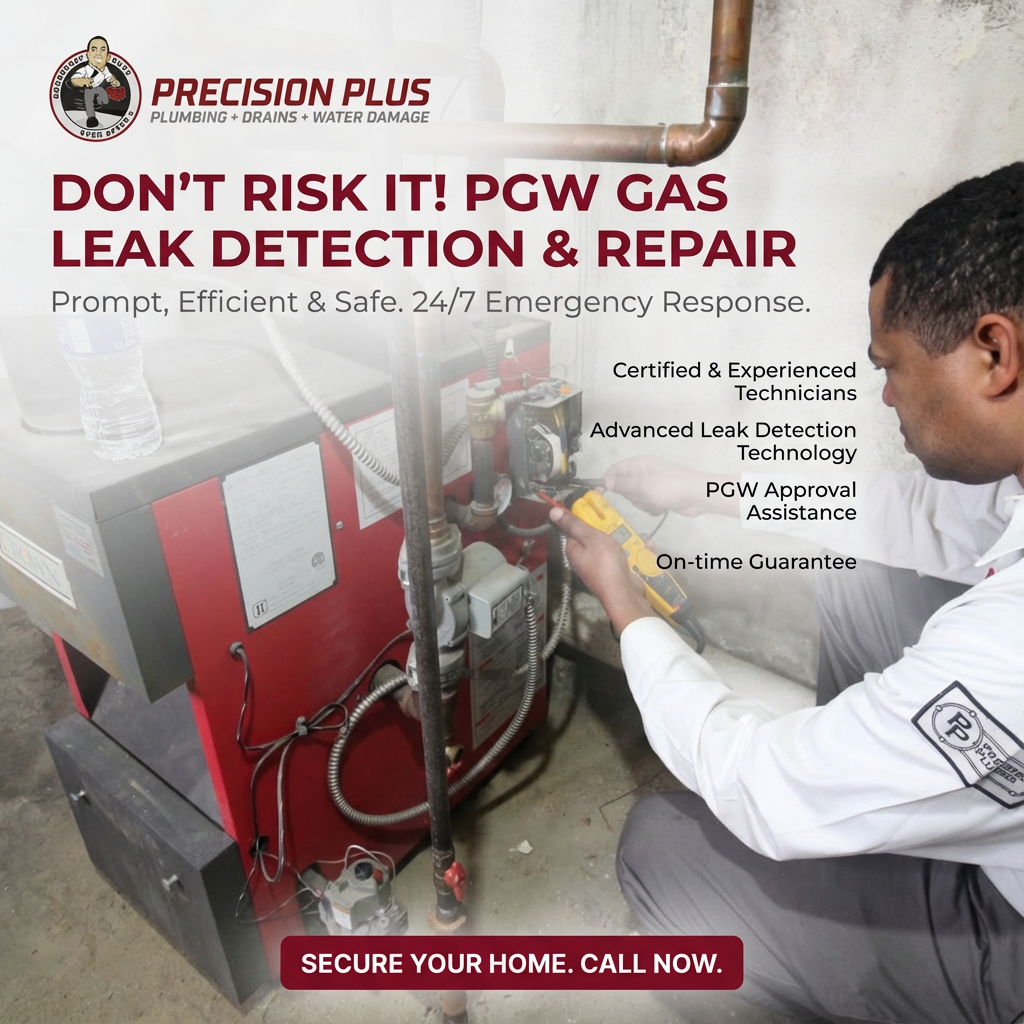
If you notice a sulfur or rotten egg odor in your West Philadelphia home, it may indicate a PGW gas leak requiring immediate action. In West Philly’s Victorian twins and multi-unit buildings, the risk compounds quickly — gas migrates through shared center walls, between floor levels in converted buildings, and through original piping chases that connect units in ways that aren’t visible.
If you smell gas in your West Philly home:
- Do not use electrical switches — Victorian-era wiring combined with gas accumulation is especially dangerous
- Do not attempt to relight any appliances — in multi-unit buildings, gas may have accumulated on a floor you can't see
- Alert all occupants on every floor — landlords: notify all tenants immediately; tenants: alert your neighbors and your landlord
- Leave the building and call PGW at 1-888-427-5325, then Precision Plus at (484) 436-4190
Why Gas Line Pressure Testing Is More Complex in West Philadelphia Properties
A pressure test in a single-story ranch home takes 30 minutes. A building-wide test in a West Philly Victorian multi-unit can take half a day — and for good reason. Here’s what makes it different:
Multi-Story Vertical Risers
West Philly's Victorian twins and multi-units are 3-4 stories tall. Gas piping runs vertically through the building — from the basement meter up through wall chases to appliances on every floor. Each floor has branch connections, and each branch is a potential failure point. Testing a vertical riser system requires pressurizing from the basement and systematically checking every floor.
Unit-by-Unit Isolation
In a multi-unit building, each apartment has its own branch line off the main riser. When the building-wide test fails, we need to isolate each unit's branch to determine which one is leaking. This means capping or valving off each apartment's gas connection one at a time and retesting — a process that requires access to every unit and careful documentation.
Concealed Victorian Piping
Victorian-era gas pipes run through internal wall chases, behind plaster-and-lathe, and through floor penetrations between levels. If a test fails and the leak is in a concealed vertical run, accessing the repair point requires careful demolition planning — especially in properties with ornate Victorian millwork that owners want to preserve.
Tenant Access Coordination
You can't test what you can't reach. Building-wide pressure testing requires every unit to be accessible — gas connections must be inspected, sealed, and monitored. If one tenant isn't home or refuses access, the test can't be completed and PGW won't accept the results. We coordinate access scheduling with landlords in advance.
Accumulated Modifications Across Decades
A Victorian home converted to apartments in the 1960s, re-renovated in the 1990s, and partially updated again in 2015 may have three different eras of gas piping in the same building — original black iron, mid-century galvanized, and modern CSST or copper. Each connection point between different pipe materials is a potential failure point under test pressure.
For West Philadelphia Landlords: Pressure Testing Your Multi-Unit Property
Before the Test: What You Need to Prepare
- Schedule access to every unit — we need entry to every apartment on test day. Coordinate with tenants at least 48 hours in advance.
- Ensure all tenants turn off gas appliances before our arrival — stoves, ovens, dryers, space heaters. This speeds the isolation process.
- Identify any recent modifications — if a tenant installed a gas appliance or a contractor did gas work recently, let us know so we can focus inspection there first.
- Have your contact info available — if we find issues requiring approval for repair, we need to reach you quickly. For remote landlords, designate a local contact
During the Test: What Happens
-
- Our technician moves through every unit, verifying all connections and sealing the system.
- The building is pressurized as a single system from the basement.
- If it passes — documentation is prepared immediately.
- If it fails — unit-by-unit isolation begins. We’ll contact you with findings and a repair estimate before proceeding.
After the Test: What You Receive
- Documented test results (pressure, hold time, gauge readings, license number)
- For PGW restorations: paperwork submitted directly to PGW on your behalf
- For permits: documentation formatted for L&I compliance
- Photos of any repairs performed (useful for remote landlords)
- Invoice with detailed line items for your records and insurance
When West Philadelphia Property Owners Need a Pressure Test
The scenarios below are specific to West Philadelphia’s Victorian twins and multi-unit properties. For a general overview of when pressure testing is required, see our city-wide gas line pressure testing page.
PGW Shutoff to Your Building
The most common reason. PGW shut off gas to the entire building — every unit is cold. They won't reconnect until the full building's gas system passes a documented pressure test. In multi-units, this means every branch line to every apartment must hold pressure. Learn about PGW gas leak repair in West Philadelphia
After a Gas Leak Repair in Any Unit
A leak was repaired in one apartment, but PGW requires a building-wide pressure test — not just the repaired section. In multi-unit conversions, the repair in unit 2 may have involved shutting valves that affect unit 3's branch line. We test everything.
Multi-Unit Renovation or Apartment Conversion
You're converting a Victorian single-family to apartments, or renovating an existing multi-unit. New gas connections to each unit — stoves, heaters, water heaters — all require pressure testing before gas flows. Philadelphia code requires documented test results to close the gas permit.
Permit Inspection for Gas Work
Philadelphia L&I requires a passing pressure test to close any gas-related permit. In West Philly's multi-unit market, permits for gas line modifications are common during apartment build-outs. Without a passing test on record, your permit stays open and your project stalls.
Selling or Buying a West Philly Multi-Unit
Buyers' inspectors for multi-unit investment properties frequently request gas line certification. A building-wide pressure test provides documented proof that the entire gas system is sound — critical for properties with original Victorian-era piping that may have been modified multiple times across decades of conversions.
Previous Test Failed
Another company or PGW tested the system and it failed. The leak must be found, repaired, and retested. In West Philly multi-units, a failed building-wide test often traces to a single unit where a fitting was improperly installed during a past renovation — but finding which unit requires systematic isolation that most companies aren't equipped to do.
Pressure Testing in West Philadelphia — Our Work
Haddington — 4-Unit Conversion, Manifold Failure
Building-wide pressure test failed on a 4-unit conversion near 60th Street. Unit-by-unit isolation showed all apartment branch lines held pressure — the leak was at the basement manifold where the riser splits. A single corroded brass fitting at the manifold was leaking under test conditions. Replaced the fitting, retested, passed. PGW restored gas to all four units next day.
University City — Investor Property, Remote Landlord
Out-of-state landlord needed a pressure test for PGW restoration after a shutoff. We coordinated tenant access across 3 units, performed the building-wide test, found a leak at a student-installed gas dryer connection on the second floor. Replaced the unapproved flexible connector with a code-compliant connection, retested, passed. Landlord received full photo documentation and invoice by email.
Cedar Park — Victorian Twin, Concealed Riser Leak
Pressure test on one half of a Victorian twin failed but all visible piping and connections tested sound. Used ultrasonic detection along the vertical riser chase and found a slow leak at a fitting behind second-floor plaster where the riser penetrated the floor framing. Accessed the fitting through a small plaster opening, re-sealed it, and passed the retest without major demolition.
Why Gas Line Pressure Tests Fail in West Philadelphia Properties
A failed pressure test means a leak exists — but in West Philly’s Victorian and multi-unit buildings, the cause is often tied to the building’s conversion history. These are the most common failure causes we find:
1
Conversion-Era Appliance Connections
When apartments were added to a Victorian single-family home, gas lines were branched to new stoves, heaters, and water heaters. These conversion-era connections — often 30-60 years old — use fittings and techniques from a different code era. They hold under normal gas pressure but fail under test conditions.
2
Mixed-Material Joint Failures
A building with original black iron, mid-century galvanized additions, and modern CSST or copper repairs has transition points between each material type. These transition fittings — dielectric unions, threaded adapters, compression couplings — are the most common failure points in multi-era buildings.
3
Concealed Vertical Riser Leaks
The main gas riser runs from the basement to the top floor through wall chases. Fittings at each floor penetration — where the riser passes through framing and connects to each unit's branch — are subject to settling stress and thermal cycling over decades. These leaks are invisible from inside any individual unit.
4
Improperly Capped Lines in Renovated Units
When an apartment is renovated and a gas appliance removed (dryer, old stove), the gas line should be properly valved off. In many West Philly conversions, we find lines "capped" with compression fittings, duct tape, or simply left open behind new kitchen cabinetry. These fail every pressure test.
5
Corroded Basement Manifold
In multi-unit buildings, the gas line typically splits at a basement manifold — the point where the single riser branches to individual apartment runs. This manifold sits in the dampest part of the building and corrodes over decades. A single corroded joint at the manifold fails the entire building's test.
6
Tenant-Installed Gas Appliances
In some West Philly rentals, tenants install their own gas dryers or portable gas heaters using unapproved flexible connectors. These connections don't meet code, often leak, and are the first thing PGW flags. During pressure testing, we identify and report all non-compliant connections.
West Philadelphia Property Owners Trust Precision Plus for Pressure Testing
Trustindex verifies that the original source of the review is Google. Great service, very professiona,l on time, cleaned up afterwards, very respectable. I would definitely be calling him for all my needs. Before I go to anybody else for anything, i will call Precision Plus first. Five out of five stars for meTrustindex verifies that the original source of the review is Google. Precision Plus Plumbing came out the next day and quickly got to work. They showed real care for our children’s well-being and handled everything with professionalism and compassion. Highly recommend!Trustindex verifies that the original source of the review is Google. Derrick was very efficient and professional. He explained what needed to be done in detail and completed the job in a timely manner. I am very pleased with the result.Trustindex verifies that the original source of the review is Google. Derrick from Precision Plumbing, performed mold testing, was quick, professional and efficient!Trustindex verifies that the original source of the review is Google. Derrick was quick assessing my issues problem solved in no time great job thanks so muchTrustindex verifies that the original source of the review is Google. QUALITY 5 STARSTrustindex verifies that the original source of the review is Google. Great experience! Quick turnaround on a Saturday. Fixed the issue and was a pleasure to work with.
Gas Line Pressure Testing — West Philadelphia Neighborhoods
We provide certified pressure testing for single-family, twin, and multi-unit properties across all of West Philadelphia:
University City
Philadelphia, PA
Spruce Hill
Philadelphia, PA
Cedar Park
Philadelphia, PA
Cobbs Creek
Philadelphia, PA
Haddington
Philadelphia, PA
Overbrook
Philadelphia, PA
Walnut Hill
Philadelphia, PA
Angora
Philadelphia, PA
West Philadelphia
Philadelphia, PA
Whether your pressure test is for a PGW restoration on a 4-unit conversion or a permit closing on a renovated Victorian twin — Precision Plus provides same-day certified testing across all of West Philadelphia. For a full overview of gas leak services in this area, visit our West Philadelphia gas leak detection page.
Serving All of West Philadelphia for Gas Line Pressure Emergencies
Precision Plus Plumbing responds to PGW gas shutoff emergencies across every zip code in Philadelphia. Whether you’re in a row home in West Philly, a twin in the Northeast, or a brownstone in Center City — we’ll be there same-day.

Derrick Jackson
Founder & Master Plumber
Since opening our doors in 1999, Precision Plus Plumbing has had one goal in mind: save busy homeowners time and frustration.
When you hire Precision Plus, you’re benefiting from a proven local business that knows your home, is familiar with older plumbing, and will educate you on what caused your problem — while discussing options on how to prevent them from happening again.
“We made the decision to provide clients with a unique experience that busy homeowners would be proud of. Our techs show up on time, do not smell like the sewer, and can resolve most problems on the initial service call.”
What started as a commitment to better service has grown into the area’s most trusted name for emergency plumbing, water damage restoration, and mold services — serving Pennsylvania, Delaware, and New Jersey.
Pressure Test Gas Line FAQ — West Philadelphia
Do you have to test the entire building, or just the unit with the problem?
PGW and Philadelphia code require a building-wide pressure test — the full system from the meter to every unit must hold pressure. Even if the leak was only in one apartment, the entire building’s piping is tested because repair work can disturb fittings elsewhere.
How long does a building-wide pressure test take on a multi-unit?
For a straightforward test with no leaks: 1-2 hours including setup, isolation, pressurization, monitoring, and documentation. If the test fails and unit-by-unit isolation is needed: 3-6 hours depending on the number of units and accessibility. Most are completed same-day.
How much does a pressure test cost for a West Philly multi-unit?
Single-family twin: $150–$350. Multi-unit building (2-4 units): $300–$600 depending on size and complexity. If leaks are found and repair is needed, the repair is quoted separately. Retest after repair is included at no additional fee.
What if one tenant won't provide access?
We need access to every unit for a building-wide test. If one tenant is unresponsive, the test cannot be completed and PGW will not accept the results. We recommend landlords provide tenants with written notice at least 48 hours in advance and establish a backup access plan (key or property manager on-site).
My building failed a pressure test by another company. Can you retest?
Yes. We re-run the building-wide test using our own calibrated equipment. If it fails again, we perform unit-by-unit isolation to pinpoint the leak, provide a repair estimate, and retest after repair — all in a single visit when possible.
Can a pressure test find which unit has the leak?
Yes — through unit-by-unit isolation. We cap each unit’s branch line systematically and retest after each isolation. When the gauge stabilizes, we’ve identified the leaking unit. Then we use electronic detection within that unit to pinpoint the exact failure point.
I'm a landlord converting a Victorian to apartments. When do I need a pressure test?
Any new gas piping installed during the conversion must pass a pressure test before gas can flow through it. Philadelphia L&I requires documented test results to close the gas permit. We recommend testing at the end of the rough-in phase before walls are closed — it’s far easier to fix a leak before drywall goes up.
Do you coordinate with PGW to restore gas after the test passes?
Yes. We submit passing documentation directly to PGW and follow up to schedule your building’s meter reconnection. For the full PGW restoration process, see our West Philadelphia PGW gas leak repair page. Most restorations happen within 24-48 hours.
More Gas Services in West Philadelphia
Gas Line Pressure is just one of the gas services we provide across West Philadelphia’s row home neighborhoods. Explore our other specialized services below.
PGW Gas Leak Repair
PGW shut off your gas? We repair the leak, pass the pressure test, and coordinate restoration.
Gas Pipe Repair
Corroded Victorian-era gas piping? Licensed repair and replacement for twins and multi-units.
Gas Heater Repair
Furnace or boiler not firing? Same-day diagnosis and repair.
Gas Water Heater Repair
No hot water? Gas water heater diagnosis, repair, and replacement.
Electric Water Heater Repair
Element failure, thermostat problems, or gas-to-electric conversion.
Need a Certified Pressure Test in West Philadelphia? Same-Day Scheduling Available.
Building-wide testing for PGW restoration, permits, multi-unit conversions, and property sales. Since 1999.