

Emergency Gas Pipe Repair — Northwest Philadelphia
Gas Pipe Repair In
Manayunk, Roxborough, Chestnut Hill & Germantown
Hillside Laterals, Stone-Wall Piping, Outdoor Gas Lines, Century-Old Black Iron — Licensed Gas Pipe Repair for Every Property Type Across Northwest Philadelphia. Same-Day Emergency Service.
Gas pipe repair in Northwest Philadelphia requires more versatility than anywhere else in the city. A corroded lateral buried beneath a steep Manayunk hillside is a completely different job from replacing a black iron riser behind Wissahickon schist in a Roxborough stone twin — which is nothing like repairing a buried copper grill line across a Chestnut Hill backyard. Precision Plus Plumbing serves every NW Philly neighborhood with technicians who adapt to the terrain, the construction type, and the piping era of your specific property. We diagnose the material, locate the failure, and deliver code-compliant repairs that pass PGW inspection and pressure testing — typically same day.
- 4.9 Star Rating (312+ Reviews)
- Licensed & Insured
- Same-Day Service

Watch How Precision Plus Detects Gas Leaks
Gas Piping in Northwest Philadelphia — Different Properties, Different Pipes, Different Problems
Other Philadelphia neighborhoods have a dominant pipe type — black iron in South Philly row homes, multi-era patchwork in West Philly Victorians. Northwest Philadelphia has ALL of them, plus pipe types and configurations you won’t find anywhere else in the city — outdoor buried lines, hillside laterals at extreme grades, and piping concealed behind stone construction.
We carry more pipe materials and fitting types on our service trucks when working in Northwest Philadelphia than for any other part of the city — because we never know whether the next call is a straight black iron joint in a Manayunk row home, a stone wall schist access job in Roxborough, or an outdoor copper grill line in Chestnut Hill. Every property is different here.
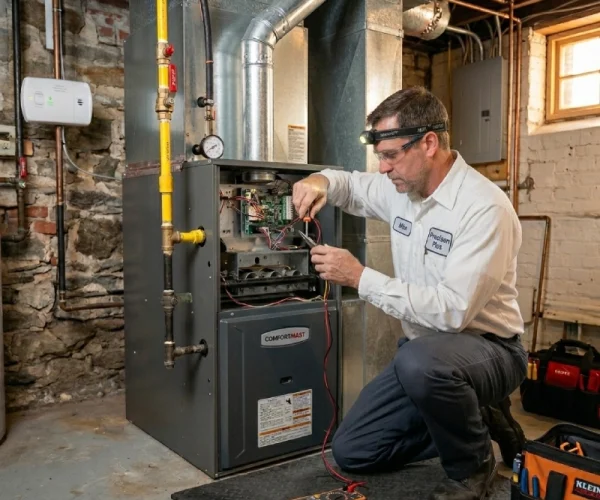
Repair, Replace, or Extend? A Gas Piping Guide for NW Philadelphia Homeowners
Repair — Fix What's Broken
One corroded fitting, one failed joint, one lateral separation. Targeted repair, minimal disruption.
TYPICAL COST: $200–$800 (interior) | $800–$2,000 (lateral excavation on hillside)
Main Run Replacement — Upgrade the Backbone
The horizontal basement main or a corroded vertical riser needs full replacement, but branch lines to individual appliances are sound. Common in Germantown Victorians and older Roxborough stone twins.
TYPICAL COST: $1,200–$3,500 depending on run length and access
Full Interior Repipe
The entire gas piping system — main, branches, risers — is past end of life. Common in properties with 100+ year old black iron that’s been patched repeatedly. A full repipe with new Schedule 40 black steel (or CSST where approved) is the long-term solution.
TYPICAL COST: $3,000–$7,000+ depending on property size
Outdoor Gas Line Installation or Replacement
Adding a new gas grill, fire pit, or outdoor kitchen — or replacing a corroded buried outdoor line. Includes trenching, approved direct-burial pipe, connections, and testing.
TYPICAL COST: $1,000–$3,000 depending on run length and terrain
Lateral Repair or Replacement
The underground service line from the PGW street main to your meter. Requires excavation. Hillside terrain (Manayunk) costs more than flat lots (Chestnut Hill/Mount Airy).
TYPICAL COST: $1,500–$4,000+ depending on depth, terrain, and length
Outdoor Gas Line Repair in Northwest Philadelphia
Northwest Philadelphia — particularly Chestnut Hill, Upper Roxborough, and parts of Mount Airy — has more homes with outdoor gas connections than any other part of the city. Outdoor gas line repair has its own set of challenges:
Common Outdoor Gas Line Problems
- Freeze-thaw cracking at joints (copper and black iron are both vulnerable)
- Tree root intrusion shifting or compressing buried pipe
- Corrosion from direct soil contact (no protection from basement environment)
- Landscape contractor damage — patios, fencing, planting beds installed over or near buried gas lines
- Non-code installation — many outdoor gas lines were installed by general contractors or landscapers without proper materials or testing
Our Outdoor Line Repair Process
- Locate the buried line using electronic detection — no digging until we know exactly where the failure is
- Excavate at the failure point — we dig smart, not wide
- Replace the damaged section with approved direct-burial pipe
- Route away from root zones where possible
- Pressure test the full system including the outdoor branch
- Backfill and compact — we restore the yard surface, not just the pipe
New Outdoor Gas Line Installation
Planning a gas grill, fire pit, or outdoor kitchen? We install new outdoor gas lines from your home’s gas system to the outdoor location — properly sized, properly buried, properly tested, and PGW-compliant from day one. This prevents the common NW Philly problem of a non-code outdoor line failing during a future full-system pressure test.
Common Gas Pipe Problems Across Northwest Philadelphia
These are the gas pipe repair scenarios we encounter most often across Northwest Philly’s Victorian twins and multi-unit conversions:
Hillside Lateral Separation (Manayunk, Upper Roxborough)
Underground laterals on steep grades experience chronic soil movement. Gravity, erosion, and water runoff gradually pull joints apart over decades. Symptoms: PGW detects a leak at the meter but interior piping tests clean. Repair requires hillside excavation — more complex and costlier than flat-terrain digging. The lateral is the homeowner's responsibility, not PGW's.
Concealed Piping Behind Wissahickon Schist (Roxborough, Chestnut Hill)
Gas pipes in stone homes pass through or behind stone walls at multiple points. Fittings at these penetrations corrode and fail invisibly — you can't see them, smell them, or access them without opening the stone. We use electronic detection and thermal imaging to pinpoint the exact location before cutting, then create the smallest possible access opening to protect the stone.
Corroded Outdoor Buried Gas Lines (Chestnut Hill, Upper Roxborough, Mount Airy)
Underground gas lines to outdoor grills, fire pits, pool heaters, and outdoor kitchens corrode from direct soil contact, tree root pressure, and freeze-thaw cycles. These lines were often installed by general contractors or landscapers rather than licensed plumbers — and may not meet gas code. Repair typically involves excavation, section replacement with approved direct-burial pipe, and a full pressure test.
Multi-Era Transition Joint Failures (Germantown, Mount Airy)
Where original black iron meets 1960s galvanized additions or modern CSST, the transition fitting is the highest-probability failure point. Germantown's diverse housing stock means more transition joints per property than single-era neighborhoods. Each transition requires specific fitting types — dielectric unions, approved adapters — and many older transitions used non-code fittings that fail under test pressure.
Corroded Supply Lines to Heating and Water Heating Equipment
The gas pipe feeding your furnace/boiler or water heater connects to your home's aging gas system. A gas smell near the heating equipment is often the supply pipe — not the appliance. In NW Philly's older homes, these supply connections are 50-100+ years old and corrode at the threaded joints where they connect to the appliance.
Abandoned and Improperly Capped Lines (All NW Neighborhoods)
NW Philly's active renovation market — especially Germantown gut rehabs and Manayunk flip projects — produces abandoned gas lines that are capped with compression fittings, duct tape, or left completely open behind new walls. These fail every pressure test and are a genuine safety hazard.
Gas Pipe Repairs in Northwest Philadelphia — Our Work
Real jobs completed by our expert technicians — delivering reliable plumbing, heating, and restoration solutions for local homes.
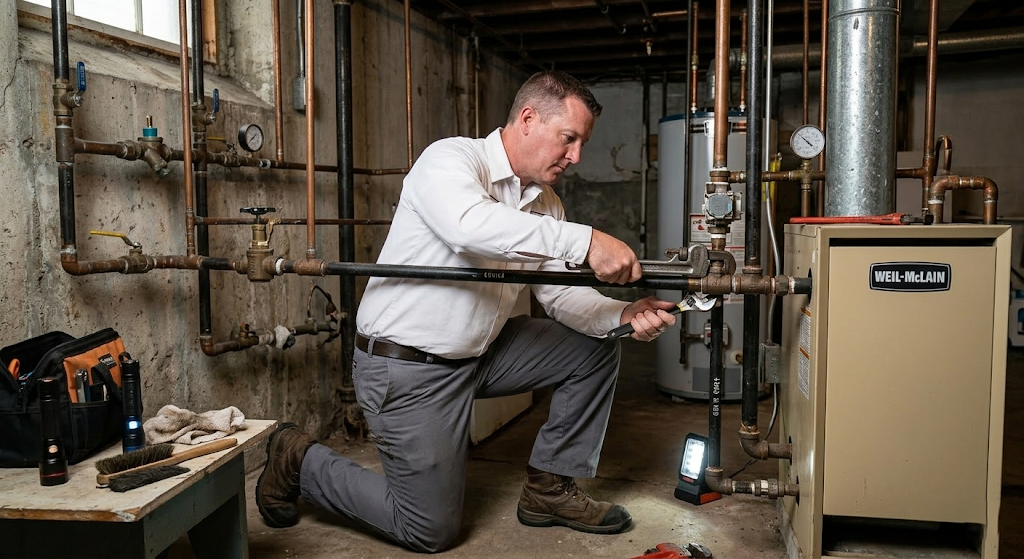
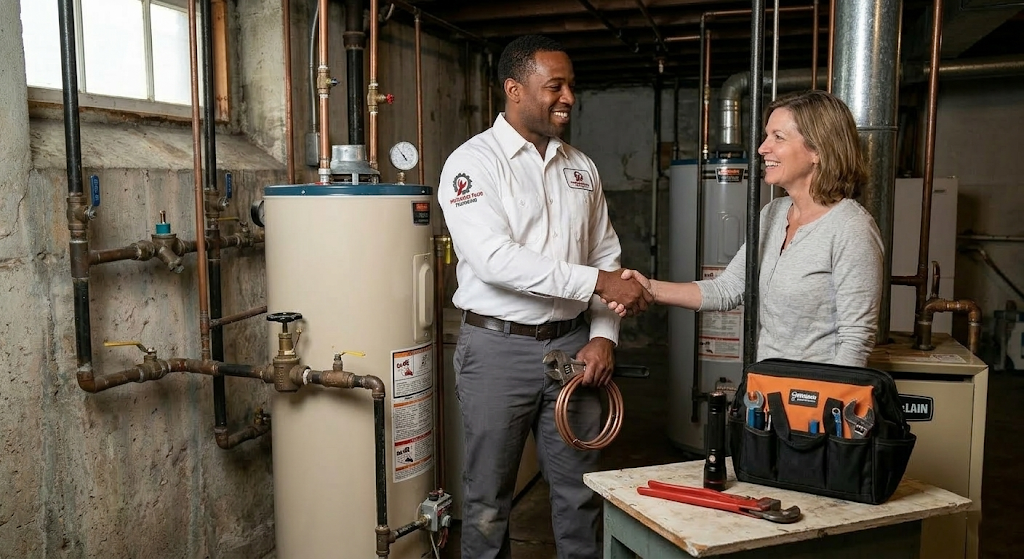
Manayunk — Hillside Lateral Excavation and Repair
A Manayunk row home on a steep grade near Cresson Street had a PGW shutoff — interior piping passed our test, but the underground lateral failed. We excavated on the hillside, found a joint separation 8 feet below grade where decades of soil erosion had undermined the pipe support. Repaired the joint, backfilled with engineered fill material to prevent future movement, and passed the full-system retest. The homeowner was surprised the lateral was their responsibility — we explained the PGW/homeowner ownership boundary before quoting.
Roxborough — Stone Twin, Concealed Riser Behind Schist
A Roxborough stone twin had a persistent faint gas smell that no one could locate. PGW shut off the meter. Our thermal imaging found elevated temperature at a point on the stone interior wall where the riser passed from basement to first floor — indicating gas flow behind the stone. We opened a 12x12 inch access panel through the schist, found a corroded elbow fitting with a pinhole leak, replaced it, sealed the access with a removable panel for future inspection, and passed the pressure test.
Chestnut Hill — Outdoor Fire Pit Line Replacement
A Chestnut Hill homeowner's full-system pressure test failed during a home sale inspection. Interior piping passed. The failure was an underground black iron line running 35 feet to a backyard fire pit — corroded through at two points from 15 years of soil contact. We replaced the full outdoor run with approved PE (polyethylene) direct-burial pipe, rerouted around a large tree root system, and retested. The home sale proceeded on schedule.
Our Gas Pipe Repair Process for Northwest Philadelphia Properties
From your first call to a warm home — here’s how it works. Adapted to your terrain, construction type, and pipe system.
1
Emergency Response & Safety Assessment
Call 24/7. Licensed plumber dispatched same-day to any NW Philly neighborhood. On arrival, we assess gas accumulation, ventilate if needed, and confirm the meter is off. In stone homes, we assess access conditions before starting diagnostic work.
2
Property-Specific Pipe Identification
We identify every pipe material, trace the routing through your property — including concealed stone wall runs, basement ceiling paths, and underground outdoor lines — and locate all failure points. Our approach adapts to your housing type: row home party walls (Manayunk), stone wall chases (Roxborough/Chestnut Hill), multi-era mixed piping (Germantown), or river-proximity moisture conditions (East Falls).
3
Repair Plan & Upfront Estimate
Written estimate detailing scope, materials, and cost. For complex jobs (hillside excavation, stone wall access, outdoor line replacement), we explain the access plan and any restoration needs. You approve before any work starts.
4
Code-Compliant Repair
Repair or replace the failed section to current Philadelphia code. In stone homes, we minimize wall penetrations and coordinate with the homeowner's mason for stone restoration. For hillside lateral repairs, we use proper compaction and backfill to prevent future movement. For outdoor lines, we use approved direct-burial pipe and route around root zones where possible.
5
Pressure Testing
Full-system pressure test after every repair — including outdoor branches. Results documented for PGW.
6
PGW Coordination & Restoration
If gas was shut off, passing test results submitted directly to PGW. Full PGW restoration coordinated on your behalf — typically 24-48 hours.
Northwest Philadelphia Homeowners Trust Precision Plus for Gas Pipe Repair

 Saxon Dave
Trustindex verifies that the original source of the review is Google.
Great service, very professiona,l on time, cleaned up afterwards, very respectable. I would definitely be calling him for all my needs. Before I go to anybody else for anything, i will call Precision Plus first. Five out of five stars for me Mary WorthyPrecision Plus Plumbing came out the next day and quickly got to work. They showed real care for our children’s well-being and handled everything with professionalism and compassion. Highly recommend!
 Keisha Jackson-SmithDerrick was very efficient and professional. He explained what needed to be done in detail and completed the job in a timely manner. I am very pleased with the result.
 Brian FeasterDerrick from Precision Plumbing, performed mold testing, was quick, professional and efficient!
 Beverly BoldenDerrick was quick assessing my issues problem solved in no time great job thanks so much
 Wayne TuckerQUALITY 5 STARS
 Dave WatsonGreat experience! Quick turnaround on a Saturday. Fixed the issue and was a pleasure to work with.
Gas Pipe Repair — Northwest Philadelphia Neighborhoods
We repair gas pipes in every property type across all of Northwest Philadelphia:
Manayunk
Philadelphia, PA
Roxborough
Philadelphia, PA
Chestnut Hill
Philadelphia, PA
Germantown
Philadelphia, PA
Mount Airy (East & West)
Philadelphia, PA
East Falls
Philadelphia, PA
West Oak Lane
Philadelphia, PA
Wissahickon
Philadelphia, PA
Serving All of Northwest Philadelphia for Gas pipe repair Emergencies

Derrick Jackson
Founder & Master Plumber
Since opening our doors in 1999, Precision Plus Plumbing has had one goal in mind: save busy homeowners time and frustration.
When you hire Precision Plus, you’re benefiting from a proven local business that knows your home, is familiar with older plumbing, and will educate you on what caused your problem — while discussing options on how to prevent them from happening again.
“We made the decision to provide clients with a unique experience that busy homeowners would be proud of. Our techs show up on time, do not smell like the sewer, and can resolve most problems on the initial service call.”
What started as a commitment to better service has grown into the area’s most trusted name for emergency plumbing, water damage restoration, and mold services — serving Pennsylvania, Delaware, and New Jersey.
Gas Pipe Repair FAQ — Northwest Philadelphia
My home is stone construction (Roxborough/Chestnut Hill). Can you access gas pipes without major damage?
Yes. We use electronic detection and thermal imaging to pinpoint the exact leak location before touching the stone. Then we create the smallest possible access opening — typically a panel that your mason can patch or we can fit with a removable access door. We do not tear out large sections of stone wal
My Manayunk home is on a steep hill. Does that make lateral repair harder?
Yes. Hillside excavation requires more equipment, soil stabilization, and proper backfill to prevent future movement. The cost is typically $800–$2,000 for a hillside lateral repair versus $500–$1,500 on flat terrain. We explain this upfront before quoting.
I have an outdoor gas line to my grill/fire pit/pool heater. Can you repair it?
Yes. We repair and replace outdoor buried gas lines using approved direct-burial materials. We locate the failure point with detection equipment before excavating to minimize yard disruption. After repair, the outdoor branch is included in the full-system pressure test.
How much does gas pipe repair cost in Northwest Philadelphia?
Interior fitting/joint repair: $200–$800. Stone wall access repair: $500–$1,200 (additional stone restoration by mason if needed). Hillside lateral repair: $800–$2,000. Outdoor gas line replacement: $1,000–$3,000. Full interior repipe: $3,000–$7,000+. Written estimate before any work.
My Germantown home has multiple types of gas pipe. Is that a problem?
It’s common — and every transition point between materials is a higher-risk failure point. We identify all pipe materials during inspection: original black iron, galvanized additions, CSST, copper. Each transition requires specific code-approved fittings. If your home has non-code transition fittings (compression couplings, hardware store adapters), we replace them during the repair.
Is the underground gas lateral from the street to my meter MY responsibility?
Yes. PGW owns the main in the street. Everything from the main to your meter — the lateral — is the homeowner’s responsibility to maintain. In NW Philly, laterals are especially vulnerable due to hillside terrain (Manayunk), tree root intrusion (Mount Airy, Chestnut Hill), and moisture conditions (East Falls).
Can you install a new gas line to an outdoor grill or fire pit?
Yes. We install new outdoor gas lines from your home’s gas system — properly sized, properly buried below frost line, and PGW-compliant with a full pressure test. This prevents the common problem of a non-code outdoor line installed by a landscaper failing during a future inspection.
Do I need a pressure test after gas pipe repair?
Yes. PGW and Philadelphia code require a certified pressure test after any gas pipe repair. We perform this as standard and submit results for PGW restoration.
More Gas Services in Northwest Philadelphia
Gas pipe repair is just one of the gas services we provide across Northwest Philadelphia’s row home neighborhoods. Explore our other specialized services below.
PGW Gas Leak Repair
PGW shut off your gas? We repair, test, and coordinate restoration — Manayunk to Chestnut Hill.
Pressure Test Gas Line
Certified pressure testing for PGW restoration, permits, and new installations.
Gas Heater Repair
Furnace or boiler not firing? Same-day diagnosis and repair.
Gas Water Heater Repair
No hot water? Gas water heater diagnosis, repair, and replacement.
Electric Water Heater Repair
Element failure, thermostat problems, or gas-to-electric conversion.
Leaking Gas Pipe in Northwest Philadelphia? Don't Wait — Call Now.
Hillside laterals, stone twins, outdoor lines, estate homes. Same-day repair since 1999.