

Certified Gas Line Testing — Northwest Philadelphia
Gas Line Pressure Testing in Manayunk, Roxborough, Chestnut Hill & Germantown
PGW-Compliant Pressure Testing for Hillside Row Homes, Stone Twins, Estate Properties, and Every Housing Type Across Northwest Philadelphia. Certified Results. Same Day.
Pressure testing a gas system in Northwest Philadelphia isn’t one-size-fits-all. A Manayunk hillside row home with a steep-grade lateral and four gas connections tests differently than a Chestnut Hill estate with six appliances, an outdoor gas grill, and a 100-foot underground service line. Precision Plus Plumbing provides certified pressure testing across every NW Philly neighborhood — adapting our approach to the specific terrain, construction type, and gas system complexity of your property. Same-day scheduling for PGW restoration emergencies.
- 4.9 Star Rating (312+ Reviews)
- Licensed & Insured
- Same-Day Service


When Northwest Philadelphia Homeowners Need a Pressure Test
The scenarios below reflect the specific situations we see across Northwest Philadelphia’s diverse neighborhoods. For a general overview of when pressure testing is required, see our [LINK→ /gas-leaks/pa/philadelphia/pressure-test-gas-line/ | anchor: “city-wide gas line pressure testing page”].
PGW Shutoff — Any NW Philly Neighborhood
PGW shut off your gas and won't restore until the system passes a documented pressure test. Whether you're in a Manayunk row home, a Roxborough stone twin, or a Germantown Victorian — the requirement is the same, but our testing approach adapts to your property type.
After a Gas Leak Repair
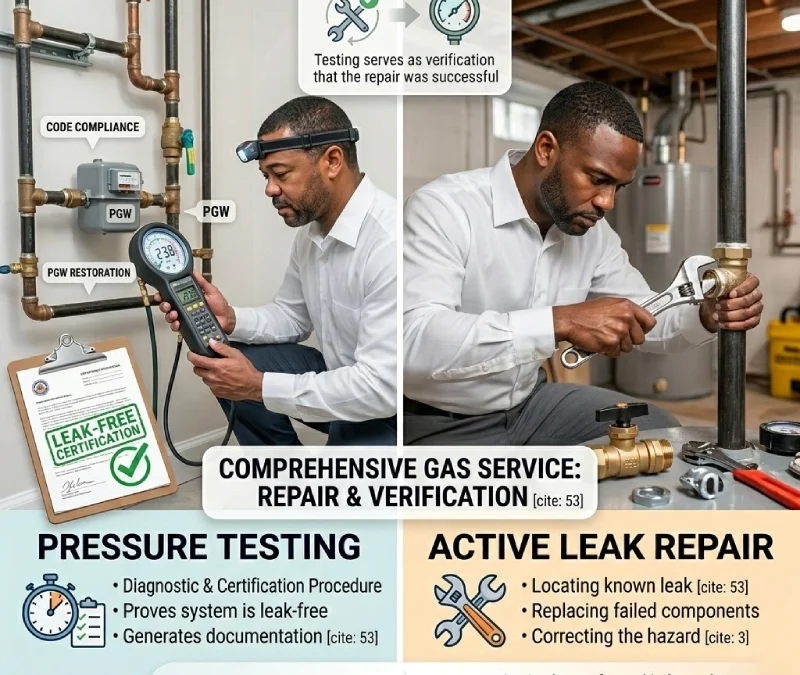
A leak was fixed — corroded pipe replaced, fitting re-sealed, lateral repaired. PGW requires a passing pressure test of the full system before reconnection. In NW Philly homes with 5-6 gas connections, "full system" means testing every branch to every appliance.
Home Renovation Affecting Gas Lines
Chestnut Hill kitchen renovations, Germantown Victorian restorations, Manayunk basement finishing projects — any work that moves, caps, or reconnects gas piping requires a pressure test before gas flows again. Philadelphia code requires documented results to close the gas permit.
New Gas Appliance Installation
Adding a gas fireplace in your Roxborough stone twin? Running a gas line to an outdoor kitchen at your Chestnut Hill property? Connecting a new gas range during a Germantown renovation? Every new gas connection must be tested before use.
Real Estate Transaction
Buying or selling a property in NW Philadelphia — especially older homes with original gas piping in Germantown, Mount Airy, or Chestnut Hill — buyers' inspectors frequently request pressure test certification. A passing test provides documented proof the system is sound.
Previous Test Failed
Another company tested the system and it failed. In NW Philly's diverse housing stock, the reason for failure varies by property type: concealed fittings behind stone walls (Roxborough), hillside lateral separations (Manayunk), or corroded outdoor gas line connections (Chestnut Hill). We diagnose the failure cause, repair it, and retest.
Why Gas Line Pressure Testing Is More Complex in Northwest Philadelphia
Every other Philly neighborhood we serve has a dominant housing type — row homes in South Philly, Victorian multi-units in West Philly, mixed singles and duplexes in the Northeast. Northwest Philadelphia is the exception: the housing type changes every few blocks, and so does the testing complexity.
Hillside Terrain and Lateral Testing (Manayunk)
Manayunk’s streets are built on steep hillsides. The underground gas lateral from the PGW street main to your meter runs at a steep angle through shifting soil. During pressure testing, if the system fails and we suspect a lateral issue, testing the lateral separately from the interior piping requires isolating the meter connection and pressurizing from the street-side — a more complex procedure than flat-terrain testing. Hillside laterals also accumulate water at low points, which can give a false pressure reading if not purged first.
Stone Construction Access Limitations (Roxborough, Chestnut Hill)
When a pressure test fails and the leak is behind a stone wall — whether Wissahickon schist in Roxborough or cut stone in Chestnut Hill — accessing the repair point is significantly more complex than in a frame or brick home. We use electronic detection and thermal imaging to pinpoint the exact failure location BEFORE cutting into any stone, minimizing demolition. Stone access adds time but protects the structural and aesthetic integrity of the home.
Multi-Appliance Properties (Chestnut Hill, Upper Roxborough)
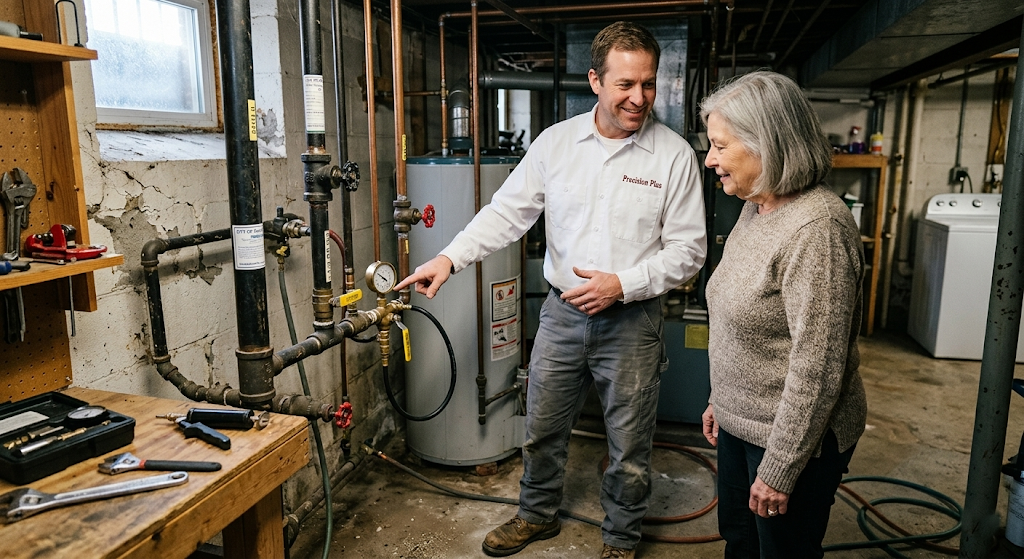
Larger NW Philly homes often have 5-6 gas connections: furnace, water heater, gas range, gas fireplace, gas dryer, and sometimes an outdoor gas grill or pool heater. Each connection is a branch off the main supply with its own valve, fitting, and connector — and each is a potential failure point during a pressure test. Testing a 6-branch system takes longer and requires more systematic isolation than a 3-branch row home system.
Outdoor Gas Line Complications
Outdoor gas connections — grills, fire pits, outdoor kitchens, pool heaters — are more common in NW Philly than in any other part of the city. These lines run underground through yards, are exposed to freeze-thaw cycles, tree root pressure, and landscape construction damage. During a full-system pressure test, these outdoor branches must be included — and they’re often the failure point that owners don’t suspect.
NW Philly Pressure Test Fact: Properties with outdoor gas connections (grills, fire pits, pool heaters) fail pressure tests at a higher rate than those without — not because the interior piping is worse, but because underground outdoor lines are exposed to environmental damage that indoor pipes aren’t. We always test outdoor branches as part of the full system check.
Why Pressure Tests Fail in Northwest Philadelphia — By Property Type
Hillside Lateral Joint Separation (Manayunk)
Manayunk's steep-grade laterals are subject to soil movement that flat-terrain laterals don't experience. Over decades, gravity pulls soil downhill, shifting pipe joints until they separate. A pressure test catches this even when the leak is too slow to smell at the surface. Repair requires excavation on hillside terrain — more complex and costlier than flat-lot excavation.
Concealed Stone Wall Fittings (Roxborough, Chestnut Hill)
Gas piping in stone homes passes through or behind stone walls at multiple points. Fittings at these penetrations are subject to settling stress and are nearly impossible to inspect visually. When a pressure test fails and all visible piping checks out, the leak is often at a fitting concealed behind stone. We use thermal imaging and ultrasonic detection before opening any stone surface.
Corroded Outdoor Gas Line (Chestnut Hill, Upper Roxborough)
Underground outdoor gas runs to grills, fire pits, and pool heaters corrode from soil contact, freeze-thaw cycles, and root pressure. These lines are often copper or older black iron that was never designed for direct burial. Homeowners frequently forget these outdoor branches exist — until the pressure test fails because of them.
Mixed-Material Transition Joints (Germantown)
Where original black iron meets galvanized conversion additions or modern CSST, the transition fitting is the weakest point. Germantown's multi-era housing stock means more transition joints per property than neighborhoods with single-era construction. Each transition point is a test failure candidate.
Dried Thread Compound on Original Fittings (All NW Neighborhoods)
Same as across Philadelphia — pipe dope and Teflon compound on threaded joints degrades over 50-100 years. NW Philly homes in Germantown, Chestnut Hill, and Mount Airy often have the oldest original piping in the city (some dating to the 1880s). These joints hold under normal gas pressure but fail under test conditions.
Improperly Capped Abandoned Lines
When gas fireplaces, old ranges, or dryers are removed during renovations, the gas line should be properly valved and capped. In NW Philly's active renovation market — especially Germantown and Manayunk — we frequently find lines "capped" with compression fittings or simply left behind drywall. Every one of these fails a pressure test.
Our Work in Action Across Northwest Philadelphia
Real jobs completed by our expert technicians — delivering gas line pressure testing solutions for local homes.

Our Pressure Testing Process for Northwest Philadelphia Properties
Adapted to your terrain, construction type, and gas system complexity.
1
Property Assessment
Before pressurizing anything, we assess your property type: housing construction (row home, stone twin, detached single, estate), number of gas appliance connections, presence of outdoor gas lines, lateral access conditions (flat lot vs hillside). This determines our testing approach.
2
System Isolation
We close the gas meter valve and isolate the piping from PGW supply. Every gas connection in the house — including outdoor grill lines, fireplace connections, and any capped/abandoned lines — is verified shut or sealed. In homes with 5-6 connections, this step takes longer but is critical for an accurate test.
3
Pressurization
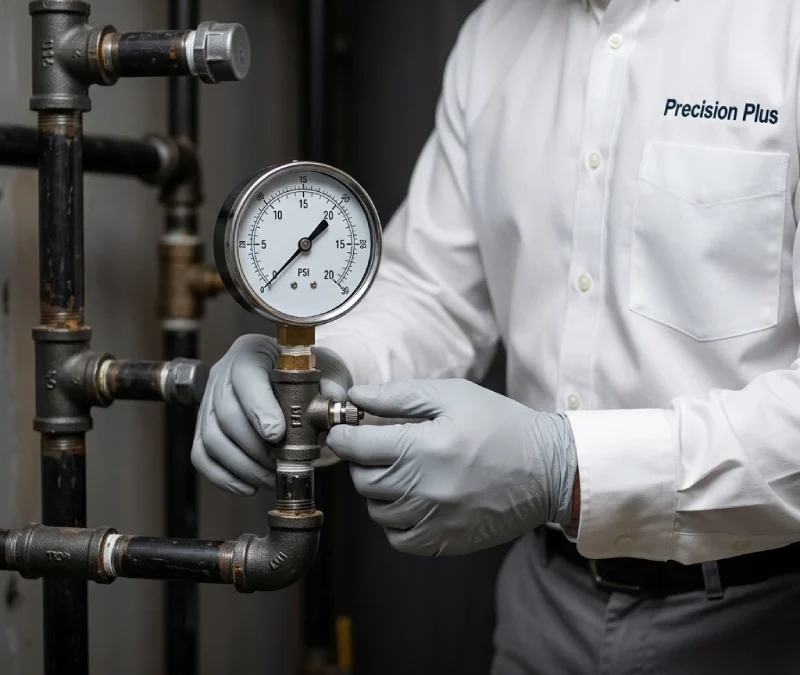
Using a calibrated test gauge, we pressurize the system to code-required pressure (typically 3 PSI). For older homes with original fittings, we bring the system to pressure gradually to avoid shock-loading century-old joints.
4
Hold Period Monitoring
Standard monitoring period. Stable gauge = pass. Any pressure drop = leak exists. In NW Philly homes with outdoor branches, we watch for slow leaks that may take several minutes to register — outdoor underground lines can have micro-leaks that only show as a gradual gauge decline.
5
Branch-by-Branch Isolation
If the system fails, we isolate each branch systematically: interior appliance connections first (furnace, water heater, range), then fireplace/dryer lines, then outdoor branches last. This identifies which section of the system is leaking. Once isolated, we use electronic detection to pinpoint the exact failure within that branch.
6
Documentation, PGW Coordination & Restoration
If your pressure test is connected to a PGW service restoration, we submit the passing results directly to PGW and coordinate your meter reconnection. Most restorations happen within 24 to 48 hours of a passing test.
Northwest Philadelphia Homeowners Trust Precision Plus for Pressure Testing

 Saxon Dave
Trustindex verifies that the original source of the review is Google.
Great service, very professiona,l on time, cleaned up afterwards, very respectable. I would definitely be calling him for all my needs. Before I go to anybody else for anything, i will call Precision Plus first. Five out of five stars for me Mary WorthyPrecision Plus Plumbing came out the next day and quickly got to work. They showed real care for our children’s well-being and handled everything with professionalism and compassion. Highly recommend!
 Keisha Jackson-SmithDerrick was very efficient and professional. He explained what needed to be done in detail and completed the job in a timely manner. I am very pleased with the result.
 Brian FeasterDerrick from Precision Plumbing, performed mold testing, was quick, professional and efficient!
 Beverly BoldenDerrick was quick assessing my issues problem solved in no time great job thanks so much
 Wayne TuckerQUALITY 5 STARS
 Dave WatsonGreat experience! Quick turnaround on a Saturday. Fixed the issue and was a pleasure to work with.
Gas Line Pressure Testing — Northwest Philadelphia Neighborhoods
We provide certified pressure testing across every Northwest Philadelphia neighborhood:
Roxborough
Philadelphia, PA
Germantown
Philadelphia, PA
Chestnut Hill
Philadelphia, PA
Manayunk
Philadelphia, PA
Mount Airy
Philadelphia, PA
Serving Every Northwest Philadelphia Neighborhoods
Serving zip codes 19128, 19127, 19129, 19118, 19119, 19150, 19138, 19144. Whether your pressure test is for a PGW restoration on a Manayunk row home or a permit closing on a Chestnut Hill renovation — Precision Plus provides same-day certified testing.

Derrick Jackson
Founder & Master Plumber
Since opening our doors in 1999, Precision Plus Plumbing has had one goal in mind: save busy homeowners time and frustration.
When you hire Precision Plus, you’re benefiting from a proven local business that knows your home, is familiar with older plumbing, and will educate you on what caused your problem — while discussing options on how to prevent them from happening again.
“We made the decision to provide clients with a unique experience that busy homeowners would be proud of. Our techs show up on time, do not smell like the sewer, and can resolve most problems on the initial service call.”
What started as a commitment to better service has grown into the area’s most trusted name for emergency plumbing, water damage restoration, and mold services — serving Pennsylvania, Delaware, and New Jersey.
Pressure Test Gas Line FAQ — Northwest Philadelphia
Does my outdoor gas grill/fire pit connection get tested too?
Yes. Every gas connection on your property — indoor and outdoor — must be part of the pressure test. Outdoor connections are actually the most common failure point in NW Philly because underground lines are exposed to freeze-thaw, root pressure, and soil corrosion. We always test outdoor branches as part of the full system.
My Manayunk home is on a steep hill. Does that affect the test?
The test itself is the same — pressurize and monitor. But if it fails and the leak is in the underground lateral, the repair is more complex. Hillside laterals in Manayunk accumulate water at low points and experience soil movement that flat-terrain laterals don’t. Excavation on steep grades requires additional planning and equipment.
My home is stone (Roxborough/Chestnut Hill). Can you find a leak without major demolition?
Yes. We use electronic gas detectors, thermal imaging, and ultrasonic detection to pinpoint the exact location before making any access opening. In stone homes, we plan the smallest possible access point to protect the wall’s structural and aesthetic integrity. Many stone wall access repairs are covered by the homeowner’s mason after we complete the gas work.
How much does a pressure test cost in NW Philadelphia?
Standard residential test: $150–$350. Homes with 5-6+ gas connections (furnace, water heater, range, fireplace, grill, dryer): $250–$450 due to additional isolation time. If the test fails and repair is needed, repair is quoted separately. Retest after repair is included at no additional fee.
What if the test fails because of an outdoor line I forgot about?
This happens regularly in NW Philly — homeowners forget about buried gas grill lines, fire pit connections, or capped lines to removed outdoor appliances. We identify every gas connection on the property during our pre-test assessment, including outdoor branches. If an outdoor line fails, we quote the repair separately.
Can you test the underground lateral separately from the house piping?
Yes. If the full-system test fails and interior piping passes, we isolate the lateral at the meter and test it independently. This determines whether the failure is underground (lateral issue) or inside the home. Lateral repair requires excavation — we locate the failure point first to minimize digging.
I'm renovating a Germantown/Chestnut Hill property. When should I pressure test?
For new gas piping, test at the end of rough-in — before walls are closed. It’s far easier to fix a leak before drywall or plaster goes up, especially in stone homes where reopening a wall is expensive. Philadelphia L&I requires a documented passing test to close the gas permit.
My home has multiple types of gas pipe. Is that normal?
Very common in NW Philly — especially Germantown and older Chestnut Hill properties. A single home may have original black iron risers, mid-century galvanized additions, and modern CSST from a recent renovation. Each transition point between materials is a higher-risk failure point during pressure testing. We identify all materials before testing.
Need a Certified Pressure Test in Northwest Philadelphia? Same-Day Scheduling Available.
Manayunk row homes to Chestnut Hill estates. PGW compliance, permits, new installations. Since 1999.