

Certified Gas Line Testing — Philadelphia
Gas Line Pressure
Testing in Philadelphia
Code-Compliant Gas Line Pressure Tests for PGW Restoration, Permit Inspections, and New Installations. Certified Results. Same-Day Availability.
- 4.9 Star Rating (312+ Reviews)
- Licensed & Insured
- Same-Day Service



Watch How Precision Plus Detects Gas Leaks
When You Need a Gas Line Pressure Test in Philadelphia
PGW Shut Off Your Gas and Requires a Test Before Restoration
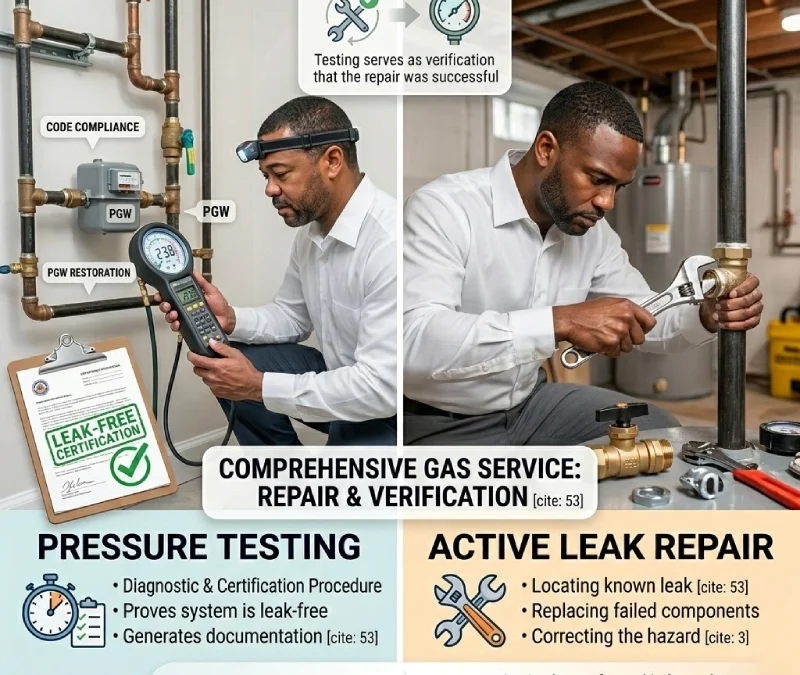
If Philadelphia Gas Works disconnected your meter due to a suspected or confirmed leak, they will not restore service until a licensed plumber performs a documented pressure test proving the system is airtight. This is the single most common reason Philadelphia homeowners call us for testing.
New Gas Line Installation or Extension
Any newly installed gas piping — whether it's a full line from the meter or a branch to a new appliance — must pass a pressure test before gas can flow through it. This applies to new construction, additions, and gas line rerouting during renovations.
Renovation or Remodeling Work That Affects Gas Piping
If a contractor moved, capped, or reconnected gas piping during a kitchen remodel, bathroom renovation, or basement finishing project, the city requires a pressure test before the gas is turned back on. The test confirms that no connections were disturbed or left unsealed.
Permit Inspection Requires Documented Test Results
Philadelphia's Department of Licenses and Inspections requires a passing pressure test as part of the permit closure process for any gas line work. Without documented results from a licensed professional, your permit stays open and your project stalls.
Failed Previous Inspection
If a prior pressure test was performed and the system failed — meaning pressure dropped during the monitoring period — the underlying leak must be identified and repaired before the test can be re-run. We handle both the diagnostics and the retest.
Suspected Leak But Not Confirmed
If you smell gas intermittently, notice a hissing sound near a gas line, or simply want peace of mind about older piping, a pressure test is the most definitive way to determine whether your gas system is leak-free.
Why Gas Line Pressure Testing Is More Complex in Northwest Philadelphia
Every other Philly neighborhood we serve has a dominant housing type — row homes in South Philly, Victorian multi-units in West Philly, mixed singles and duplexes in the Northeast. Northwest Philadelphia is the exception: the housing type changes every few blocks, and so does the testing complexity.
Hillside Terrain and Lateral Testing (Manayunk)
Manayunk’s streets are built on steep hillsides. The underground gas lateral from the PGW street main to your meter runs at a steep angle through shifting soil. During pressure testing, if the system fails and we suspect a lateral issue, testing the lateral separately from the interior piping requires isolating the meter connection and pressurizing from the street-side — a more complex procedure than flat-terrain testing. Hillside laterals also accumulate water at low points, which can give a false pressure reading if not purged first.
Stone Construction Access Limitations (Roxborough, Chestnut Hill)
When a pressure test fails and the leak is behind a stone wall — whether Wissahickon schist in Roxborough or cut stone in Chestnut Hill — accessing the repair point is significantly more complex than in a frame or brick home. We use electronic detection and thermal imaging to pinpoint the exact failure location BEFORE cutting into any stone, minimizing demolition. Stone access adds time but protects the structural and aesthetic integrity of the home.
Multi-Appliance Properties (Chestnut Hill, Upper Roxborough)
Larger NW Philly homes often have 5-6 gas connections: furnace, water heater, gas range, gas fireplace, gas dryer, and sometimes an outdoor gas grill or pool heater. Each connection is a branch off the main supply with its own valve, fitting, and connector — and each is a potential failure point during a pressure test. Testing a 6-branch system takes longer and requires more systematic isolation than a 3-branch row home system.
Outdoor Gas Line Complications
Outdoor gas connections — grills, fire pits, outdoor kitchens, pool heaters — are more common in NW Philly than in any other part of the city. These lines run underground through yards, are exposed to freeze-thaw cycles, tree root pressure, and landscape construction damage. During a full-system pressure test, these outdoor branches must be included — and they’re often the failure point that owners don’t suspect.
NW Philly Pressure Test Fact: Properties with outdoor gas connections (grills, fire pits, pool heaters) fail pressure tests at a higher rate than those without — not because the interior piping is worse, but because underground outdoor lines are exposed to environmental damage that indoor pipes aren’t. We always test outdoor branches as part of the full system check.
Common Reasons a Gas Line Pressure Test Is Required in Northwest Philadelphia
PGW Service Restoration
PGW will not reconnect your gas meter after a shutoff until a licensed plumber submits documented proof that the gas system holds pressure. This is non-negotiable — no test, no gas.
Property Sale or Transfer
Some Philadelphia real estate transactions require gas line certification as part of the buyer's inspection contingency. A passing pressure test gives both parties documented assurance that the gas system is safe and code-compliant.
New Appliance Installation
When a new gas range, dryer, furnace, or water heater is connected to your home's gas piping, the new connection must be tested to confirm it's properly sealed and doesn't introduce a leak into the system.
Gas Line Replacement or Extension
Whether you're replacing corroded black iron pipe, running a new line to an outdoor grill, or extending gas service to a finished basement, all new piping must pass a pressure test before it carries gas.
Permit Closure
An open gas permit with the Philadelphia Department of Licenses and Inspections cannot be closed without a documented pressure test. If your contractor pulled a gas permit for renovation work, you need a passing test on file to finalize the permit and avoid violations.
Previous Inspection Failure
If a gas line failed a prior pressure test — whether performed by another company, a PGW inspector, or a city inspector — the leak must be located, repaired, and the test re-run by a licensed professional before any forward progress can happen.
Our Work in Action Across Philadelphia
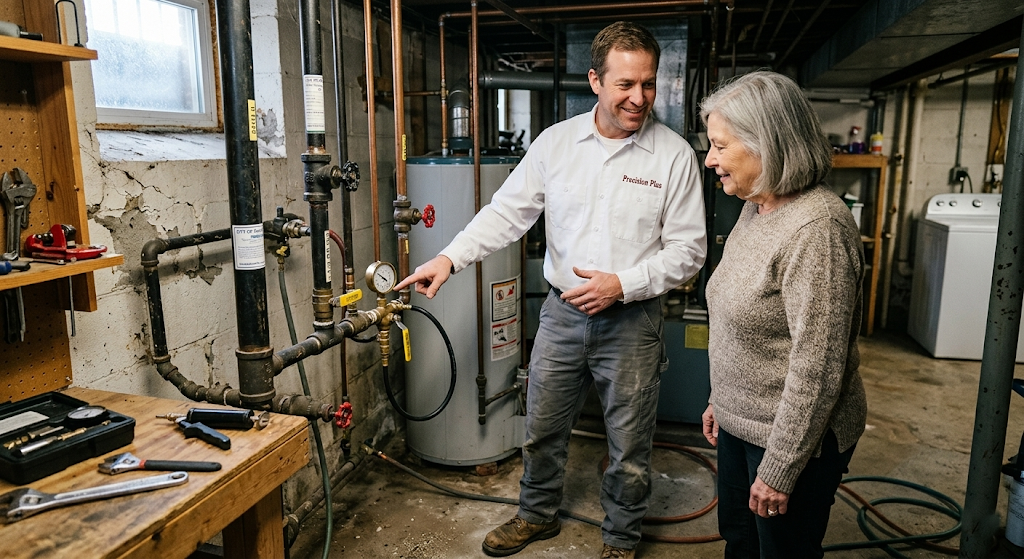
Real jobs completed by our expert technicians — delivering gas line pressure testing solutions for local homes.
Our Pressure Testing Process for Northwest Philadelphia Properties
Adapted to your terrain, construction type, and gas system complexity.
1
Property Assessment
Before pressurizing anything, we assess your property type: housing construction (row home, stone twin, detached single, estate), number of gas appliance connections, presence of outdoor gas lines, lateral access conditions (flat lot vs hillside). This determines our testing approach.
2
System Isolation
We close the gas meter valve and isolate the piping from PGW supply. Every gas connection in the house — including outdoor grill lines, fireplace connections, and any capped/abandoned lines — is verified shut or sealed. In homes with 5-6 connections, this step takes longer but is critical for an accurate test.
3
Pressurization
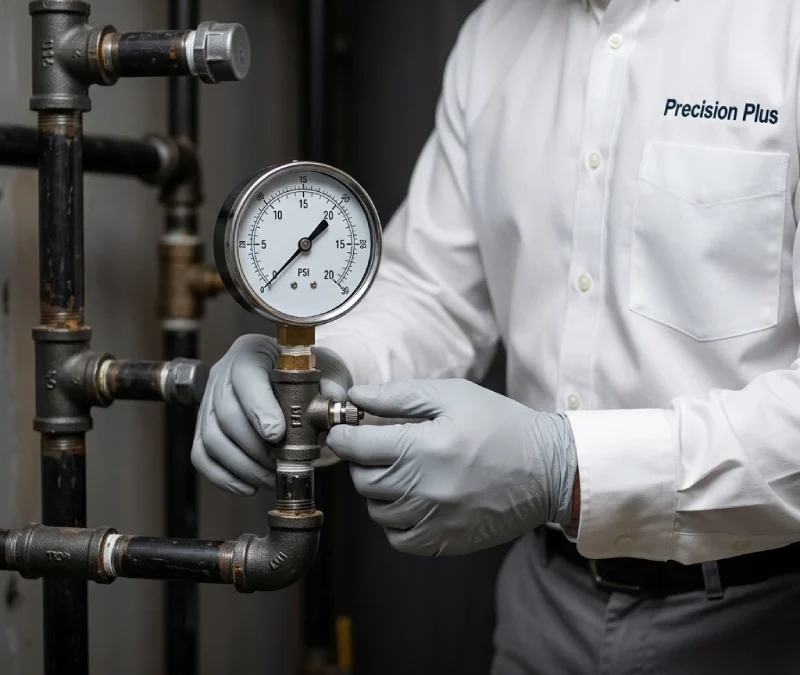
The pressurized system is monitored for a minimum hold period — usually 10 to 15 minutes. Our technician watches the gauge for any movement. A stable reading means the system is airtight. Any pressure drop indicates a leak.
4
Leak Identification (If Test Fails)
If the system fails the pressure test, we use electronic leak detection equipment and soapy solution testing at every joint, valve, and connection to pinpoint the exact location of the leak. We provide you with a clear repair estimate before proceeding.
5
Documentation and Certification
Upon a passing test, we prepare the official documentation required by PGW and the Philadelphia Department of Licenses and Inspections. This includes the test pressure, hold time, gauge readings, and the license number of the performing plumber.
6
PGW Coordination and Restoration
If your pressure test is connected to a PGW service restoration, we submit the passing results directly to PGW and coordinate your meter reconnection. Most restorations happen within 24 to 48 hours of a passing test.
Benefits of Choosing Precision Plus for Gas Water Heater Repair
Same-Day & Emergency Service
No-hot-water calls are prioritized. Available evenings, weekends, and holidays throughout every Philadelphia neighborhood.
Upfront, Honest Pricing
Written estimate before any work starts. You approve the cost first. No hidden charges and no surprise billing.
All Major Brands Serviced
A.O. Smith, Rheem, Bradford White, Rinnai, State, Kenmore, American Standard, Whirlpool — we repair every major brand of tank-style gas water heater.
Safety-First Approach
Every repair includes carbon monoxide testing, gas connection checks, and T&P relief valve verification before we leave your home.
Parts Stocked on Every Truck
Thermocouples, thermopiles, gas control valves, anode rods, T&P valves, igniters, and supply connectors — on board and ready for same-visit repair.
Locally Owned & Operated
We live and work in Philadelphia. Our business runs on referrals from the neighbors we serve, and we take that responsibility seriously.
Trusted by Philadelphia Homeowners for Gas Line Pressure Testing

 Saxon Dave
Trustindex verifies that the original source of the review is Google.
Great service, very professiona,l on time, cleaned up afterwards, very respectable. I would definitely be calling him for all my needs. Before I go to anybody else for anything, i will call Precision Plus first. Five out of five stars for me Mary WorthyPrecision Plus Plumbing came out the next day and quickly got to work. They showed real care for our children’s well-being and handled everything with professionalism and compassion. Highly recommend!
 Keisha Jackson-SmithDerrick was very efficient and professional. He explained what needed to be done in detail and completed the job in a timely manner. I am very pleased with the result.
 Brian FeasterDerrick from Precision Plumbing, performed mold testing, was quick, professional and efficient!
 Beverly BoldenDerrick was quick assessing my issues problem solved in no time great job thanks so much
 Wayne TuckerQUALITY 5 STARS
 Dave WatsonGreat experience! Quick turnaround on a Saturday. Fixed the issue and was a pleasure to work with.
Gas Line Pressure Testing Across Philadelphia
Center City
Philadelphia, PA
West Philadelphia
Philadelphia, PA
Northeast Philadelphia
Philadelphia, PA
Manayunk
Philadelphia, PA
Southwest Philadelphia
Philadelphia, PA
Serving Every Philadelphia Neighborhood

Derrick Jackson
Founder & Master Plumber
Since opening our doors in 1999, Precision Plus Plumbing has had one goal in mind: save busy homeowners time and frustration.
When you hire Precision Plus, you’re benefiting from a proven local business that knows your home, is familiar with older plumbing, and will educate you on what caused your problem — while discussing options on how to prevent them from happening again.
“We made the decision to provide clients with a unique experience that busy homeowners would be proud of. Our techs show up on time, do not smell like the sewer, and can resolve most problems on the initial service call.”
What started as a commitment to better service has grown into the area’s most trusted name for emergency plumbing, water damage restoration, and mold services — serving Pennsylvania, Delaware, and New Jersey.
Frequently Asked Questions — Gas Line Pressure Testing in Philadelphia
What exactly is a gas line pressure test?
How long does a gas line pressure test take?
Does PGW require documentation from the pressure test?
How much does a gas line pressure test cost in Philadelphia?
What happens if my gas line fails the pressure test?
Is a pressure test required for gas permits in Philadelphia?
Can you restore my gas service after the pressure test passes?
Only PGW is authorized to physically restore your gas meter. However, Precision Plus Plumbing handles the coordination for you. We submit passing test documentation directly to PGW and follow up on your behalf to schedule the reconnection. In most cases, PGW restores service within 24 to 48 hours of receiving our paperwork.