

When we talk about a PGW gas leak, we're talking about a serious emergency in your Philadelphia home. If you smell rotten eggs, hear a strange hissing sound, or see plants dying for no reason near a gas line, you need to act fast. Evacuate immediately and call PGW's emergency line.
How to Recognize a PGW Gas Leak in Your Home
Your own senses are your best first defense against a gas leak. Most of us were taught to recognize that distinct rotten egg smell utilities add to natural gas, but a PGW gas leak can show up in much quieter ways. If you only rely on your nose, you could miss other critical warning signs.
Knowing what to look, listen, and smell for is the first real step to keeping your family safe. An active leak isn't always loud or obvious, which is why every Philadelphia homeowner needs to be familiar with all the potential signs.
Auditory Clues You Shouldn't Ignore
Sometimes, you'll hear a gas leak before you smell it. Take a moment to listen closely near your gas appliances—your furnace, water heater, stove—and along any visible gas pipes in your basement.
What are you listening for?
- A faint hissing sound: This is the classic sound of gas escaping a high-pressure fitting or connection.
- A whistling noise: Similar to hissing, this can point to a small but persistent leak.
It's easy to write off these quiet sounds as just the normal hums and clicks of your home's equipment, but they demand your attention. When it comes to gas lines, a strange noise is never something to ignore.
Unexpected Visual Signs of a Gas Leak
Often, the proof of a gas leak is something you see, not smell or hear. This is especially true for leaks happening in underground lines outside your home.
I'll never forget a call we got from a Philadelphia family. They couldn't figure out why their prize-winning rose bushes were suddenly dying. It turned out to be a slow underground gas leak starving the plant roots of oxygen. That visual clue was the only thing that tipped them off.
Keep your eyes open for these visual red flags:
- Bubbling water: If you see bubbles continuously forming in puddles or wet spots on your lawn, it might be gas escaping a buried pipe.
- Dead or discolored vegetation: Patches of dead grass or dying shrubs right above a pipeline route are a huge indicator of a problem underground.
- Dust or dirt blowing from a fitting: A small, focused stream of dust blowing from a gas fitting when there's no wind is a sure sign of a leak.
This isn't a small problem in Philadelphia. Research from Drexel University found that methane emissions from the city's gas infrastructure are nearly four times higher than official estimates. Knowing these signs is more critical than ever. It's also vital to recognize how a leak can affect your health; check out our guide on gas leak symptoms to learn what to watch for.
Your Immediate Safety Steps for a Suspected Leak
If you think you have a PGW gas leak, every second matters. What you do in the next few moments can make all the difference, so it’s crucial to act correctly and without hesitation. The number one rule is to avoid creating any source of ignition.
Natural gas itself isn't what explodes; it's the mixture of gas and air inside your home that becomes incredibly volatile. A single spark is all it takes.
This means you can't touch anything that might create that spark. Don’t flip light switches, don't unplug the toaster, and absolutely do not use your cell phone while you're still inside. Even something as simple as using a landline or adjusting the thermostat can generate a tiny electrical arc—more than enough to cause a disaster.
Evacuate and Ventilate Immediately
Your only job right now is to get everyone out of the house. Get out. Now. Don’t stop to grab personal items or try to track down the source of the leak on your own.
As you leave, prop the front door open behind you. This gives the gas an escape route and helps ventilate your home, lowering the dangerous concentration of gas building up inside. Once you're out, get far away from the property—at least 300 feet, which is about the length of a football field.
Never assume a faint smell means it's not a big deal. Gas can concentrate quickly in enclosed areas like basements or utility closets, and that small issue can become a massive hazard in minutes. Getting out is the only safe move.
Only when you are a safe distance from your home should you use your cell phone to call for help. Using it any closer could provide the very spark you're trying to avoid.
The signs of a leak aren't always obvious, but you should trust your senses. A quick check can save lives.
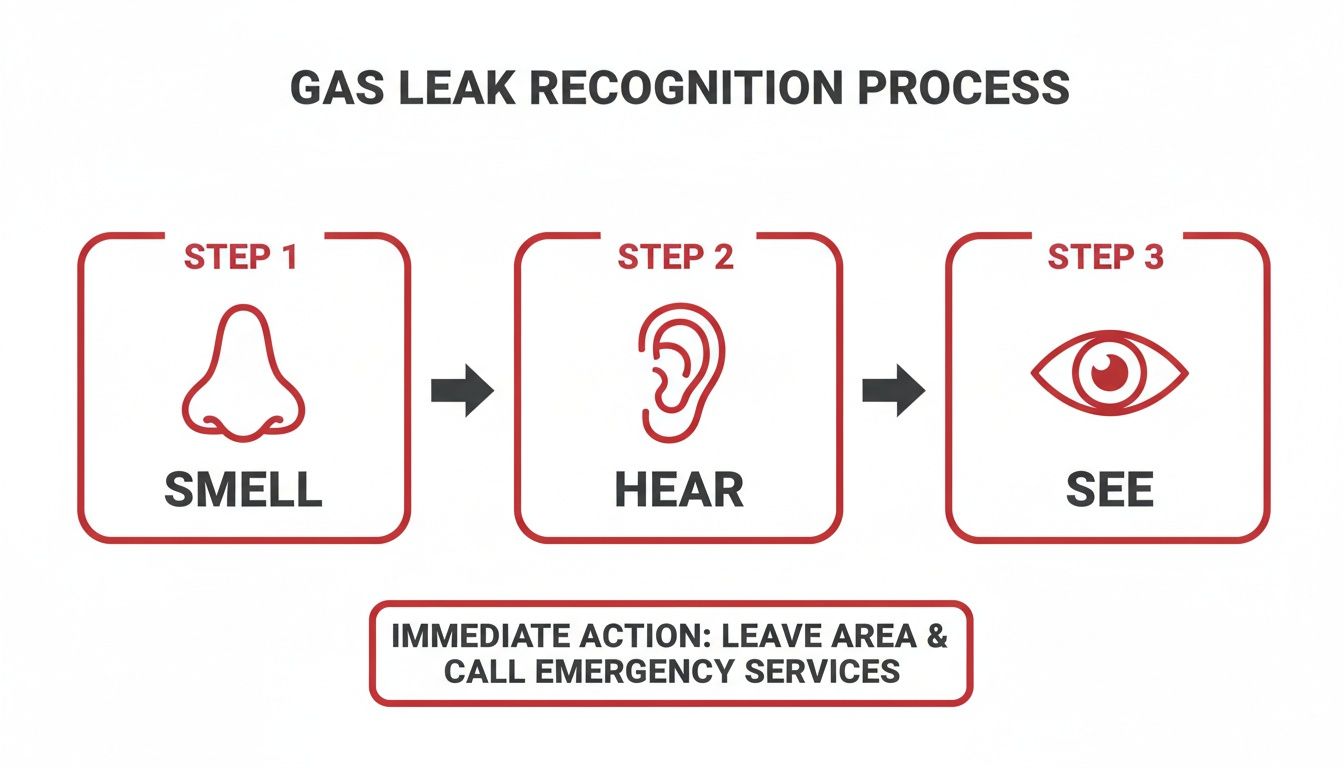
As the diagram shows, a leak can often be smelled (that classic rotten egg odor), heard (a hissing or whistling sound), or even seen (dust blowing from a pipe or bubbling in standing water). If any of your senses are telling you something is wrong, listen.
Key Actions to Avoid During an Evacuation
To keep everyone safe, make sure these "don'ts" are part of your family's emergency plan:
- Don't try to start a car that’s parked in an attached garage or near the house.
- Don't attempt to shut off the gas meter yourself unless you’ve been specifically trained by a professional on how to do it safely.
- Don't go back inside your home for any reason until a PGW technician has given the official all-clear.
Knowing exactly what to do in a gas emergency transforms panic into purposeful, life-saving action. For more in-depth information, this Emergency Gas Line Repair Safety Guide is an excellent resource to review before you ever need it.
Who To Call When You Suspect a Gas Leak (And In What Order)
Once you and your family are safely outside and away from the house, it's time to get the right people on the phone. In a high-stress situation like a gas leak, knowing exactly who to call—and when—is crucial for getting the fastest, safest response.
Your first and most important call is to the PGW Emergency Hotline at (215) 235-1212. This line is staffed 24/7 by the people who manage Philadelphia's gas infrastructure. They are the only ones authorized to work on the main gas lines and meters.
When you get them on the phone, try to stay calm and give them the key details:
- Your complete, exact address.
- That you've evacuated and are calling from a safe location.
- A simple description of what you noticed (the smell, sound, etc.).
Expert Tip: Take a minute right now and save that number in your phone. Label it "PGW Emergency." Fumbling for a number while you're smelling gas is a stress you can easily avoid. Trust me on this one.
When Does a 911 Call Make Sense?
While PGW handles the gas line itself, there are certain situations where your first call should actually be to 911. If the situation feels like an immediate, life-threatening emergency, it probably is.
Dial 911 before calling PGW if you notice any of these signs:
- An incredibly strong or overpowering gas odor.
- A loud hissing or roaring sound, which could signal a major line break.
- Anyone is feeling dizzy, light-headed, nauseous, or showing other physical symptoms of gas exposure.
In these scenarios, the Philadelphia Fire Department needs to get there fast to handle public safety and potential medical needs. They will coordinate directly with PGW, but their job is to protect people first.
Understanding the Roles of PGW vs. a Plumber
Here’s where a lot of homeowners get confused. After you call PGW, they’ll dispatch a technician to your home. Their job is to find the source of the leak and make the area safe.
If the leak is on their side of the equipment (the street lines or the gas meter itself), they’ll handle the repair. However, if the leak is located inside your property—in the pipes that run from your meter to your furnace, water heater, or stove—the repair is your responsibility.
The PGW tech will shut off the gas service to your home, a process often called a "tag out," and will tell you to hire a licensed plumber. They will not fix the pipes inside your house. Knowing this handoff is coming helps you prepare for the next step.
To help you get ahead, here is a quick-reference table that breaks down who does what during a gas leak emergency.
Emergency Contact Roles and Responsibilities
| Contact | Their Primary Role | When You Should Call Them |
|---|---|---|
| PGW Emergency | Manages the city's gas infrastructure, including the main lines and meters. They make the area safe by shutting off the gas supply. | Immediately for any suspected gas leak. They are your first call unless there is an immediate medical emergency. |
| 911 | Dispatches the Fire Department for immediate life-safety threats, medical assistance, and public evacuation. | Call 911 first if the leak is severe (loud roar, very strong smell) or if someone is feeling sick or dizzy. |
| Licensed Plumber | Repairs gas lines located on your property (from the meter to your appliances) after PGW has shut off the service. | After PGW has identified the leak is on your property and has "tagged out" your meter, making it safe to work. |
This clear division of labor ensures that the utility secures the main lines while a qualified contractor handles the repairs on your private property. If you find yourself needing to find a professional quickly, our guide on how to choose the best emergency plumber in Philadelphia offers crucial advice for making a fast, reliable choice under pressure.
What to Expect From PGW and Your Plumber
So you've made the call to PGW's emergency line. What happens now? Knowing who does what—and when—can take a lot of the guesswork and stress out of a tense situation. It really breaks down into two distinct phases: the utility company's safety response and your plumber's repair work.
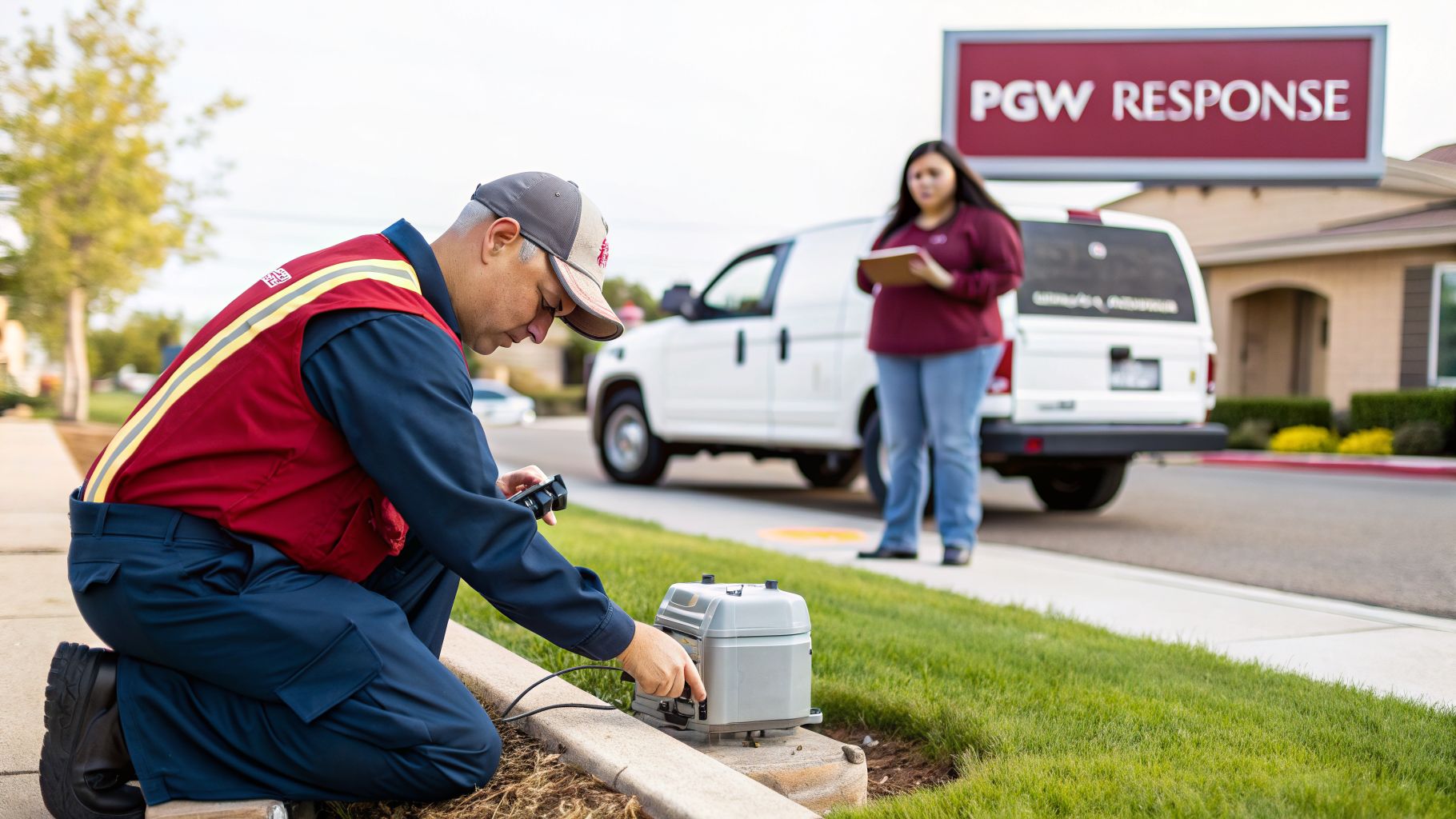
The PGW Technician's Role
When the PGW truck arrives, their technician has one job: public safety. They aren’t there to fix the pipes inside your house. Their focus is solely on confirming the leak and neutralizing the immediate threat.
They'll use a sensitive electronic gas detector to check for gas in the air and pinpoint if the leak is on PGW's equipment (like the main line in the street) or on your property's gas lines—that is, any pipe past the gas meter.
If the leak is on your side of the meter, the technician will immediately shut off the gas supply and physically lock the meter. This is known as a “tag out.” It’s a non-negotiable safety step that stops gas from flowing into your home.
PGW's responsibility ends at the tag out. They secure the source to prevent a disaster, but they won't enter your home or repair your gas lines, furnace, or water heater. At this point, the ball is in your court.
The Licensed Plumber's Expertise
This is the moment you call in a qualified, licensed plumber. After PGW has made the area safe, our team at Precision Plus Plumbing comes in to do the detective work and perform the actual repair.
We don't just start tearing into walls. We use specialized diagnostic tools to trace the leak to its exact source. In my experience, the problem often hides in a few common places:
- Hidden Piping: We use our own detectors to find leaks behind drywall or under floors, often without having to do major demolition.
- Appliance Connections: Fittings on furnaces, stoves, water heaters, and dryers are frequent culprits. A fitting can work loose over time or a flex line can fail.
- Corroded Pipes: Many older Philadelphia homes have black iron pipes that are susceptible to rust and corrosion. We’ll assess the pipe's condition and recommend a permanent fix, not a temporary patch.
Finding the real source is critical, especially in a city with aging infrastructure. A 2012 analysis revealed PGW had the second-worst rate of pipeline leaks in the country, reporting nearly one leak for every mile of main. While this report focuses on utility-owned lines, it highlights the age of the gas system throughout our area. You can read the full WHYY report on PGW's pipeline challenges to learn more.
Getting Your Home Back to Normal
Once we've found the problem, we’ll walk you through exactly what’s wrong and what it will take to fix it. You’ll get a clear, upfront cost before any work begins—no surprises.
Our goal is to get you back up and running in a single visit. We keep our trucks fully stocked with a huge inventory of parts, which means we can solve over 90% of gas leak issues on the spot. You won't be stuck for days in a cold house waiting for a part to arrive.
After the repair is done, we perform all the necessary pressure tests to ensure the system is completely sealed and safe. Then, we coordinate directly with PGW to get them back out to remove the lock and restore your gas service. We handle the entire process so you can get your home—and your life—back to normal as quickly as possible.
Getting Proactive: How to Prevent Future Gas Leaks
Once you’ve dealt with the immediate stress of a gas leak scare, the next logical step is to make sure it never happens again. The best emergency, after all, is the one you avoid entirely. This is especially true here in Philadelphia, where our older homes and aging infrastructure demand a little extra vigilance. Being proactive isn't just a good idea—it’s a necessary investment in your safety and peace of mind.
The reality is, the risk is all around us. Studies have found an average of four natural gas leaks for every mile of road in Philadelphia, and some surveys have shown that number climbing as high as 6.5 leaks per road mile. With a significant portion of PGW’s pipelines being over 40 years old and considered leak-prone, you can’t just assume the system outside your home is perfect. The most important thing you can control is the plumbing inside your own walls.
Make Annual Inspections a Non-Negotiable
Your single most powerful move is to get your gas lines and appliances professionally inspected once a year. Think of it as an annual physical for your home’s most critical system. This is absolutely not a DIY project; it takes a licensed plumber with the right training and specialized leak detection tools to do it right.
A thorough inspection from a professional will cover all the bases:
- Gas Appliances: We check all the connections to your furnace, water heater, stove, and dryer. These fittings can loosen over time and are common failure points.
- Visible Gas Lines: Any exposed pipes in your basement or utility room are examined for even the slightest hint of corrosion or physical damage.
- Appliance Performance: We also check if your appliances are burning fuel efficiently. A clean, efficient burn is a great indicator of a healthy system.
Getting ahead of problems is always the smartest play. As you can imagine, yearly maintenance can help prevent dangerous gas line leaks by catching small issues before they become major hazards.
Smart Steps to Be Ready for an Emergency
Beyond calling in the pros, there are a few simple things every homeowner should do to be prepared. First and foremost, have a professional show you exactly where your main gas shutoff valve is and tag it clearly. You don’t want to be fumbling around in a panic trying to find it.
Pro Tip: Know where your gas shutoff is and make sure it’s not seized from rust. A bright, colorful tag can make it instantly recognizable in an emergency, saving precious seconds.
Here’s another thing we see all the time in Philly homes: the link between a wet basement and gas line problems. Persistent dampness creates the perfect environment for rust to eat away at black iron gas pipes. Keeping your basement dry isn't just about mold or water damage—it's a crucial gas safety measure.
If you have any doubts about the health of your gas appliances, like your water heater, take a look at our guide on gas hot water heater troubleshooting for more detailed insights.
Your Top Questions About PGW Gas Leaks Answered
Once PGW has left and the immediate danger is over, a whole new set of worries can set in. If you've had your gas shut off, you're likely feeling confused, frustrated, and wondering what happens next. We get these calls all the time from Philadelphia homeowners, so let's clear up some of the most common questions.
Knowing the process is the first step to getting your heat and hot water back on. It might feel like you're stuck in limbo, but there's a clear path forward.
PGW Shut Off My Gas. Why Won’t They Turn It Back On?
This is probably the number one question we hear, and it's a source of major frustration for homeowners. Here’s the breakdown: PGW's job is to protect the public by managing the gas supply right up to your meter. If they find a leak on your side of that meter—anywhere inside your house or on your property—their protocol is to shut everything down immediately to make it safe.
Once they've locked your meter, their responsibility ends. They aren't licensed or insured to touch the privately owned gas lines inside your home. At that point, the ball is legally in your court.
To get your gas service restored, here’s what has to happen:
- You need to call a qualified, licensed plumber to find and fix the leak inside your home.
- After the repair, your plumber will run a pressure test to prove the entire system is sealed and safe.
- Finally, your plumber will handle the coordination with PGW, scheduling a time for them to come back, unlock the meter, and get you back up and running.
Is It Normal to Smell a Little Gas Near My Furnace?
No. Never. While you might get a tiny, split-second whiff of the "rotten egg" smell (mercaptan) when a gas appliance kicks on, any smell that hangs around is a serious red flag. You should never ignore a gas odor, no matter how faint.
Even a tiny leak in a basement or utility closet can fill the space with an explosive mixture of gas and air. Don't take chances. Always, always err on the side of caution.
Our Expert Take: Treat every gas smell like an emergency. Don't try to find it yourself. Just get everyone out, get a safe distance away from the house, and then call the PGW emergency line. It is always better to be safe than sorry. A false alarm is an inconvenience; ignoring a real leak can be a catastrophe.
How Much Will It Cost to Fix My Gas Leak?
This is a tough one to answer without seeing the problem firsthand, as the cost depends entirely on the leak's location and what it takes to fix it.
A simple repair, like tightening a loose fitting on a furnace or hot water heater, is a relatively quick and inexpensive job. However, if the leak is in a pipe hidden behind a wall or buried under a concrete floor, the job becomes much more complex and, naturally, more expensive.
A trustworthy plumber will never give you a price over the phone—it’s just not possible to do it accurately. Instead, they should come to your home, diagnose the exact source of the leak, and give you a clear, upfront price before starting any work. This ensures you know exactly what the problem is and what the solution will cost, allowing you to make an informed decision without any high-pressure sales tactics.
If PGW has tagged your meter and you need to get your service restored safely and quickly, don't wait. Precision Plus Plumbing has a team of licensed, certified technicians on call 24/7. We'll find the problem, provide guaranteed upfront pricing, and perform the expert repairs needed to get your home back to normal. Find out more about our guaranteed gas leak repair services.