

When your gas stove starts acting up, it can throw your whole kitchen routine into chaos. That familiar click-click-click with no flame, or even worse, the faint smell of gas, is enough to cause some serious stress. As experts in gas stove repair in Philadelphia, we know that knowing what to do in those first few moments is key to keeping your home and family safe.
What to Do When Your Gas Stove Acts Up
It’s one of those moments every homeowner dreads. Whether it's a burner that refuses to light, a flame that looks weak and orange, or a hiss you can’t quite place, a problem with a gas appliance demands your full attention. The good news is, not every issue is a five-alarm fire. Some problems are simple fixes, but others require a pro—and knowing the difference is everything.
The number one rule is non-negotiable: if you smell gas, act immediately. That distinct "rotten egg" odor is your signal to stop what you're doing. This isn't a situation for troubleshooting or wishful thinking; it's a potential gas leak, which carries a serious risk of fire or explosion.
Don't touch any light switches, use your phone, or do anything that could create a spark. Your only job is to get everyone out of the house, and once you're a safe distance away, call for emergency help. To be fully prepared, take a moment to read our guide on what to do if your Philadelphia home has a gas leak.
Your First Response Decision
Now, if there's no gas smell, you can take a breath and do a little detective work. A lot of the time, the culprit is surprisingly simple. For instance, that constant clicking with no ignition is often just a bit of burnt-on food or grease blocking the igniter or the burner ports. A good, thorough cleaning can often get things working again.
But if a deep clean doesn't solve it, or if the problem seems related to the gas flow itself (like a weak or uneven flame), that's your cue to put down the sponge and pick up the phone. It's time to call a professional.
This decision tree makes it simple: a gas smell is an automatic call to a professional. For anything else, a quick cleaning is a good first step before deciding you need a service visit.
Gas Stove Problem Quick Diagnosis
To help you quickly assess the situation, we've put together this simple diagnostic table. It breaks down the most common symptoms, what you can safely try yourself, and when it's absolutely time to call in the experts.
| Symptom | Potential DIY Fix | When to Call a Pro |
|---|---|---|
| Smell of Gas | Absolutely none. Evacuate immediately. | Immediately. Do not delay. |
| Burner Clicks, Won't Light | Clean burner cap, ports, and igniter with a brush and soapy water. Ensure parts are completely dry. | If cleaning doesn't work, the igniter or spark module may be faulty. |
| Weak or Orange Flame | Clean burner ports to ensure proper air/gas mixture. Debris can disrupt the flow. | If the flame is still weak, yellow, or sooty after cleaning, it could be a regulator issue. |
| Uneven Flame | Clean out clogged burner ports with a paperclip or stiff-bristled brush. | If ports are clean but the flame is still lopsided, the burner itself might be damaged. |
| Pilot Light Is Out | Some older models allow for relighting the pilot. Check your stove's manual for specific instructions. | If you're uncomfortable, the pilot won't stay lit, or your stove has electronic ignition. |
Think of this table as your initial triage guide. For minor issues caused by kitchen messes, a little bit of elbow grease is a great first step. But for anything involving gas flow, electrical components, or problems that persist after cleaning, a professional diagnosis is the safest and most effective path forward.
Getting to Know Common Gas Stove Problems
There's nothing more frustrating than turning the knob on your gas stove and getting… nothing. Or maybe you get that endless click-click-click with no flame, or a weak, sputtering flame that can barely heat a pan. Knowing what’s going on behind the knob can help you describe the issue clearly and feel more in control when you need to call for a repair.
Most gas stove issues aren't a sign of a total system meltdown. Instead, they usually point to a simple disruption in the delicate dance between gas, air, and the spark that brings them to life. When one of those three things is out of sync, things start to go wrong.
The Burner Clicks and Clicks… But No Flame
This is easily the most common headache we see. You hear the igniter trying its best, clicking away, but the burner just refuses to light. That clicking sound is the spark trying to connect with the gas, but something is getting in the way.
Nine times out of ten, the culprit is a dirty or blocked igniter. Think of the igniter as the spark plug for your burner. If it’s caked with grease, moisture, or old food from a pot that boiled over, the spark it generates simply can’t make the jump to the gas stream. It’s like trying to light a damp match—the potential is there, but the connection fails.
- What's usually to blame? Spilled food or liquid is the top offender.
- The quick check: A careful cleaning of the igniter and burner ports can often solve the problem instantly.
- What if that doesn't work? If it’s still not lighting after a good cleaning, the igniter itself may have failed and needs to be replaced.
Weak, Orange, or Uneven Flames
A healthy gas flame is a beautiful thing: a steady, quiet, and consistently blue cone. If you’re seeing a flame that’s weak, flickering, making a "whooshing" sound, or burning orange or yellow, it’s a red flag that the fuel-to-air mixture is off.
The burner ports—those little holes the gas comes through—can get clogged with debris. It’s a lot like trying to drink a thick milkshake through a clogged straw; you just can't get a steady flow. This blockage forces the gas out unevenly, creating a lopsided or weak flame. An orange flame is a bigger concern, as it means there isn't enough oxygen in the mix, which can create dangerous carbon monoxide.
A consistently weak or discolored flame isn't just an annoyance that slows down your cooking. It’s a clear signal that your stove is running inefficiently and potentially unsafely. Getting it looked at is important for both your cooking and your peace of mind.
Here in the Philadelphia area, these types of issues are a daily occurrence. Based on local data, the average stove repair cost lands between $100 and $300, with faulty igniters and clogged burners being the primary drivers. You can learn more about what goes into typical appliance repair expenses to see how these numbers compare.
Oven Temperature Is All Over the Place
Another classic problem is an oven that just won't hold its temperature. You set it for 350°F, but your dinner comes out either half-raw or burnt to a crisp. This kind of unpredictability almost always points to a problem with the oven's temperature sensor or igniter.
Inside your oven is a thin metal rod called a temperature sensor. Its only job is to read the air temperature and tell the stove's control board when to release more gas to maintain the heat. If that sensor is failing, or even just touching the oven wall by mistake, it will send bad information. It’s just like a broken thermostat in your house that thinks it’s 75 degrees when it’s actually 65, so it keeps shutting the heat off too soon.
Emergency Actions for Gas Appliance Safety
When it comes to natural gas, there's simply no room for error. Your safety is the absolute top priority, and knowing exactly what to do in a crisis can change everything. If you ever catch that distinct "rotten egg" smell of gas in your home, what you do in the next few moments is critical.
This is not the time to play detective or hope it goes away. A gas leak is a serious, immediate hazard. You need to act with purpose to keep everyone in your home safe. The entire goal is to prevent a single spark and get to fresh air as quickly as possible.
Your Immediate Safety Protocol
If you smell gas, follow these four steps without hesitation. They are designed to minimize risk and secure the area until professionals can take over.
- Do Not Create a Spark: This is the most important rule. Don't touch anything electrical. That means no light switches (on or off), no unplugging appliances, and no using a landline phone. Even a tiny static spark from walking on carpet could be enough to ignite the gas.
- Ventilate the Area: If it's safe and on your way out the door, crack open a few windows. Don't waste precious seconds doing this, though—your first job is to get out.
- Evacuate Everyone Immediately: Get all people and pets out of the house right now. Leave personal items behind. Nothing is more important than getting to safety.
- Call for Help from a Safe Location: Once you're a safe distance away—like at a neighbor's house or down the block—use your cell phone to call your gas utility's emergency number. Then, call a 24/7 service like Precision Plus Plumbing for emergency gas stove repair in Philadelphia.
Knowing what to look for is the first step. Being familiar with the signs of a gas leak is something every homeowner should be confident about.
Remember: A gas leak is never a DIY project. Trying to find or fix a gas line on your own is incredibly dangerous and can lead to disaster. This work is strictly for licensed and qualified professionals.
While you can safely handle minor issues like cleaning a clogged burner, anything that involves the gas supply itself is a hard stop. For a closer look at what you might notice, you can learn more about how to spot the subtle clues in our detailed guide on gas leak symptoms. Your well-being is what matters most, and knowing when to call for help is the smartest move you can make.
Choosing a Pro for Your Philadelphia Repair
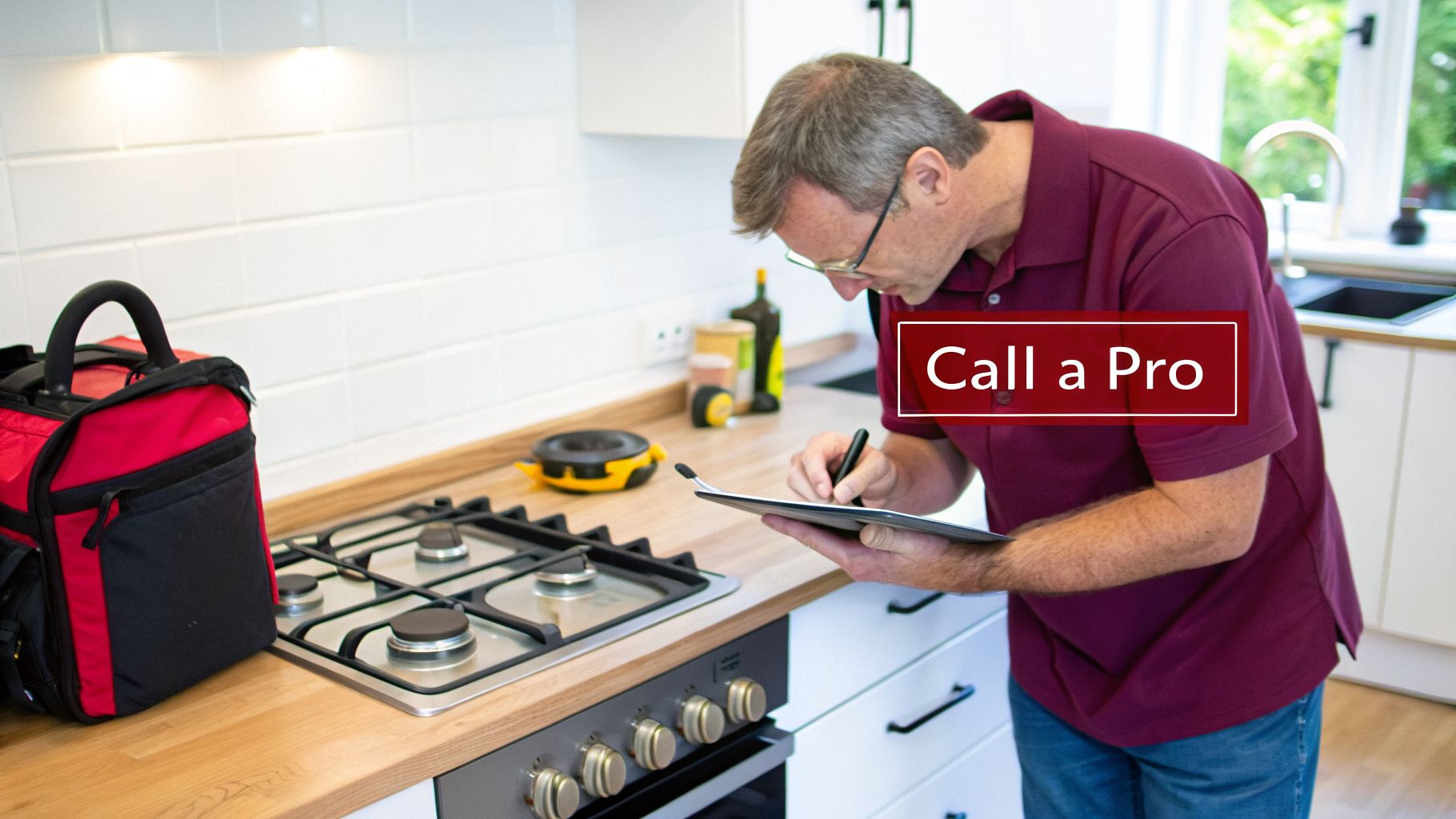
Sometimes, a good cleaning is all it takes to get your stove working again. But some problems are a clear signal that it’s time to call for backup. You've already tried the simple fixes, and honestly, knowing when to step back and let an expert take over is the smartest repair decision you can make.
If you’ve scrubbed the burner parts clean and the issue isn't fixed, that’s your first major clue. When a weak flame, a clicking igniter that never catches, or an oven that won’t hold temperature sticks around after a deep clean, it’s rarely about the grime anymore. More often than not, it points to a failing component like an igniter, a thermocouple, or a gas regulator—parts that require specific tools and know-how to replace safely.
And then there's the big one: gas. Any problem you suspect is related to the gas supply itself is an immediate, no-questions-asked call to a professional. That faint but persistent gas smell you notice every so often? That’s not something to ignore or get used to. It's a serious red flag that requires a licensed technician to come find the leak and make your system safe.
The Precision Plus Plumbing Promise
When you need gas stove repair in Philadelphia, you aren’t just looking for someone to fix a part. You’re looking for reassurance. At Precision Plus Plumbing, we've built our entire service around delivering that peace of mind, because we know how stressful it is when an appliance—especially a gas one—acts up.
That’s why our team is on call 24/7 for emergency service. When you call, you speak to a real person who can get help on the way, fast. We also know your time is precious, so we stand by our On-Time Guarantee.
Choosing a repair company is an act of trust. You need to feel confident that the team coming into your home is qualified, honest, and dedicated to solving the problem correctly on the first try. It’s about keeping your family safe and getting your home back to normal without any lingering worries.
What to Expect During Your Service Visit
We've made our service calls as straightforward and efficient as possible. Our number one goal is to diagnose the problem accurately and fix it right then and there.
Here’s what that looks like in practice:
- Real Diagnostics: Our technicians start by listening to you. Then, they’ll run a complete diagnostic check to find the root cause of the problem, not just treat the symptom you’re seeing.
- Clear, Upfront Options: Before we touch a single tool, we’ll walk you through our findings and give you clear repair options with upfront pricing. No jargon, no pressure, and absolutely no surprise fees on the final bill.
- Fixing It on the First Trip: Our trucks are basically warehouses on wheels, stocked with the most common parts for gas stove repairs. This preparation means we can resolve over 90% of issues on the initial visit, getting your kitchen back in working order in a single trip.
This focus on preparedness is something you should look for in any emergency service. In fact, we talk more about what sets a great company apart in our guide on how to choose the best emergency plumber in Philadelphia. To top it off, we stand behind all our work with multiple guarantees, including our Risk-Free Guarantee and No-Lemon Guarantee, so you can be sure the repair and the parts are built to last.
Figuring Out Gas Stove Repair Costs in Philadelphia
Let's be honest, when your gas stove quits on you, the first question that pops into your head isn't about the technical details—it's "How much is this going to cost me?" It’s a fair question, and the answer isn't a simple flat rate.
The final price for a gas stove repair in Philadelphia really depends on what’s actually wrong. Think of it like this: replacing a faulty igniter that’s easy to get to is a quick, straightforward job. But hunting down a tricky gas valve issue or a fried control board? That’s a whole different story, requiring more time, skill, and more complex parts.
Breaking Down the Costs
You’ll generally find that gas appliance repairs are a bit pricier than their electric counterparts. This isn't about upselling; it comes down to two things. First, the components themselves often cost more. Second, and more importantly, working with gas lines requires a technician with specific licensing and training to do the job safely. You’re not just paying for a part—you’re paying for the peace of mind that comes with proven expertise.
This reality is backed up by what we see across the city. Industry data from sources like Angi shows that while a typical appliance repair in Philadelphia might run between $100 and $400, jobs involving gas models can carry a 10-20% premium. That extra cost covers the specialized labor and more expensive parts needed to ensure everything is handled correctly. You can see how these figures compare with the broader market by looking at local appliance repair data.
What Influences the Final Bill?
Several key things factor into your total repair cost. Knowing what they are helps you see exactly where your money is going.
- The Part Itself: There’s a huge price difference between a simple thermocouple and a main electronic control board.
- Labor and Complexity: The time and skill it takes to safely access, diagnose, and replace the broken component is a major factor.
- Trip or Diagnostic Fee: This initial fee covers the technician’s travel and the expert time spent pinpointing the exact cause of the problem.
Here at Precision Plus Plumbing, we believe in total transparency. Once our technician has diagnosed the issue, we’ll walk you through clear, upfront options. You’ll know the exact cost before we pick up a single tool—no surprises, no hidden fees. We even offer a price-match policy and financing to make sure a critical repair doesn’t break the bank.
A transparent quote isn’t just about numbers; it’s about trust. Knowing the full cost upfront, including parts and labor, allows you to make an informed decision without the pressure of hidden fees.
Our main goal is to get your kitchen back up and running efficiently. We stock our trucks with the most common replacement parts, which allows us to fix over 90% of issues on the very first visit. This doesn't just save you time; it gives you a clear, single-visit cost, showing the real value of calling a team that comes prepared to finish the job.
Why a Licensed Plumber Is Best for Gas Repairs
When your gas stove starts acting up, your first instinct might be to call a standard appliance repair service. It makes sense on the surface, but working with natural gas isn't like fixing a leaky dishwasher. It's a completely different ballgame, one that requires a specific license, extensive training, and a level of responsibility most appliance techs simply don't carry.
Think of it this way: you wouldn't ask your family doctor to perform open-heart surgery. Both are medical experts, but only one has the specialized skills for that critical, high-stakes job. The same logic applies here. Only a licensed plumber has the qualifications demanded by utility companies like Philadelphia Gas Works (PGW) to legally and, more importantly, safely work on the gas lines in your home.
This isn't just about red tape or following the rules. It’s about understanding the real risks and having the expertise to protect your home and family from the devastating consequences of a mistake.
The Plumber's Holistic Safety View
A licensed plumber looks at your gas stove repair with a much wider lens than someone who just fixes appliances. We aren't just zeroing in on the faulty igniter; we’re trained to assess the entire gas and ventilation system it's connected to. This big-picture approach is absolutely crucial for your family's safety.
While we're getting your stove back in working order, we're also on the lookout for other potential hazards an appliance tech might miss:
- Improper Ventilation: Is the area properly vented? Poor airflow can lead to a silent, dangerous buildup of carbon monoxide.
- Aging Gas Lines: We’ll check the condition of the gas pipes themselves, looking for any corrosion or wear that could signal a future leak waiting to happen.
- Related Appliance Risks: We can also spot potential issues with other gas appliances, like your furnace or water heater, to ensure they're connected and vented correctly.
A gas stove repair isn't just about fixing one part. It's a full safety check of a critical system in your home. When you hire a licensed plumber, you're getting an expert who understands the entire gas delivery network, not just the appliance at the end of it.
This comprehensive mindset is non-negotiable when you consider the stakes. Industry data shows that gas leaks can develop in 20-30% of stoves that aren't repaired correctly—a statistic that directly shapes the strict residential restoration protocols set by Philadelphia Gas Works. Here at Precision Plus Plumbing, we build those same rigorous standards into every single job we do, whether you're in Philly, South Jersey, or New Castle County, DE. You can learn more about professional range repair protocols to see why this level of detail matters.
Your Gas Stove Repair Questions, Answered
When your gas stove is on the fritz, you've got questions. It's only natural. We've put together answers to some of the most common concerns we hear from homeowners across Philadelphia, giving you the clarity you need to move forward.
How Quickly Can a Technician Reach My Home?
When you’re dealing with a potential gas leak, every second counts. That’s why we offer 24/7 emergency service across the Greater Philadelphia area. If you suspect a leak, call us immediately—we dispatch a technician right away, no questions asked.
For non-emergency issues, we’ll get you on the schedule for the first available appointment that works for you. We know your time is valuable, which is why our On-Time Guarantee means you’ll never be left wondering when we’ll show up.
Should I Repair My Old Stove or Replace It?
This is the big question for many people, and there isn't always a simple answer. Our technicians will lay out all the facts for you—no jargon, no pressure—so you can make a smart call for your home and your budget.
We often suggest a helpful rule of thumb to guide the decision:
If a repair is going to cost more than 50% of what a new, comparable stove would run you, replacing it is usually the better financial move in the long run.
Ultimately, our job is to give you the expert diagnosis and honest pricing you need to decide. Whether that means a solid repair to get a few more years out of your current stove or helping you understand what to look for in a new one, we're here to help.
What Areas Do You Service Besides Philadelphia?
While we're proud to be a go-to for gas stove repair in Philadelphia, our service area covers a much wider footprint. We serve the entire Greater Philadelphia region and its surrounding suburbs.
You’ll find our trucks and expert technicians helping homeowners throughout:
- South Jersey
- New Castle County, Delaware
No matter where you are in our service area, you can expect the same rapid response and high level of expertise. Our commitment to quality service doesn't stop at the city line.
When you need fast, reliable service backed by guarantees you can trust, call Precision Plus Plumbing. Schedule your gas stove repair online or call us for 24/7 emergency service.